


This article was first published on Deythere.
- Treasury Yield Surges Causes Trouble for Bitcoin Price
- Oil Prices and Middle East Conflict Creates a Risk-Off Mood
- ETF Outflows Continue to Sway Sentiment
- Hyperliquid and Arthur Hayes Drama Steals Market’s Attention
- Conclusion: What’s Next for Bitcoin
- Glossary
- Frequently Asked Questions About Bitcoin Price
- Why did Bitcoin price fall below $63,000?
- How do Treasury yields affect Bitcoin price?
- What role did the Iran-Israel conflict play?
- Why is Arthur Hayes back in the news?
- Could Bitcoin bounce back quickly?
- References
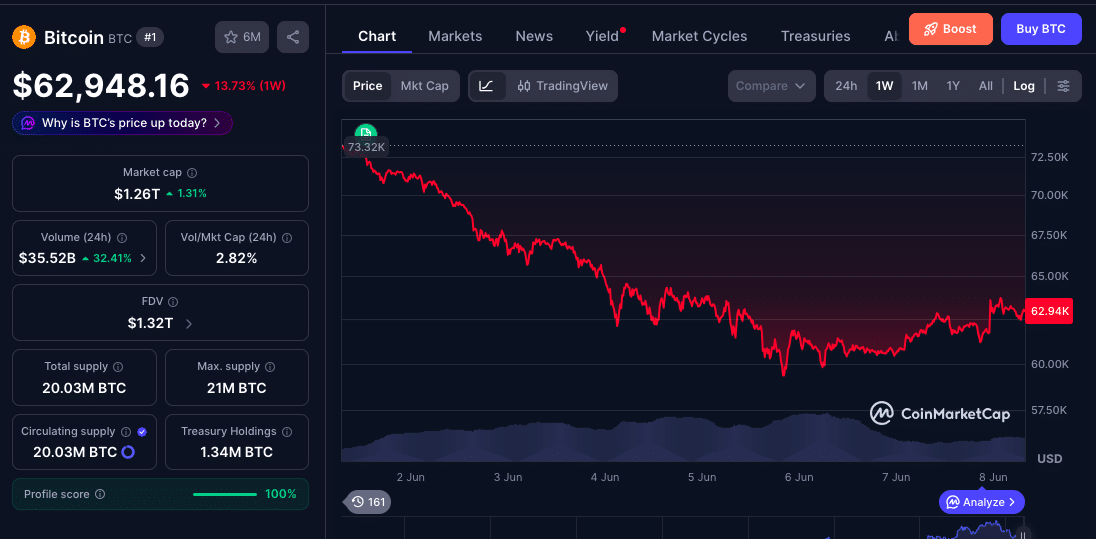
Bitcoin price has tanked below $63,000 as investors react to a heap of unsettling issues which include the growing tension between Iran and Israel, a rise in oil prices and whispers that the U.S. Federal Reserve might go ahead and tighten monetary policy again.
Bitcoin had briefly shot up to $63,600 towards the end of Sunday night before doing a complete turnaround and sliding back to $62,900-$63,000 during Monday trading. This all came as a result of oil prices surging by more than 3% and Asian stocks getting battered by renewed geopolitical uncertainty.
The overall crypto market was also in free fall, with Ethereum, XRP and a host of other major altcoins wiping out all the gains they’d made over the weekend.
Treasury Yield Surges Causes Trouble for Bitcoin Price
One major factor that is really weighing on Bitcoin price is the rapid rise in U.S. Treasury yields.
The two-year Treasury yield shot up to 4.19%; a new high since February 2025. This happened after a U.S. jobs report came in a bit stronger than expected, which has investors worried that the Federal Reserve might just decide to keep interest rates high; or even hike them further. Rising yields generally isn’t great news for investors in speculative assets like cryptocurrencies.
Market sentiment has changed seriously. Only a few months ago, traders were expecting interest rates to get cut multiple times. Now, investors are reassessing those expectations as economic data remains resilient.
This has already been seen in crypto markets. Bitcoin lost nearly 14% over the previous week; and at one point was even below $60,000 before it managed to recover some of that lost ground.
Oil Prices and Middle East Conflict Creates a Risk-Off Mood
The latest selloff was also pushed by Middle East politics, with tensions escalating between Israel and Iran.
Oil prices went ballistic; with West Texas Intermediate crude pushing past $94 per barrel and Brent crude hitting $96 after renewed military clashes between the two nations threatened hopes of de-escalation. Investors worried that this might affect global energy supplies and send inflation pressures soaring again.
Based on history; rising oil prices can create additional challenges for risk assets because they increase inflation expectations. Higher inflation pressure, which often means tighter monetary policy, which reduces liquidity available for investments in stocks and cryptocurrencies.
As a result, traders started to gravitate towards safer assets while dumping their exposure to riskier markets.
ETF Outflows Continue to Sway Sentiment
Bitcoin price is also under pressure from institutional investors. Over recent weeks; spot Bitcoin exchange-traded funds (ETFs) have seen massive outflows, reducing an important source of demand that had driven those earlier rallies.
Combined with higher yields and geopolitical worries; these outflows have added another reason for caution among investors.
Analysts note that volatility is likely to remain high this week as markets wait for fresh U.S. inflation data and other high-profile public offerings expected to attract investor attention.
Hyperliquid and Arthur Hayes Drama Steals Market’s Attention
Beyond Bitcoin, traders are sitting on the edge of their seats waiting to see what is next with Hyperliquid’s HYPE token.
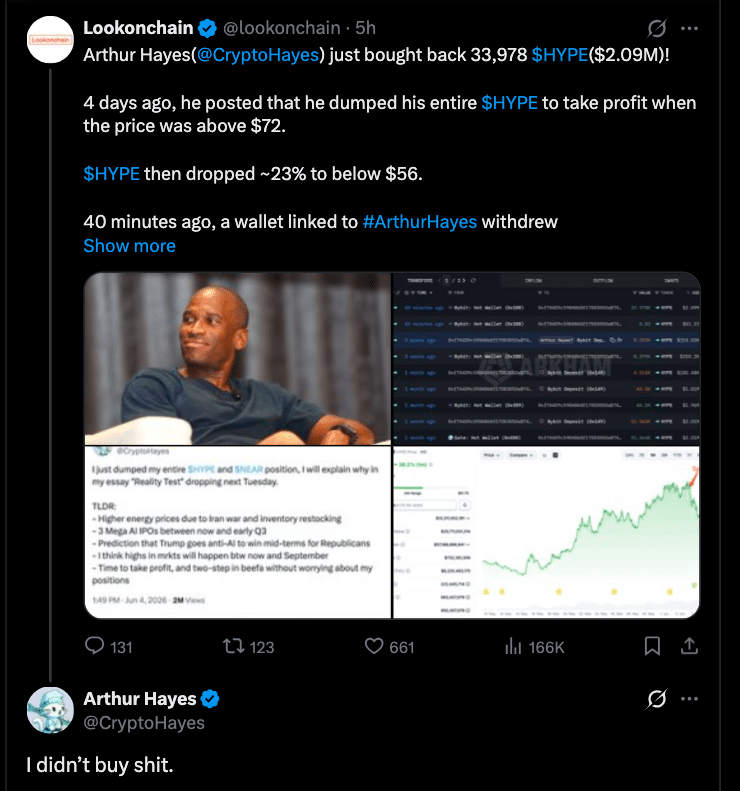
Last week, BitMEX co-founder Arthur Hayes confirmed that he had dumped his HYPE holdings after previously saying how bullish he was on the token. This sale coincided with a market correction and a major token unlock event that increased circulating supply.
However, as of this Monday, accounts tracking blockchain activity reported that a wallet allegedly linked to Hayes withdrew approximately 33,978 HYPE tokens worth $2.09 million from Bybit. The transaction immediately sparked speculation that he had re-entered the market. Hayes quickly shot down the claim with a public statement: “I didn’t buy shit.”
The whole controversy unfolded after HYPE plummeted more than 20% from its all-time high of $75.51 on June 2 and now traders are struggling to make sense of the impact of a massive token unlock that happened on June 6.
Conclusion: What’s Next for Bitcoin
The near-term outlook for the Bitcoin price isn’t looking great. It relies on how a number of macroeconomic factors play out.
If oil prices keep going up, and Treasury yields remain high, risk assets are going to struggle to regain momentum. However , if there’s any easing of tensions, or softer inflation data, sentiment could stabilize.
For now, Bitcoin is caught in a hard place between growing institutional adoption and macroeconomic uncertainty. While Bitcoin is still the biggest in the market, investors are getting really sensitive to macroeconomic signals. Until things get clearer on inflation, interest rates and geopolitical troubles , the market seems stuck with this market volatility.
Glossary
Bitcoin (BTC): The biggest cryptocurrency by market cap.
Treasury Yield: What investors get as a return for holding U.S. government bonds.
Spot Bitcoin ETF: An exchange-traded fund that buys and holds Bitcoin.
Risk-Off Sentiment: When investors move away from higher-risk assets.
Token Unlock: When previously locked up cryptocurrency tokens are finally released into the market.
Inflation: The rate at which prices for goods and services increase over time.
Frequently Asked Questions About Bitcoin Price
Why did Bitcoin price fall below $63,000?
Oil prices shot up, Treasury yields hit a 16 month high; and geopolitical tensions increased investor risk aversion.
How do Treasury yields affect Bitcoin price?
If Treasury yields go higher; investors start to get drawn to fixed income investments, and that makes riskier assets like cryptocurrencies look less attractive.
What role did the Iran-Israel conflict play?
Renewed conflict sent oil prices soaring; increased investor concern about inflation and global economic stability and as a result, crypto markets fell.
Why is Arthur Hayes back in the news?
It is because on-chain trackers linked some HYPE token purchases to a wallet linked to Hayes but he promptly came out and said he didn’t buy the token.
Could Bitcoin bounce back quickly?
If inflation fears ease, or tensions calm down, or institutional demand picks up, things could turn around sooner rather than later.