

HTX delists USD1 after a disagreement over frozen blockchain addresses intensified between the exchange and World Liberty Financial (WLFI), the issuer of the stablecoin. The decision follows claims by HTX that WLFI restricted specific exchange-linked addresses during sanctions compliance reviews, limiting the circulation of certain assets connected to the project.
- Why Did HTX Delists USD1 Following the Address Freeze?
- What Changes Have Been Made for USD1 Holders?
- What Does the HTX Delists USD1 Decision Mean for the Dispute?
- How Has World Liberty Financial Responded?
- How Are Sanctions Connected to the Situation?
- How Did the Conflict Between Justin Sun and WLFI Begin?
- Conclusion
- Glossary
- Frequently Asked Questions About HTX Delists USD1
In response, the exchange suspended multiple trading pairs and removed USD1 from its platform. The development adds a new chapter to an ongoing conflict involving entities linked to crypto entrepreneur Justin Sun and the Trump family-backed digital asset venture, with legal and compliance issues continuing to unfold.
Why Did HTX Delists USD1 Following the Address Freeze?
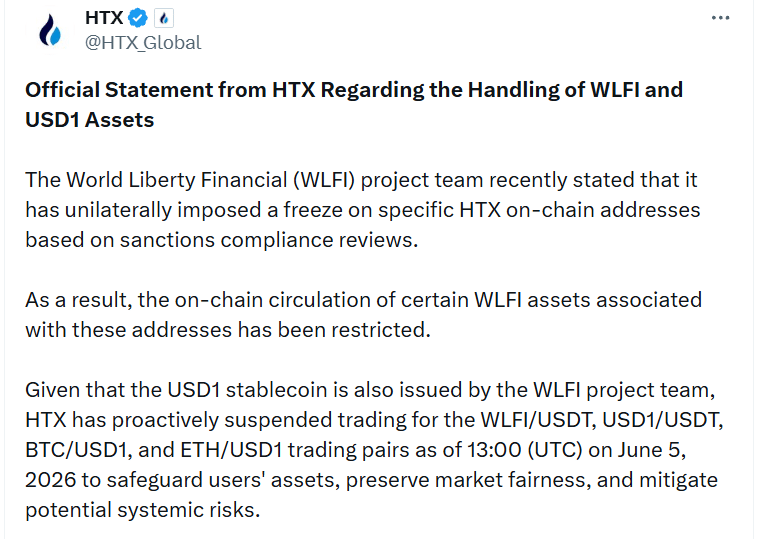
HTX delists USD1 after alleging that WLFI unilaterally froze certain HTX on-chain addresses. In an official statement released on Saturday, June 6, 2026, the exchange said the restrictions were introduced as part of sanctions compliance reviews conducted by the WLFI project team. HTX stated that the action restricted the circulation of some WLFI-related assets associated with those addresses.

The exchange argued that the freeze was implemented without sufficient prior communication, adequate contractual or legal grounds, transparent disclosure, or adherence to due process. HTX added that the decision affected users and their assets, prompting the platform to take protective measures.
What Changes Have Been Made for USD1 Holders?
HTX delists USD1 and has outlined how affected users are being handled. The exchange announced that USD1 was delisted at 03:00 UTC on Sunday, June 7, 2026. Following the removal, deposit and conversion services tied to the stablecoin are no longer supported. Eligible USD1 holdings are being converted into USDT at a 1:1 ratio.
HTX said the converted assets will be credited to users’ Spot Accounts, while the exact completion time and distribution details will be announced separately. The platform also suspended trading for WLFI/USDT, USD1/USDT, BTC/USD1, and ETH/USD1 pairs. HTX stated that these steps were necessary to safeguard user assets, preserve market fairness, and reduce potential systemic risks.
What Does the HTX Delists USD1 Decision Mean for the Dispute?
HTX delists USD1 as the disagreement between the two parties moves beyond routine platform operations. The exchange said the freeze restricted access to assets connected to the WLFI ecosystem and called on the project team to reverse the action. HTX maintained that the restrictions infringed on the rights and interests of users.
The company also stated that it will take measures to safeguard users’ legitimate rights and interests, including but not limited to pursuing legal remedies. Legal and compliance experts often note that disputes involving asset freezes can become increasingly complex when sanctions reviews, custody rights, and platform obligations intersect.
How Has World Liberty Financial Responded?
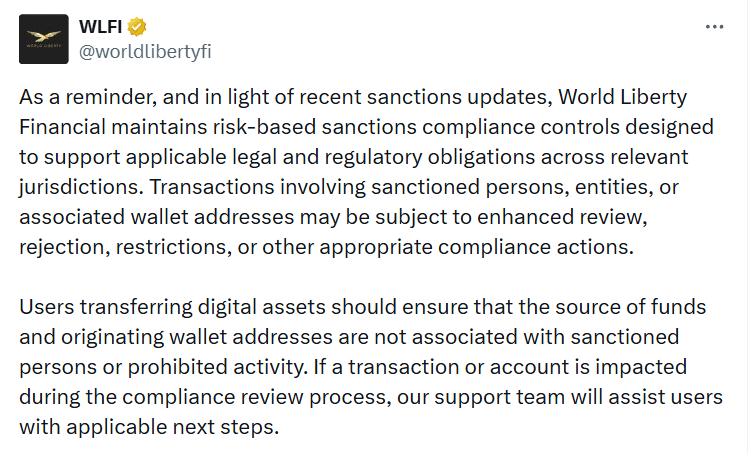
World Liberty Financial has not publicly addressed HTX’s specific allegation regarding the frozen addresses. However, the project stated in an X post on June 3 that it maintains risk-based sanctions compliance controls designed to support applicable legal and regulatory obligations across relevant jurisdictions. WLFI said transactions involving sanctioned persons, entities, or associated wallet addresses may be subject to enhanced review, rejection, restrictions, or other compliance actions.
The project also advised users to ensure that transferred assets do not originate from wallets linked to sanctioned individuals or prohibited activities. The organization counts U.S. President Donald Trump and his three sons, Donald Jr., Eric Trump, and Barron Trump, among its advisers, giving the dispute significance beyond the digital asset sector.
How Are Sanctions Connected to the Situation?
Sanctions compliance appears to be a central issue in the dispute. On May 26, UK authorities sanctioned HTX’s former entity, Huobi Global S.A., stating that there were reasonable grounds to suspect it had supported the Russian government through financial services. HTX rejected the relevance of that designation to its current operations.
The exchange stated that Huobi Global S.A. is distinct from the online HTX platform and argued that the sanctions should not affect its services. Days later, WLFI reiterated that its compliance framework includes sanctions-related reviews and controls. While the project did not directly mention HTX, the timing of the statement drew attention as tensions between the parties increased.
How Did the Conflict Between Justin Sun and WLFI Begin?
The dispute began before the latest delisting announcement. Justin Sun, who reportedly owns HTX and serves on the exchange’s global advisory board, filed a lawsuit against World Liberty Financial in April. Sun alleged that the platform froze his tokens and threatened to burn them without proper justification. In May, WLFI responded with a defamation lawsuit against Sun.

The project claimed he made false statements about the organization and violated WLFI token sale terms through alleged prohibited transfers, short-selling activities, and straw purchases. The legal actions marked a sharp shift in relations between the two sides. Sun had previously been viewed as a major supporter of the Trump-linked crypto initiative and had invested heavily in the broader WLFI ecosystem.
Conclusion
HTX delists USD1 as its dispute with World Liberty Financial deepens over frozen addresses, compliance reviews, and competing legal claims. The exchange has ended support for the stablecoin, suspended several related trading pairs, and initiated a 1:1 conversion of eligible USD1 holdings into USDT.
While HTX argues that the freeze lacked transparency and proper process, WLFI maintains that its sanctions compliance framework is designed to meet regulatory obligations. With lawsuits already filed by both sides and the Trump family-linked project remaining at the center of the conflict, the disagreement has evolved into a significant confrontation with implications for users, compliance practices, and digital asset market participants.
Glossary
HTX: A global cryptocurrency exchange formerly known as Huobi.
USDT: A digital dollar used across crypto markets.
On-Chain Address: A wallet location on a blockchain.
Asset Delisting: Removal of a token from an exchange.
Trading Pair: Two assets available for trading against each other.
Frequently Asked Questions About HTX Delists USD1
Why did HTX delist USD1?
HTX delisted USD1 after claiming that WLFI froze exchange-linked blockchain addresses.
What happened to USD1 holders on HTX?
HTX said eligible USD1 holdings will be converted to USDT at a 1:1 ratio.
Which trading pairs were suspended by HTX?
HTX suspended WLFI/USDT, USD1/USDT, BTC/USD1, and ETH/USD1 trading pairs.
How did WLFI respond to the situation?
WLFI said it maintains sanctions compliance controls and reviews certain wallet activities.
Could HTX take legal action against WLFI?
Yes, HTX said it may pursue legal action to protect its users and interests.