

Bitcoin price prediction remains a major focus for investors as Bitcoin hovers near a critical support zone and market fear intensifies. While many traders are searching for signs of a bottom, several on-chain indicators suggest the market has not yet reached the kind of panic-driven capitulation that typically marks the end of a major correction.
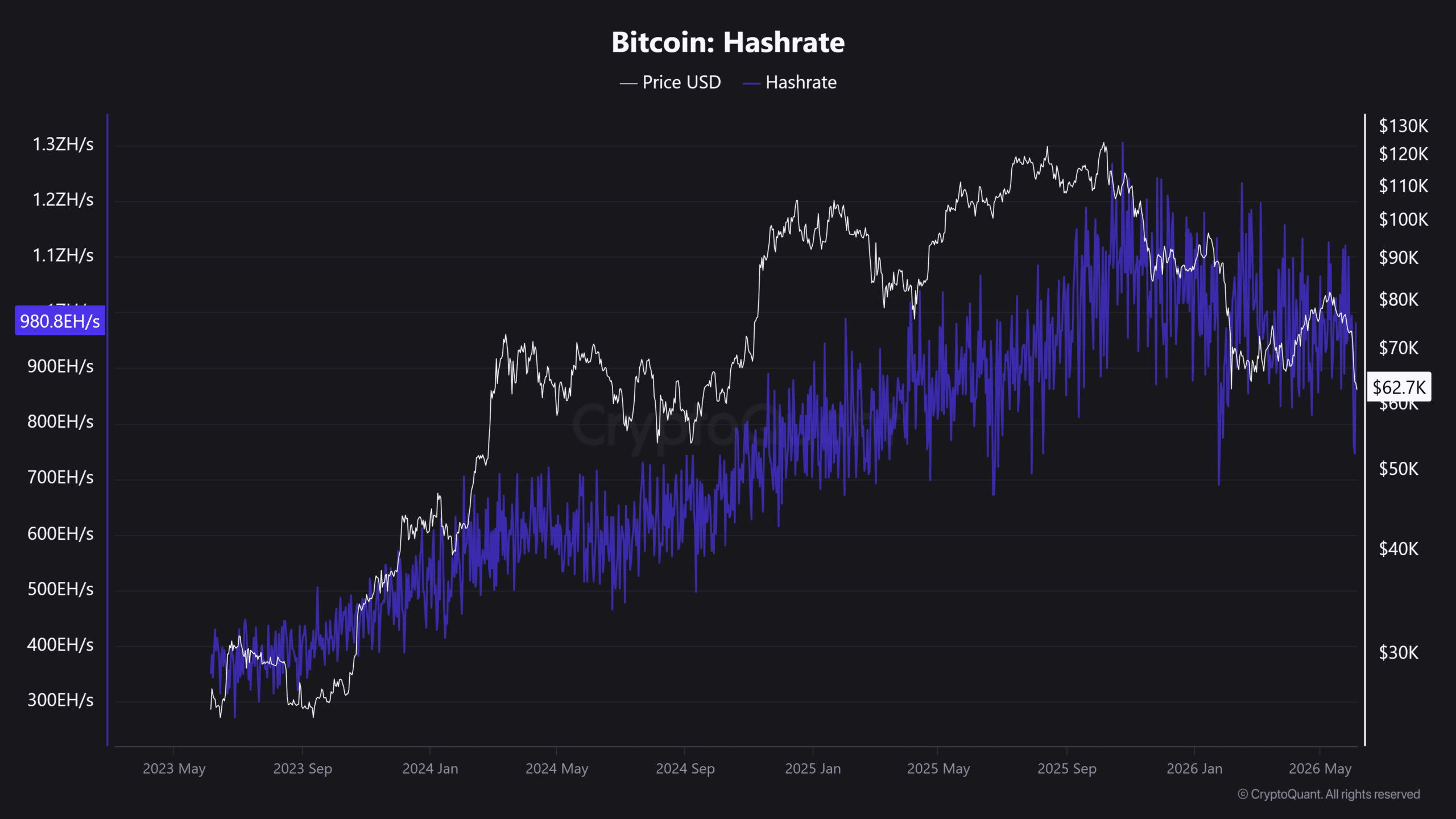
According to the source, Bitcoin’s hashrate has gradually declined since December 2025 after years of nearly uninterrupted growth. Combined with weakening sentiment and growing pressure on Bitcoin miners, the trend has sparked concerns across the crypto market. Yet analysts argue that the current weakness still resembles a normal mid-cycle correction rather than a full-scale market breakdown.
Bitcoin Miners Are Under Pressure, but History Offers Context
One of the most important signals comes from Bitcoin miners and the network’s hashrate. After an almost uninterrupted climb since Q3 2021, Bitcoin’s hashrate has spent the past six months moving lower, creating concern among market observers. Research shared through CryptoQuant Insights showed that Bitcoin’s seven-day moving average hashrate has declined by roughly 6.6%, while the thirty-day moving average has fallen around 3%.
Although concerning, these declines remain far smaller than the major hashrate drops recorded during China’s mining ban in 2021 and the bear markets of 2018 and 2022. Analyst Woominkyu noted that the current slowdown appears to represent miner capitulation rather than broader market capitulation.
According to the analysis, miner capitulation has historically appeared near important cycle lows, raising the possibility of a market bottom developing in the months ahead. As weaker operations leave the network, stronger participants often remain, creating conditions that can eventually support recovery.
Bitcoin Price Prediction Faces a Critical Test at $60K
The latest Bitcoin price prediction largely depends on Bitcoin’s ability to hold support near $60,000. Market watchers believe this level could determine whether the correction stabilizes or deepens.
At the same time, analysts see potential for a short-term reaction around $62,000. However, they caution against confusing a bounce with a recovery. Analysts believe a move from $62,000 could provide temporary relief. However, they do not view such a bounce as evidence of a lasting trend reversal.
Current market data shows Bitcoin trading near levels that continue attracting heavy attention from investors. If Bitcoin breaks below the February low near $60,000, many analysts believe the market could enter the true capitulation phase that has so far remained absent.
Bears Are Active, but Panic Selling Has Not Arrived
Another key reason behind the current Bitcoin price prediction comes from the Bull-Bear Index. This metric combines spot aggression, open interest, funding rates, ETF flows, and exchange flows to measure overall market behavior.
The latest readings show that bears remain active. However, they are still not close to the extreme negative readings that accompanied February’s severe sell-off. At that time, the indicator approached the -40% level associated with intense market stress.
Importantly, capital outflows remain controlled. Investors continue reducing exposure, but the data does not show the type of widespread panic that typically defines capitulation. This suggests the market is weakening in an orderly manner rather than experiencing a disorderly collapse.

Why Sentiment and Midterm Cycles Tell a Different Story
Market sentiment has fallen sharply into extreme fear territory. Yet analyst Axel Adler Jr highlighted an important detail: emotion has fallen much faster than capital flows.
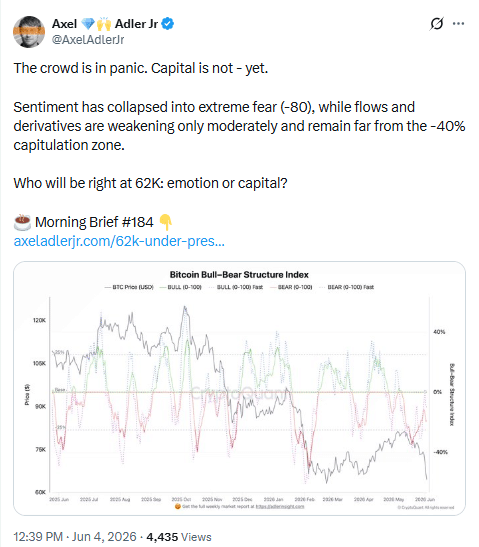
In simple terms, investors are increasingly fearful, but money has not left the market at the same pace. This disconnect helps explain why analysts believe capitulation remains incomplete.
Another reason analysts remain cautious is that Bitcoin’s current retreat closely resembles previous midterm-year corrections. Benjamin Cowen noted that although market participants often feel each cycle is different, Bitcoin has historically experienced similar periods of weakness before resuming its broader trend. He stated that while the current situation may feel unique, Bitcoin is behaving much as it has during previous midterm years.
This historical context supports the latest Bitcoin price prediction, which suggests the recent decline may still be part of a normal market cycle rather than evidence of structural weakness.
Conclusion
The latest Bitcoin price prediction points to a market under pressure but not yet in full capitulation. Sentiment has weakened, Bitcoin miners are facing challenges, and bears continue to dominate short-term momentum. However, controlled capital outflows, moderate hashrate declines, and historical cycle comparisons suggest the market has not reached the panic stage seen during major bottoms.
Current weakness remains broadly consistent with historical mid-cycle corrections rather than an unprecedented breakdown. For now, all eyes remain on the $60,000 level, which could determine whether Bitcoin finds stability or faces the deeper capitulation many analysts still expect.
Glossary of Key Terms
Hashrate: The total computing power securing the Bitcoin network.
Miner Capitulation: A period when miners reduce activity because mining becomes less profitable.
Bull-Bear Index: A market indicator that measures bullish and bearish activity using several trading metrics.
Capital Outflows: Money leaving an asset or market over a specific period.
Market Sentiment: The overall attitude and emotions of investors toward an asset.
FAQs About Bitcoin Price Prediction
What is the latest Bitcoin price prediction?
Analysts believe Bitcoin may stabilize above $60,000, but a break below that level could trigger deeper selling.
Why are Bitcoin miners important?
Bitcoin miners secure the network and often provide early signals about market health and profitability.
What does miner capitulation mean?
It refers to miners reducing operations due to declining profits, often occurring near market bottoms.
Why is the $60,000 level important?
Many analysts view it as a key support zone that could determine Bitcoin’s next major move.