


This article was first published on Deythere.
- Bitcoin Price Recovers Quickly After Hot CPI Report
- Crypto Fund Inflows Show Institutions Are Still Buying
- BNB and Dogecoin Outperform Major Tokens
- Regulatory Momentum and Technical Resistance Shape Market Outlook
- Conclusion
- Glossary
- Frequently Asked Questions About Bitcoin Price Movements After CPI Report
- Why did the Bitcoin price recover after the CPI report?
- Why did inflows into crypto funds increase?
- What are traders watching for the 200-day moving average?
- Which cryptocurrencies outperformed Bitcoin?
- How does inflation affect Bitcoin?
- References
Bitcoin price quickly rose back above $81,000 right after testing the psychological barrier at $80,000 following hot U.S. CPI report. The quick bounce was due to increasing institutional inflows into crypto investment products and a decline in Bitcoin bearish positions.
Despite inflation fears and rising Treasury yields pushing traditional equities lower, the crypto market fared way better. Contrary to the macroeconomic pressures on markets, analysts say the latest price action indicates that buyers are staying active just beneath the surface.
For the sixth consecutive week, digital asset investment products saw inflows, totaling $857.9 million last week according to new data from CoinShares. Of this, Bitcoin products alone attracted $706.1 million, while short-Bitcoin products saw $14.4 million in outflows, the largest unwind of bearish positions this year.
Bitcoin Price Recovers Quickly After Hot CPI Report
Bitcoin Price initially dropped to $79,000 price range after the April CPI report data showed inflation remained stubbornly elevated.
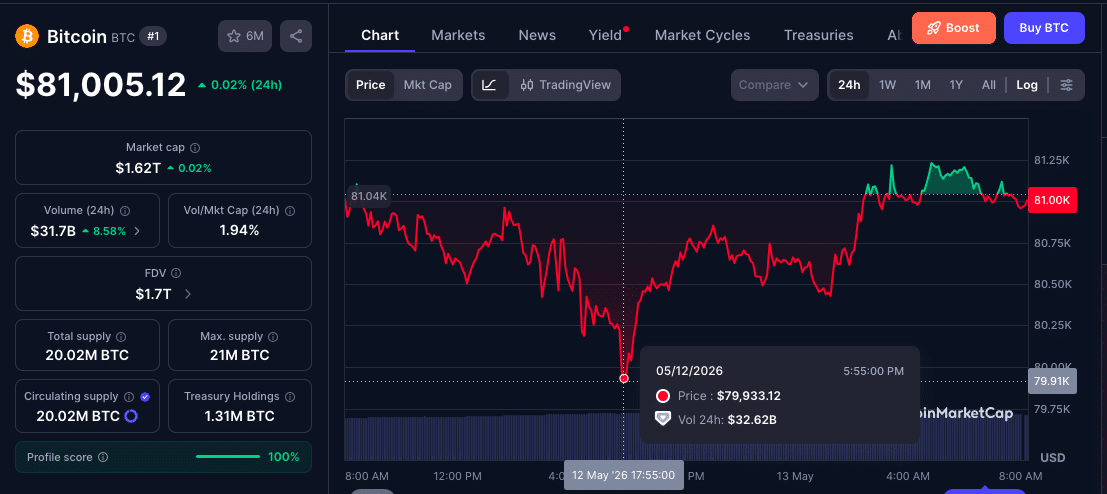
That rebound stood out because traditional markets reacted far more negatively. The Nasdaq 100 dropped by almost 1%, while semiconductor stocks were hit hard after weeks of strong gains. Fixing bond yields also raised concerns that the Fed will keep interest rates higher for longer.
While all of this took place, Bitcoin proved more resilient compared to equities. More and more analysts regard this as a sign that long-term buyers are not leaving the market aggressively during dips but rather using them as an opportunity to accumulate BTC.
There has also been some positive sentiment in the market as expectations grow ahead of the debate surrounding the Digital Asset Market CLARITY Act..
After lawmakers struck a deal on stablecoin yield provisions earlier this month, the Senate Banking Committee is expected to examine the legislation this week.
Crypto Fund Inflows Show Institutions Are Still Buying
One of the strongest bullish signals came from institutional fund flows. CoinShares latest reports suggests that last week, nearly $858 million in crypto investment products flowed into the market, primarily toward Bitcoin-related products.
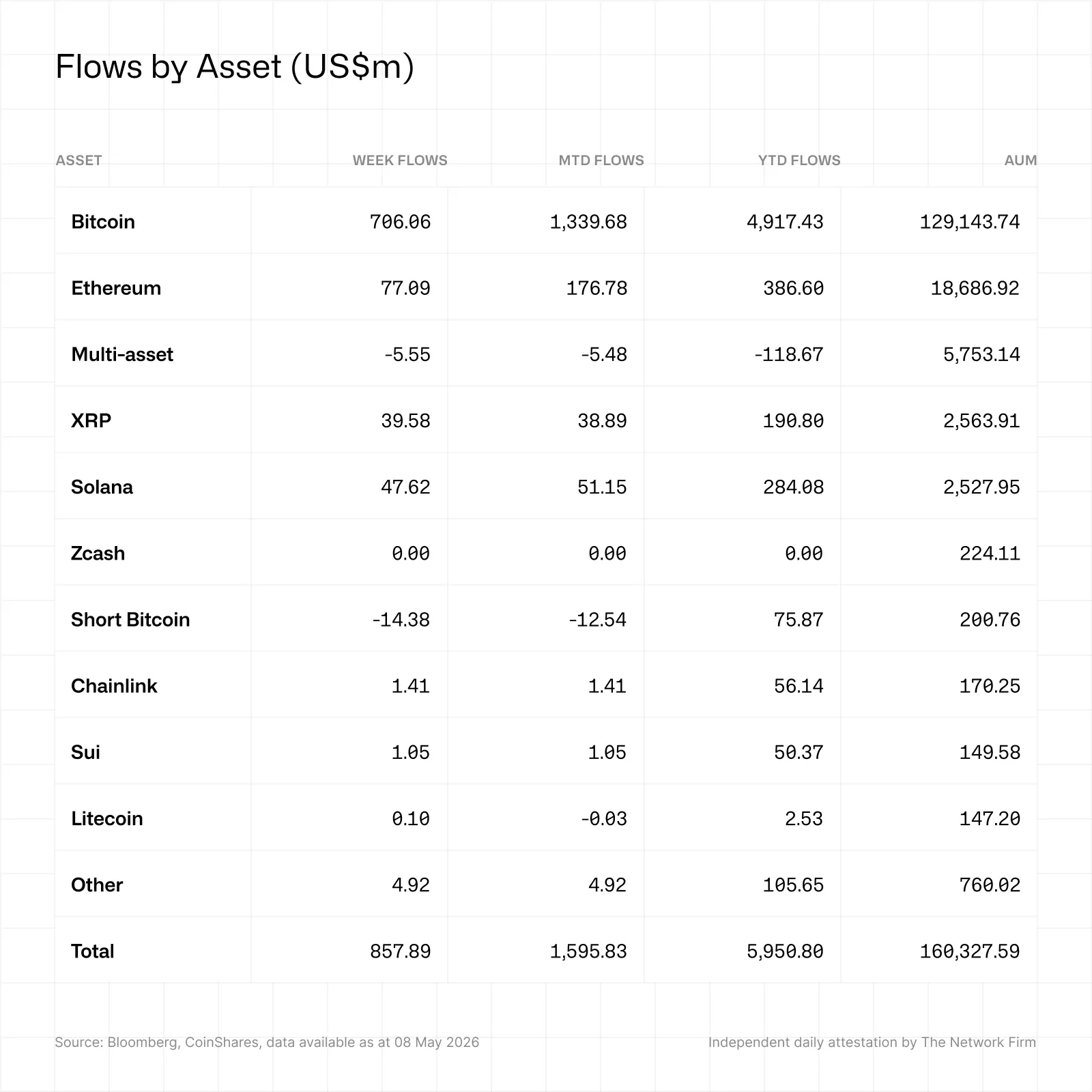
For Ethereum products, inflows totaled $77 million; for Solana products, they were $47.6 million; and for XRP, they were $39.6 million. The total amount of capital managed across digital asset funds increased to approximately $160 billion.
Even more importantly, traders withdrew funds from the short-Bitcoin products. Which would imply losing some sense of bearish conviction despite elevated inflation fears.
Many analysts observed the fact that repositioning of this type occurs more often before long bull runs. Institutional investors appear more focused on medium-term accumulation than short-term macro volatility.
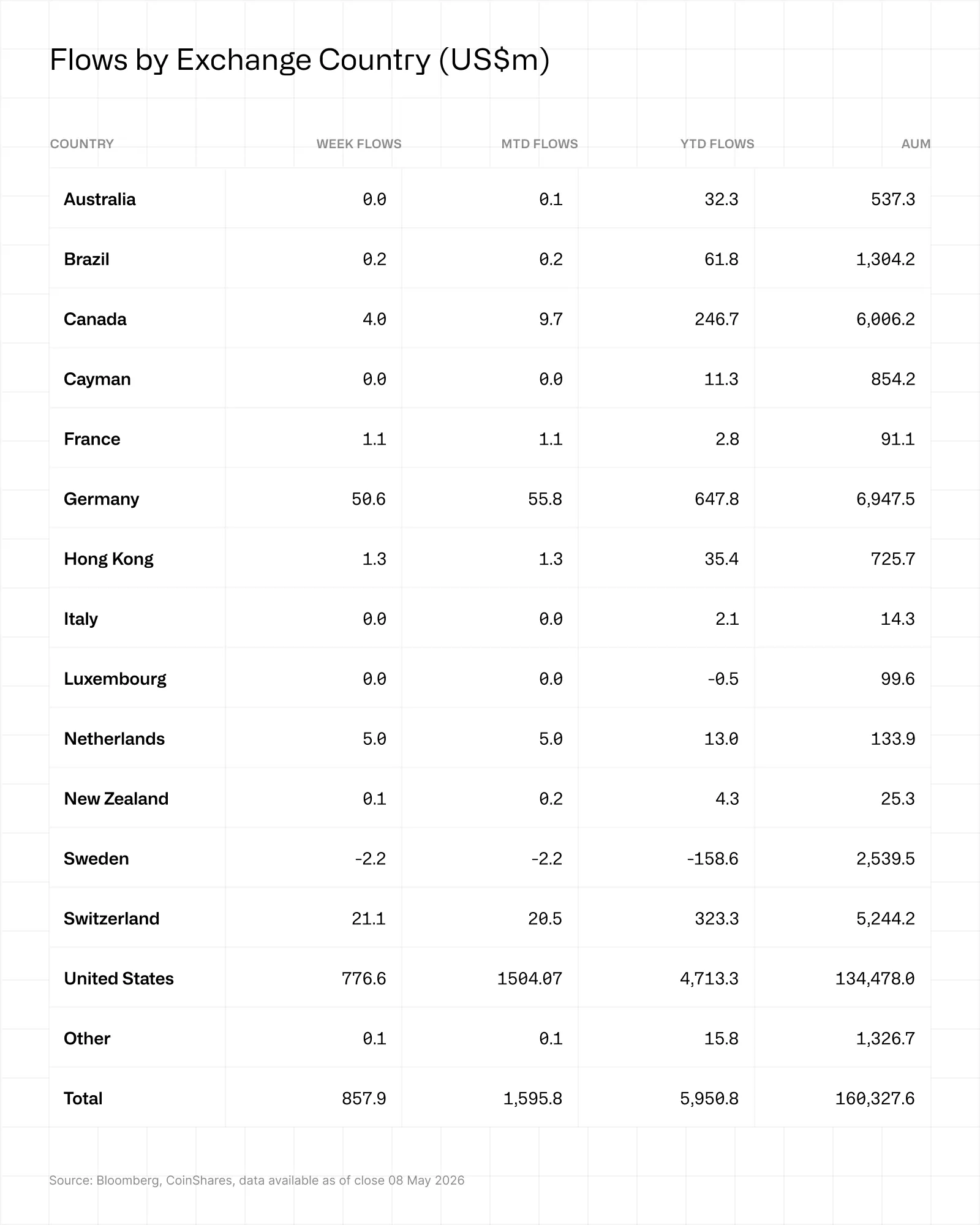
More than $776 million of the weekly total came to the United States, which continued to be by far the largest source of inflows. Healthy inflows were also recorded in Germany and Switzerland.
BNB and Dogecoin Outperform Major Tokens
While Bitcoin held steady; several large-cap altcoins outperformed in the market.
BNB gained roughly 2.5% to trade near $677; making it one of the strongest performers among major cryptocurrencies. Dogecoin also climbed about 1.3% to around $0.111.
Meanwhile, Ethereum continued lagging behind peers. ETH slipped slightly to around $2,300 and remained down more than 3% over the past week. Solana also posted a modest decline, while XRP traded near $1.45.
BNB was supported by continued deals involving the Binance ecosystem; and Dogecoin held onto some speculative momentum based on retail flows.
Meanwhile; Ethereum’s underperformance is less impressive as bears worry about weaker on-chain activity and waning institutional demand compared to Bitcoin.
Regulatory Momentum and Technical Resistance Shape Market Outlook
The next major hurdle, according to analysts’ targets, will be the 200-day moving average, a level that BTC has failed to achieve cleanly over the previous week.
Bitcoin’s price momentum has diminished around that key level, but according to FxPro analyst Alex Kuptsikevich the pullback looks more like a normal consolidation so far than a reversal in trend.
Technical traders are monitoring action closely at the $80,000 to $82,000 range. If the break above resistance holds, then a move towards the mid-$80,000 may be renewed while failure to hold support may trigger renewed selling pressure.
Regulatory developments are increasingly becoming a major market driver, too. Sentiment has been boosted across crypto markets by an improvement in optimism regarding the CLARITY Act, which investors are hoping could pave new clearer rules that might encourage mass institutional participation.
Now; industry leaders such as CoinShares and some ETF issuers have attributed recent inflows to hopes that lawmakers are finally headed toward a more clear-cut digital asset regime.
Meanwhile, macroeconomic risks are still quite high. Rising oil prices; higher Treasury yields, and ongoing geopolitical tensions involving Iran continue to pressure global markets.
Investors are keeping a close eye on upcoming economic data and Federal Reserve commentary; looking for clues on how interest rate policy may evolve in the future.
Conclusion
Bitcoin price showed resilience recently as it rebounded quickly after suffering a sell-off prompted by inflation data. Institutions kept buying as hot CPI report shook the traditional markets and Bitcoin products led the way for digital asset funds
Strong institutional inflows; fading bearish positioning, and optimism surrounding the CLARITY Act are helping support sentiment even as macro conditions remain difficult.
In the days ahead, incoming inflation data, Treasury yields and regulatory developments in Washington could determine whether or not BTC can maintain any momentum it has above $81,000.
Glossary
CPI Report: Consumer Price Index, measure of inflation and the change in consumer prices
200-day Moving Average: A long-term technical indicator to determine market direction
Crypto fund inflows: Inflow of capital into digital assets investment products including ETFs and institutional funds
CLARITY Act: A U.S. bill that seeks to clarify regulatory jurisdiction over digital assets
Frequently Asked Questions About Bitcoin Price Movements After CPI Report
Why did the Bitcoin price recover after the CPI report?
Bitcoin price bounced back after buyers stepped in right after the CPI report sell-off, and institutional inflows into crypto funds continued to rate.
Why did inflows into crypto funds increase?
Improving sentiment around crypto regulation and expectations surrounding the CLARITY Act helped drive institutional investment into digital assets.
What are traders watching for the 200-day moving average?
The two-hundred day moving average is a notable technical resistance level that mostly determines the long-term direction of the market.
Which cryptocurrencies outperformed Bitcoin?
BNB and Dogecoin outperformed most major cryptocurrencies over the past 24 hours.
How does inflation affect Bitcoin?
This can keep ratios of interest rates higher for a longer period and is likely to put potential pressure on Bitcoin in the short term.