

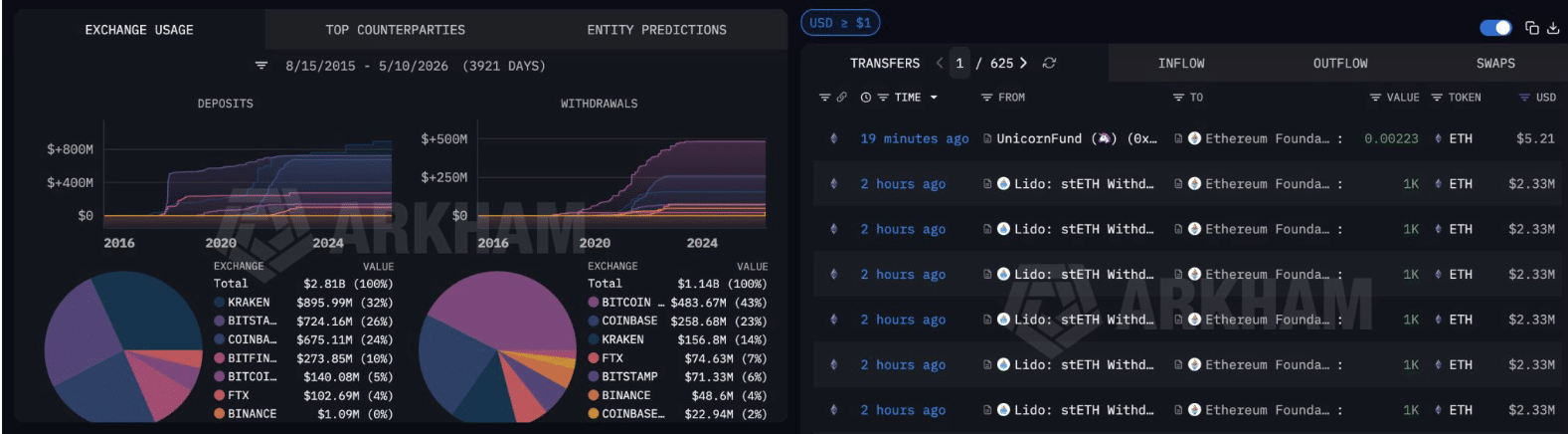
The Ethereum Foundation unstaking of nearly $50 million in ETH has placed fresh attention on how one of crypto’s most important nonprofit organizations manages liquidity, staking exposure, and long-term funding. On-chain data shows the Foundation withdrew about 21,270 ETH from Lido, a move that quickly sparked debate across the Ethereum market. Some traders read it as a possible sell-pressure warning.
Others see something more routine: a treasury adjustment after months of staking activity, grants, and operational spending. The truth sits in the middle, which is often where crypto’s most useful signals live.
Ethereum Foundation Unstaking: What Happened?
The latest Ethereum Foundation unstaking involved about 21,270 ETH, valued near $49.6 million at the time of the withdrawal. The funds were pulled from Lido, the liquid staking protocol that allows ETH holders to earn staking rewards while using a liquid derivative in the wider DeFi market.
This was not a small wallet shuffle. Earlier this year, the Foundation said it planned to stake about 70,000 ETH, with rewards flowing back into its treasury. That staking program was tied to broader funding needs, including research, protocol development, ecosystem work, and grants.
That context matters because the Ethereum Foundation unstaking does not automatically mean the ETH is headed to exchanges. Large treasury wallets often move funds before spending, diversifying, reviewing risk, or preparing for future obligations. In plain terms, it may be less of a red alarm and more of a cash management step.
Why the Market Reacted So Quickly
Crypto traders watch Foundation wallets closely because past ETH sales by major holders have sometimes arrived near sensitive price zones. Ethereum is currently trading around $2,301, with an intraday range between roughly $2,258 and $2,313, based on current market data.
The Ethereum Foundation unstaking came as ETH struggled to build strong momentum above nearby resistance. That made the timing feel uncomfortable for short-term traders. When a large wallet unlocks liquid ETH, the market naturally asks one question first: will this become sell pressure?
So far, the better question is slightly different, as has the ETH moved toward exchange-linked addresses? Without clear exchange inflows, the move remains a liquidity event, not confirmed selling.
Treasury Rebalancing Looks More Likely Than Panic Selling
The Ethereum Foundation unstaking also fits a broader pattern of treasury rebalancing. The Foundation has ongoing obligations, and ETH-denominated holdings can create funding risk when prices move sharply. For a nonprofit that supports core infrastructure, having all or most treasury value exposed to one volatile asset is not always practical.

There is also the Lido angle, taking ETH out of a third-party staking route can reduce protocol exposure. After several DeFi security events across the wider market, large holders have become more careful about where capital sits and how many layers of smart-contract risk it touches.
That does not mean Lido is being rejected, it means the Foundation may be keeping more ETH under direct control. In crypto, custody and liquidity are not small details. They are the plumbing.
Key Indicators Traders Should Track
The first indicator after the Ethereum Foundation unstaking is exchange flow. If the withdrawn ETH moves to major trading venues, bearish pressure becomes a stronger concern. If it stays in treasury-linked wallets, the selloff argument weakens.
The second indicator is ETH’s support structure. A clean hold above the recent $2,250 to $2,300 area would show that buyers are absorbing the headline risk. A break below that zone may invite faster selling from short-term traders.
The third indicator is staking behavior. If more ETH leaves staking while price momentum fades, the market may read it as caution. But if staking participation stays healthy, this single Ethereum Foundation unstaking may look like normal balance-sheet management.
Conclusion
The Ethereum Foundation unstaking is important, but it should not be treated as proof of an incoming dump. The withdrawal shows that the Foundation is adjusting liquidity after a large staking initiative, while the market is trying to judge whether that ETH will remain in treasury wallets or move closer to sale channels. For now, the strongest reading is measured: this is a major treasury signal, not a confirmed bearish event.
Frequently Asked Questions
What is the Ethereum Foundation unstaking about?
The Ethereum Foundation unstaking refers to the withdrawal of about 21,270 ETH from Lido, worth close to $49.6 million.
Does this mean ETH will be sold?
Not necessarily. A withdrawal becomes more concerning if the ETH moves to exchange addresses or sale-related venues.
Why did the Foundation stake ETH before?
It previously said staking rewards would support treasury funding for ecosystem work, research, and grants.
What should traders watch next?
They should watch exchange inflows, ETH support near $2,250 to $2,300, and any further treasury wallet movement.
Glossary of Key Terms
Staking: Locking ETH to help secure the network and earn rewards.
Lido: A liquid staking protocol that lets ETH holders stake while receiving a liquid token.
Treasury Rebalancing: Adjusting holdings to manage funding, liquidity, and risk.
Exchange Inflow: Crypto moving into an exchange wallet, often watched as a possible selling signal.
Sources