

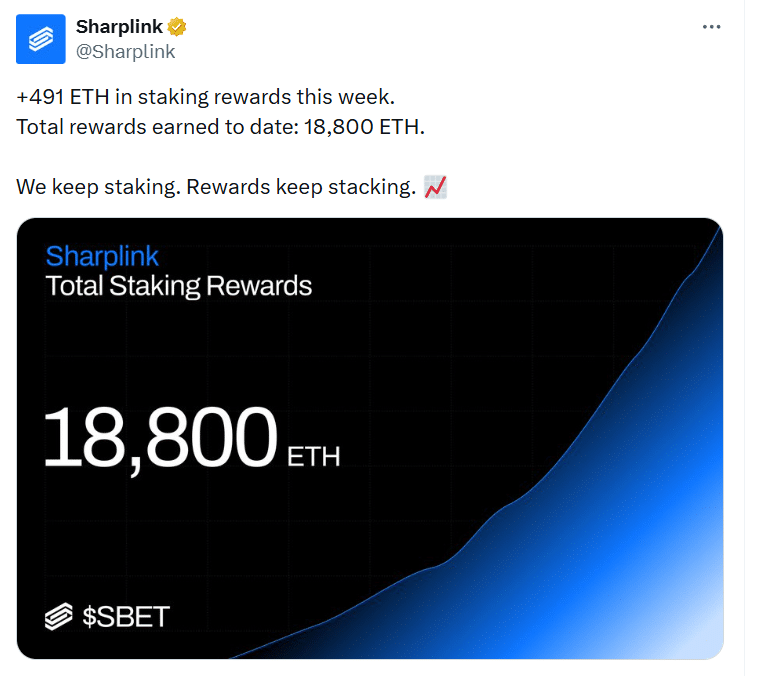
SharpLink has added 491 ETH in weekly rewards, lifting its total Ethereum staking rewards to 18,800 ETH since it began its Ethereum treasury strategy in June 2025. The update gives the market a clearer look at how public companies are trying to make crypto holdings more productive, not just more visible on the balance sheet. Instead of holding ETH as a passive reserve, SharpLink has built its model around staking, yield, and long-term exposure to Ethereum’s network activity.
Ethereum staking rewards become SharpLink’s main treasury driver
SharpLink’s latest reward update matters because it shows a different kind of corporate crypto play. Bitcoin treasury companies usually rely on price appreciation. SharpLink, by contrast, is trying to earn while it holds. That is where Ethereum staking rewards become central to the model, since staked ETH can generate protocol-based income while still keeping the company exposed to Ethereum’s broader market direction.
The company’s dashboard describes staking rewards as ETH earned since June 2, 2025, including both native staking rewards and liquid staking rewards. It also notes that native rewards are reported as revenue under U.S. GAAP, while liquid staking rewards are recognized as other income when realized through redemption. That accounting detail is not just technical fine print. For investors, it helps explain how staking income may appear in financial statements.
SharpLink reported earlier that it shifted strategy in June 2025 by making ETH its primary treasury reserve asset. It also said its goal was to give investors a disciplined way to participate in Ethereum’s role in global finance while activating ETH’s yield potential. That shift turned the company from a standard listed business into one of the more watched Ethereum treasury vehicles in the market.
Why this matters for crypto market indicators
For crypto investors, the headline number is only one part of the signal. The stronger read comes from several indicators working together: total ETH holdings, staking participation, reward growth, ETH price movement, network yield, validator demand, and liquidity conditions. When these indicators point in the same direction, the market usually pays closer attention.
Ethereum staking rewards are especially useful because they show whether a treasury is actively using the network rather than simply sitting on tokens. In traditional finance, it is a little like comparing cash parked in a vault with cash placed into income-generating instruments. The risk profile is not identical, of course, but the basic idea is easy to understand: idle capital and productive capital are not viewed the same way.
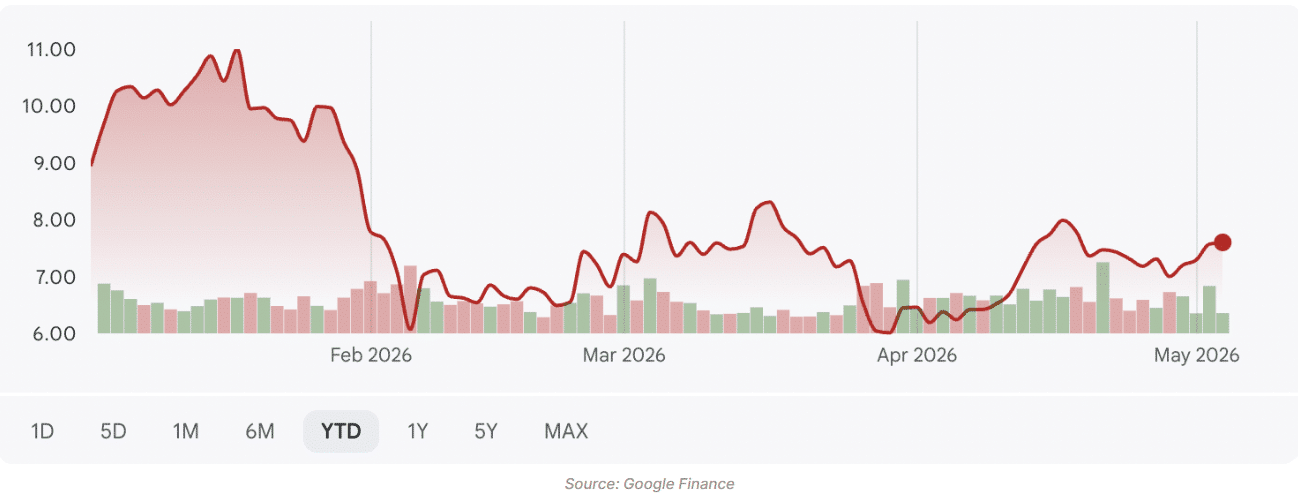
SharpLink’s reported holdings have placed it among the largest Ethereum treasury companies. Its public site presents the company as an institutional-grade Ethereum treasury platform, while third-party tracking and company disclosures show a rapid buildout since the strategy began. The key question now is whether the market rewards that productivity, especially during periods when ETH price action is weak or choppy.
Staking changes the treasury conversation
The rise of Ethereum staking rewards also changes how investors compare ETH-focused treasuries with Bitcoin-focused ones. Bitcoin has a cleaner scarcity narrative, but it does not offer native staking yield. Ethereum carries smart contract, network, and execution-layer complexity, yet it also allows institutions to participate in validator economics.
That difference is important. If ETH prices rise, SharpLink benefits through asset appreciation. If ETH prices move sideways, staking can still add incremental ETH over time. If prices fall, rewards may soften the blow, though they cannot erase market risk. There is no magic shield here, but there is a more active treasury structure.
This is why Ethereum staking rewards are becoming one of the more watched indicators for ETH treasury companies. They show how much additional ETH is being created through participation, how consistent the reward stream looks, and whether the company’s strategy is scaling beyond a one-time crypto purchase.
Conclusion: SharpLink’s ETH strategy is becoming easier to measure
SharpLink’s latest 491 ETH weekly reward update gives investors another measurable data point in a market that often runs on noise. The company’s total Ethereum staking rewards now stand at 18,800 ETH, and that figure strengthens the case that staking is no longer a side feature of its treasury plan. It is the plan.
Still, investors should keep the broader picture in view. ETH price trends, staking yields, liquidity, treasury disclosures, share dilution, regulatory treatment, and accounting rules all matter. Ethereum staking rewards can support long-term value creation, but they do not remove volatility. The better takeaway is more balanced: SharpLink is showing how Ethereum treasuries may evolve from passive holdings into productive digital asset strategies, and the market now has clearer numbers to judge that approach.
Frequently Asked Questions
What did SharpLink announce?
SharpLink added 491 ETH in weekly staking rewards, bringing its total Ethereum staking rewards to 18,800 ETH since launching its ETH treasury strategy.
Why are staking rewards important?
They allow ETH holders to earn additional ETH by supporting the network, which can make a treasury more productive than simply holding tokens.
Does this mean SharpLink’s strategy is risk-free?
No. ETH price volatility, staking risks, liquidity conditions, accounting rules, and market sentiment can still affect performance.
What crypto indicators should investors watch here?
Investors should watch ETH price action, total treasury holdings, staking yield, reward growth, liquidity, on-chain activity, and company disclosures.
Glossary of Key Terms
ETH: The native asset of the Ethereum network.
Staking: The process of locking or deploying ETH to help secure Ethereum and earn rewards.
Treasury strategy: A company’s plan for holding and managing assets on its balance sheet.
Validator: A network participant that helps confirm Ethereum transactions and secure the blockchain.
Yield: The return earned from an asset, often shown as income or rewards.
Sources