



The most recent Ethereum price rally has hit a wall again under $2,400 as Ethereum continued to confirm a resistance zone that kept it down in 2026.
With ETH having approached the level repeatedly over the past three months only to retreat each time, it may seem that a dip could be forthcoming. The repeated rejection is one of the most glaring signs that Ethereum has deeper structural pressure even while some parts of the crypto markets try to recover.
So far this year, Ether is still down around 21%, underperforming the wider digital asset market, which itself has fallen about 11% year-to-date.
While Bitcoin has managed to stabilize above key support zones and several competing chains continue attracting activity, Ethereum’s recovery has looked fragile and inconsistent.
Behind that weakness is a combination of diminishing on-chain activity, waning institutional interest, and rising competition from faster rival chains.
Ethereum’s DApp Slowdown Is Hurting ETH Demand
One of the major reasons that the current Ethereum price rally keeps fading is due to a massive drop in decentralized application activity over Ethereum’s ecosystem.
In the last six months, Ethereum-based decentralized exchange volumes have plunged by roughly 53%, while DApp revenue has declined about 49% during the same time.
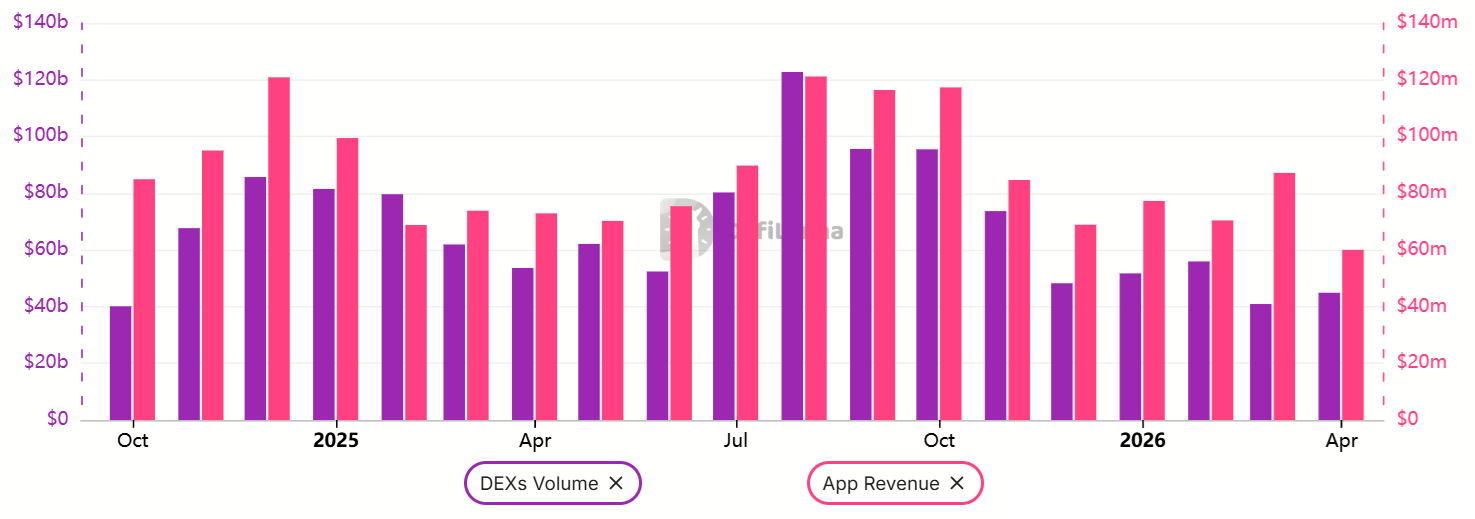
The collapse in meme coin trading earlier in the year removed one of the strongest traffic drivers for Ethereum-based decentralized exchanges. Token launch activity also slowed considerably, reducing transaction demand across the network.
Meanwhile, repeated security breaches have dented users’ faith in DeFi protocols.
In total, April 2026 saw around $630 million of crypto hacks with the KelpDAO and Drift Protocol hacks accounting for most of the losses on-chain. Blockchain security company Hacken attributed a host of the attacks to DPRK-linked actors, adding fuel to fears over DeFi security.
This has triggered a higher impact beyond Ethereum itself. Over the past three months, aggregate decentralized exchange activity across the crypto industry has been down roughly 47%.
While Ethereum still has the largest ecosystem by total value locked, the stagnant activity is reducing both network fees and economic demand supporting ETH prices that were once much stronger.
Market Share is Being Taken by Solana and Hyperliquid
Ethereum’s dominance is also facing stronger competition than in previous cycles.
While Ethereum maintains leadership when layer-2 networks are included, users increasingly gravitate toward chains that offer lower fees and simpler experiences at the base layer.
Despite Ethereum remaining approximately six times larger in terms of total value locked [TVL], Solana and Hyperliquid now make up a 42% share of decentralized application revenue. That has become difficult for investors to ignore.
A lot of the users just do not yet understand how Ethereum’s scaling structure works, especially its dependence on layer-2 rollups. Competing chains market themselves as simpler alternatives, reducing friction for retail traders and developers.
Ethereum developers claim the market could be underestimating the impact of the forthcoming “Glamsterdam” hard fork.
Uttam Singh, an engineer at Alchemy, said recently that some investors misreported the upgrade as a challenge to rollups when it actually strengthens the network. As Singh states, the update will reportedly increase Ethereum’s base-layer capacity 3x and mitigate bottlenecks via parallel transaction execution and block-data pre-fetching.
Even so, uncertainty remains around whether these upgrades will materially increase network fees and staking yields — two metrics closely tied to long-term ETH valuation.
That hesitation continues to act as a drag on sentiment.
More Caution From Institutional Investors
The appetite for Ethereum at institutional level also appears to be losing steam when compared to earlier market cycles.
The largest publicly quoted holder of Ether known as Bitmine has become a major example of the pressure facing large ETH treasury firms.
Reports indicated the company had purchased approximately $12.2 billion worth of ETH, with its holdings now worth about $10.8 billion as Ethereum languishes in a protracted bearish trend.
The latest filings from Bitmine had quarterly losses exceeding $3.8 billion, largely because of unrealized losses on its Ethereum reserves.
Despite chairman Tom Lee continuing to defend the long-term Ethereum thesis, the scale of the paper losses has damaged institutional sentiment around ETH exposure. ETF activity has lingered in-between as well.
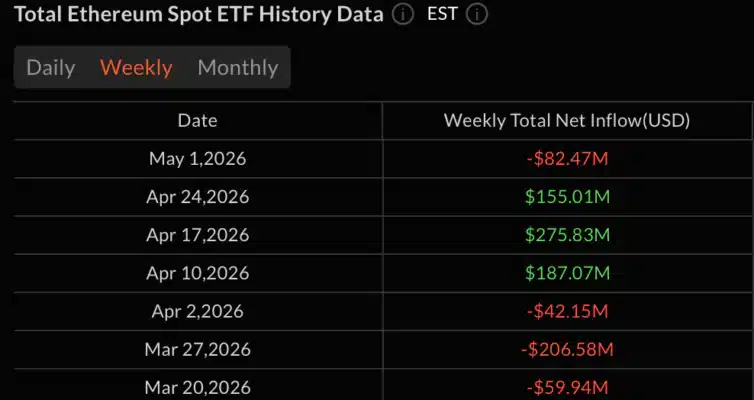
Earlier in April, certain Ethereum investment products showed extended streaks of inflows, with data suggesting that around $633 million entered spot ETH ETFs through 10 sessions.
Recent ETF flow data however, has become inconsistent suggesting uncertainty around Ethereum’s ability to outperform competing networks in the near term.
Although, some institutional players still continue to accumulate. Staking activity is growing, while exchange reserves have reportedly fallen to multi-year lows, tightening the supply of liquid ETH.
That creates a market caught between two opposing forces: weak sentiment in the short term and continued long-term accumulation by large holders.
Macro Pressure and Technical Resistance Keep ETH Captive
Beyond Ethereum-specific factors, overall macro conditions are also impeding any capacity for bullish price action.
Rising Treasury yields, elevated oil prices, and geopolitical tensions have reduced investor appetite for risk assets throughout 2026. Analysts at FXEmpire recently warned that Ethereum faces a dense resistance cluster between $2,340 and $2,400, where multiple technical indicators now converge.
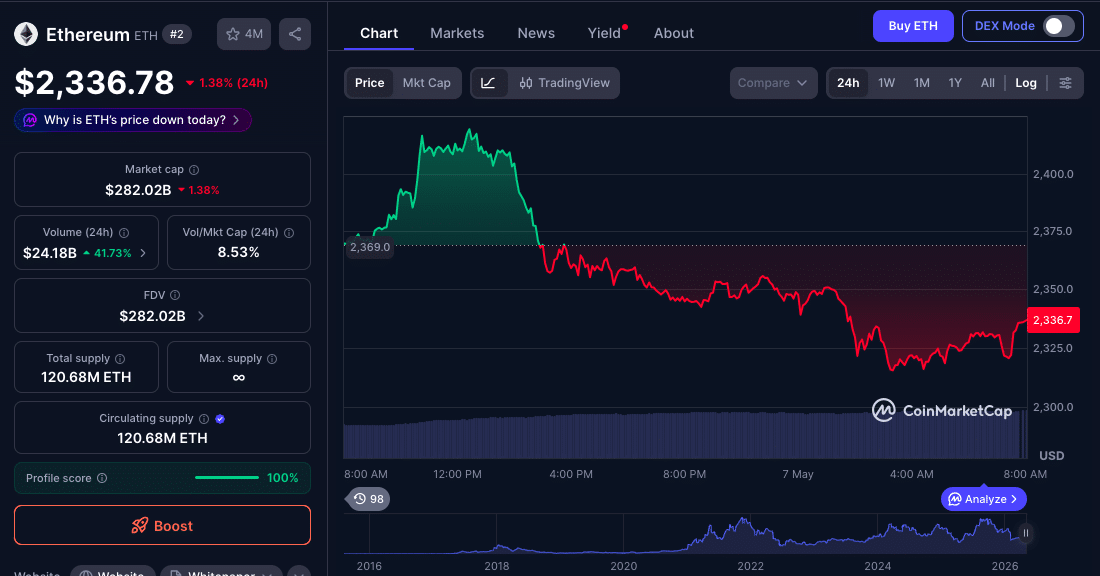
There are more traders willing to take profits than risk chasing higher prices as each run fails near that zone.
Ethereum’s realized price at these levels is not enticing to long-term holders still under water, creating a dense concentration of break-even sellers, according to technical analysts. This means that many investors who bought at the beginning of the year are now using rallies to exit rather than add exposure.
As long as liquidity remains cautious and network activity stays subdued, ETH may continue struggling to sustain breakouts above resistance.
Conclusion
The current Ethereum price rally keeps running into the same problem and that is weakening fundamentals beneath the surface.
Deteriorating DApp activity, falling revenue generation, negative security events history and competition from increasingly fast chains not to mention subdued institutional sentiment, are all factors keeping ETH below its $2,400 resistance level.
None of these issues permanently block Ethereum price rally from eventually reclaiming higher levels like $2,800 or beyond. Ethereum still has the largest ecosystem smart contracts, deep institutional infrastructure, and largest developer base.
However, as of now, the market needs more convincing that demand for new Ether and investors are returning before it gives ETH a sustained breakout.
Glossary
DApp: A decentralized application which works on a blockchain network.
DEX: Decentralized exchange allowing peer-to -peer way of crypto trading.
Total value locked (TVL): The total amount of assets secured in DeFi protocols.
Layer-2 Rollups: Solutions created to help with transactions on Ethereum.
Staking yield: Rewards generated by staked crypto assets which secure a blockchain network.
Frequently Asked Questions About Ethereum price rally
Why does Ethereum price rally keep failing near $2,400?
Ethereum price is pressured by dwindling DApp activity, a technical resistance at 1,650 USD levels as well as the lower appetite of investors.
How much is ETH down in 2026?
Ether is 21% lower on the year.
What role do hacks play in Ethereum price rally slowdown?
Major protocol exploits reduced confidence in DeFi activity and contributed to weaker network usage.
Are institutions still buying Ethereum?
Some institutions are still adding to their ETH stacks, however institutional sentiment has turned lower in recent weeks due to the latest drawdowns.
Can a sustained Ethereum price rally still happen in 2026?
Yes. Analysts think the strong on-chain activity and successful upgrades should help the overall sentiment over time.