



Ethereum supply is shrinking quietly, yet the impact feels like a coiled spring waiting to snap. Beneath calm price action, a deeper shift is unfolding as long-term holders pull coins out of circulation.
According to the source, Ethereum supply tightening reflects rising conviction among large investors who now favor holding over trading. This behavior signals a transition from speculation to long-term positioning, shaping how the market may react next.
Ethereum Staking Surge Quietly Reshapes Market Structure
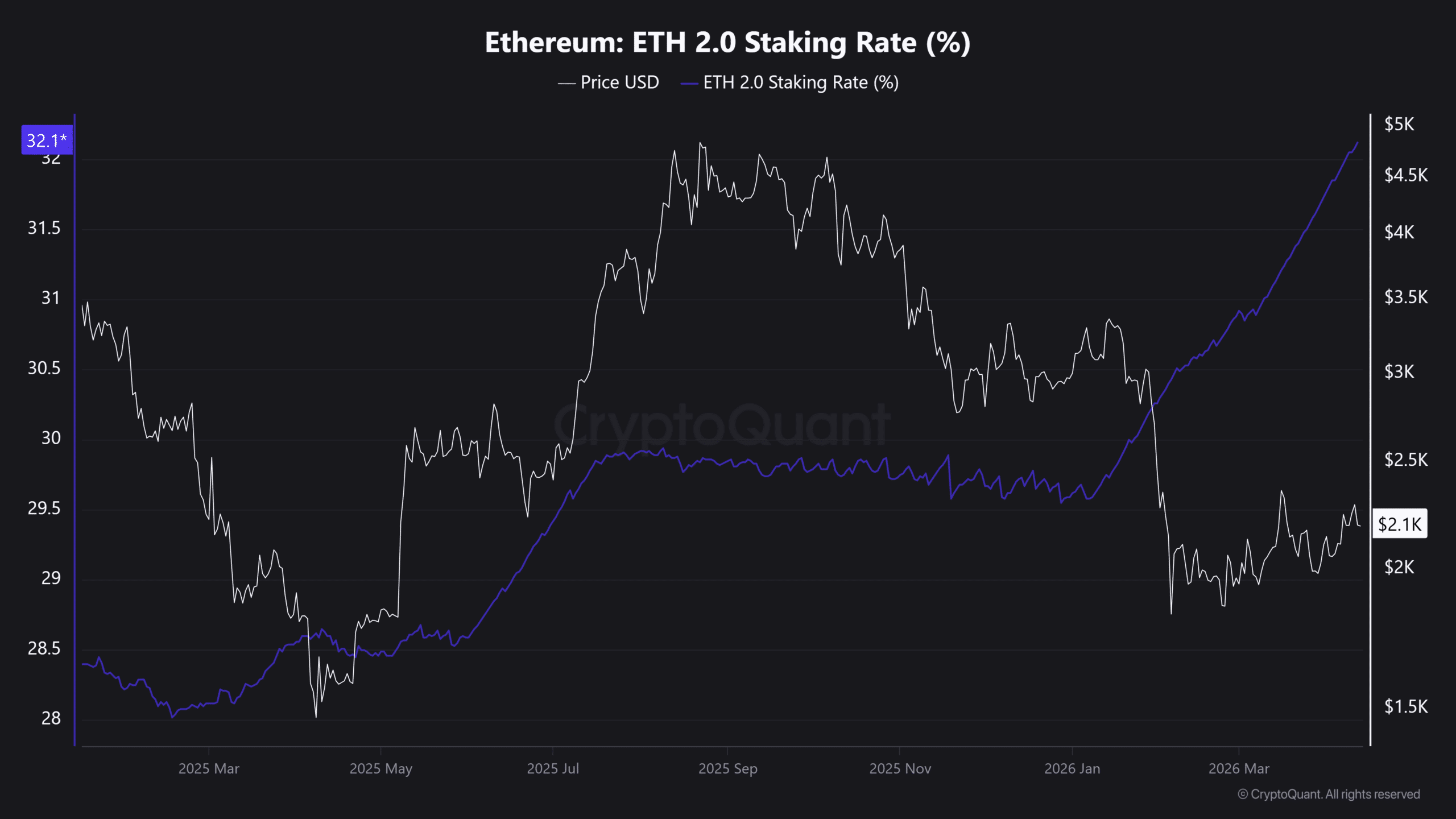
The rise of Ethereum staking continues to reshape how Ethereum supply flows across the market. Instead of sitting on exchanges, coins now move into validators, where they remain locked for yield and network security.
Recent data shows the staking ratio has climbed to 32.1%, locking nearly 39 million ETH. This steady rise in Ethereum staking reflects growing trust in long-term returns rather than short-term trades.
At the same time, exchange reserves have dropped to around 14.9 million ETH. This means less liquid Ethereum supply remains available for selling, which naturally reduces downside pressure during uncertain periods.
Ethereum Supply Meets Institutional Confidence
Institutional sentiment now plays a key role in tightening Ethereum supply. Analysts see this shift as more than a passing trend.
Geoffrey Kendrick recently noted in a research insight that Ethereum could reach $40,000 by 2030. Such projections influence behavior, encouraging investors to lock holdings rather than trade them.
Large holders have already acted. Repeated deposits of 2,000 ETH into staking contracts, along with a single wallet staking 18,000 ETH worth $39.45 million, highlight how Ethereum staking actively reduces liquid Ethereum supply. This pattern signals accumulation, not distribution.
Price Compression Signals a Brewing Breakout
While Ethereum supply tightens, price action tells a story of restraint. After falling toward $1,800 in February, ETH formed higher lows through April. This pattern often signals accumulation, where buyers slowly absorb selling pressure.
Data from technical charts shows ETH trading between $2,180 and $2,220, with resistance sitting near $2,200 to $2,400. Each attempt to break higher fades quickly, suggesting demand remains cautious.
This compression phase often acts like a pressure cooker. When Ethereum supply shrinks and price holds steady, even a small demand surge can trigger a sharp move. Market history shows that such tight ranges rarely last.
Ethereum Staking vs Demand: A Market at a Crossroads
The balance between Ethereum staking and demand now defines the market’s direction. On one side, Ethereum staking continues to lock more coins, steadily reducing Ethereum supply. On the other, demand has yet to surge.
This creates what analysts call a structural squeeze. Reduced Ethereum supply increases price sensitivity, meaning the market reacts faster to new inflows. If demand strengthens, the upside could accelerate quickly.
However, weak demand may stretch consolidation further. In this phase, Ethereum staking acts as a stabilizer, preventing sharp declines while quietly building pressure beneath the surface.

Conclusion
The steady decline in Ethereum supply marks a turning point in how the asset behaves. With Ethereum staking rising and liquidity drying up, the market structure looks stronger than before.
Yet, supply alone does not move markets. Demand must step in to unlock the next phase. If new capital enters, Ethereum could break resistance with force. If not, the market may continue drifting sideways, building tension slowly.
For now, Ethereum stands in a quiet storm. The foundation is set, and Ethereum supply is tightening. The next move depends on whether demand arrives before patience runs out.
Glossary of Key Terms
Ethereum supply: Total ETH available for trading and circulation in the market.
Ethereum staking: Locking ETH to support the network and earn rewards.
Exchange reserves: ETH held on exchanges, available for immediate trading.
Supply squeeze: Reduced supply that increases price sensitivity to demand.
Higher lows: A price pattern showing gradual buying strength over time.
FAQs About Ethereum Supply
What is ETH supply and why is it shrinking?
ETH supply is shrinking because more ETH is being locked through Ethereum staking and long-term holding.
How does Ethereum staking affect price?
Ethereum staking reduces liquid supply, which can support price stability and amplify upward moves when demand rises.
Why is ETH not breaking resistance yet?
Demand remains moderate, even though ETH supply is tightening, limiting strong upward momentum.
Can Ethereum rally from this phase?
Yes, if demand increases, the reduced ETH supply could trigger a strong breakout.