



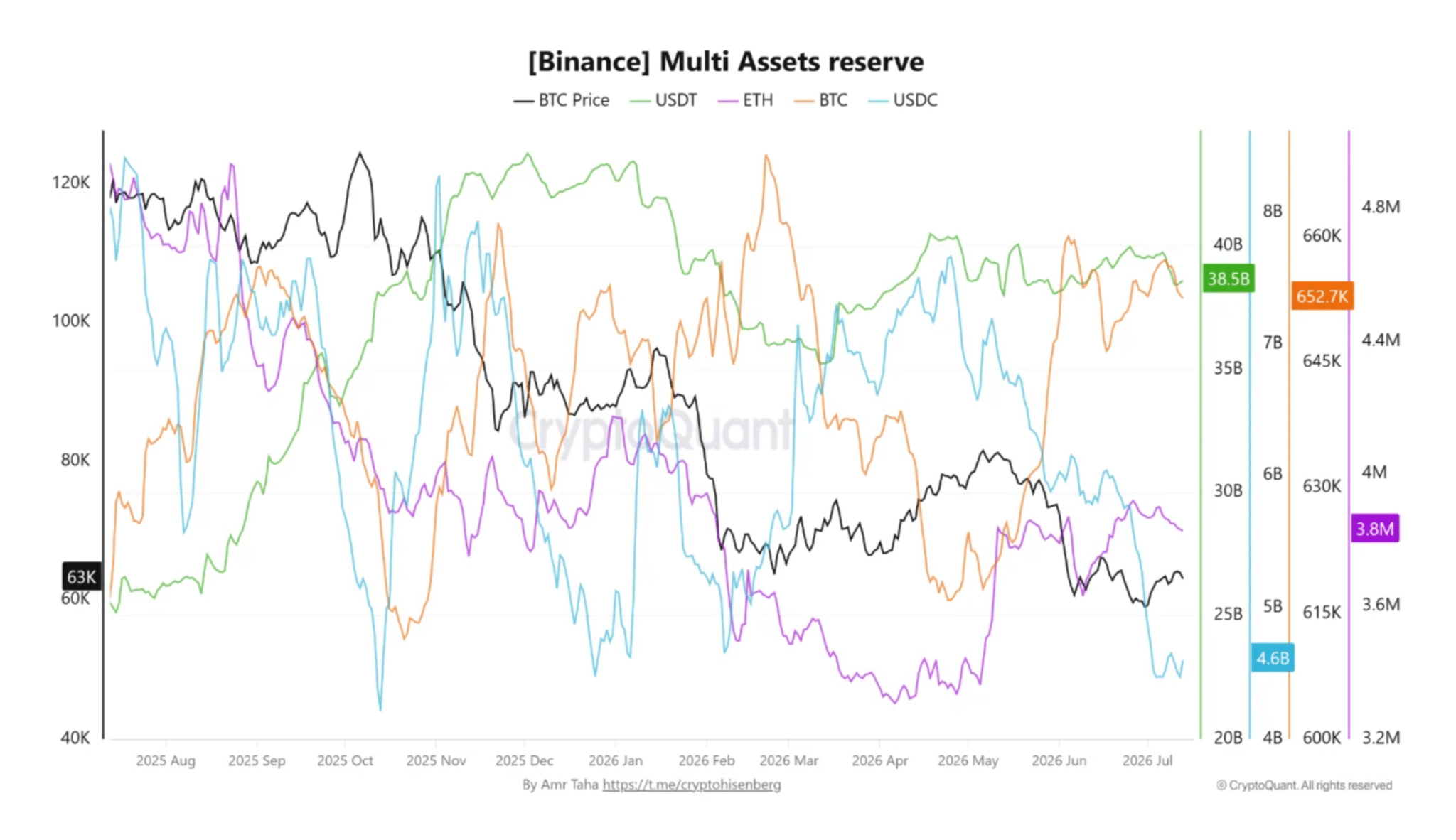
Something quietly significant has been unfolding inside Binance’s stablecoin reserves, and most traders have not noticed yet. USD Coin holdings on the exchange have fallen 40.3%, sliding from 7.7 billion dollars down to 4.6 billion dollars, according to on-chain data from CryptoQuant. Tether, meanwhile, has not moved an inch.
It remains parked at 38.5 billion dollars, a level it has held steady for months. That gap now sits at nearly 33.9 billion dollars, and it tells a story about trader behavior that goes well beyond a single exchange’s balance sheet.
This is not a case of stablecoin liquidity draining out of Binance altogether. It is closer to a reshuffling, with users voting with their wallets and choosing one asset over another. When people move funds off an exchange or shift between coins, the reasons rarely make headlines, but the pattern here is hard to miss. Traders appear to be consolidating around Tether for everyday trading and settlement, leaving USDC to play a smaller supporting role.
What the Numbers Actually Show
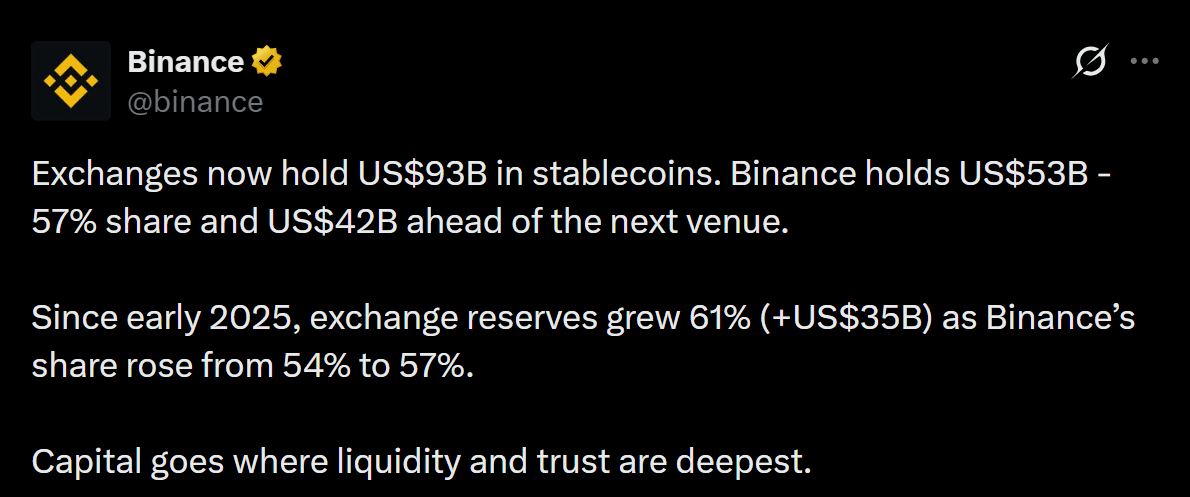
Binance still commands an enormous share of the market as the exchange holds roughly 53 billion dollars in stablecoins, which works out to 57 percent of the 93 billion dollars sitting across all exchange reserves combined. That dominance has not slipped even as the USDC and USDT split has widened. Since early 2025, stablecoin reserves at the leading exchange have grown 61 percent, adding 35 billion dollars in fresh liquidity along the way.
So the overall pie has gotten bigger, even while one ingredient has shrunk. That is worth sitting with for a moment, because it changes the interpretation. A shrinking USDC balance next to a growing total reserve is not a warning sign. It is a reallocation, plain and simple, and it suggests Tether is becoming the default choice for active trading pairs on the platform.
Stablecoin Liquidity Spreads Beyond the Whales
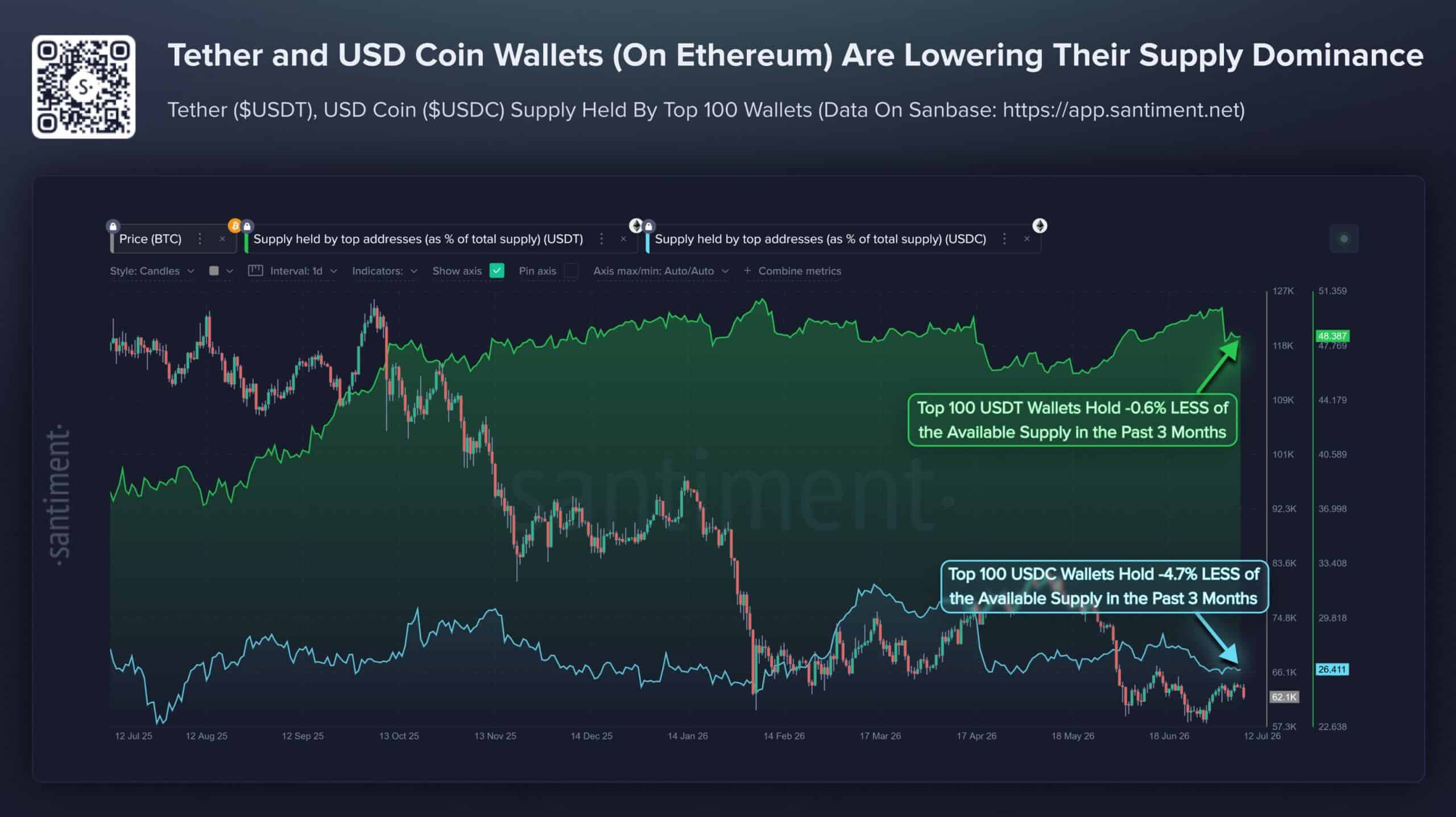
There is a second thread here that deserves attention as over the past three months, the top 100 USDT wallets have seen their share of total supply dip by 0.6 percent. The largest USDC holders saw a steeper decline, losing 4.7 percent of their share, based on Santiment tracking data. In plain terms, big holders are not hoarding stablecoin liquidity the way they once did. Ownership is thinning out across exchanges, institutions, decentralized protocols, and everyday retail accounts.
Think of it like water finding more channels to flow through instead of pooling behind one dam. That kind of distribution usually points to a healthier market structure, since it means fewer single points of failure and less dependence on a handful of large players making coordinated moves.
Can This Fuel the Next Rally
Here is the catch, and it is an important one, total stablecoin supply across the market sits close to 312 billion dollars, yet risk asset buying has not caught up with that figure. ETF flows have been mixed, exchange balances tell a similarly uneven story, and a lot of that capital appears to be sitting on the sidelines rather than chasing price action.
Broader stablecoin liquidity by itself does not guarantee a bull run. What actually moves markets is participation, meaning active wallet addresses, fresh account creation, and daily transaction counts all trending upward together. Capital sitting idle in a wallet, no matter how widely distributed, does not push prices higher on its own. Someone has to actually use it.
Conclusion
Binance’s shifting reserve mix offers a useful lens into how trader preferences evolve without a single dramatic headline forcing the change. USDT has cemented itself as the exchange’s dominant settlement asset, while USDC has receded into a smaller role. Whether this reshuffling turns into fresh market momentum depends less on how much stablecoin liquidity exists and more on whether traders start putting that capital to work.
Frequently Asked Questions
Why did Binance’s USDC reserves fall 40 percent?
Traders appear to be shifting balances toward USDT for trading and settlement, not withdrawing funds from the platform altogether.
Is Tether losing market share too?
Its wallet concentration has eased slightly, but its total reserve balance on Binance has stayed flat near 38.5 billion dollars.
Does this signal an exchange liquidity crisis?
No, Binance’s total stablecoin holdings have actually grown 61 percent since early 2025, reaching roughly 53 billion dollars.
What would trigger a stablecoin-driven rally?
Rising active wallets, new account growth, and increased daily transactions, not just a larger total supply sitting idle.
Glossary of Key Terms
Stablecoin liquidity: The amount of dollar-pegged digital assets, such as USDT or USDC, available for trading or settlement on an exchange.
On-chain data: Transaction and wallet information recorded directly on a blockchain, used to track movement of funds.
Whale wallet: A large holder of a cryptocurrency or stablecoin whose transactions can meaningfully influence market supply.
Exchange reserves: The total balance of assets an exchange holds on behalf of its users at a given time.
Risk asset accumulation: The buying of volatile investments, such as cryptocurrencies or stocks, typically using stable or cash-equivalent funds.