

Hyperliquid ETF products posted a sharp increase in trading activity this week as investor demand for HYPE-linked funds strengthened despite weakness across broader financial markets. The newly launched US-listed products tied to Hyperliquid recorded a combined 50% jump in trading volume on Wednesday, an unusual trend for recently introduced exchange-traded funds. The rise in activity came while stocks, bonds, gold, Bitcoin, and several crypto assets traded lower.
- Why Is Hyperliquid ETF Activity Drawing Attention?
- How Did The First Hyperliquid ETF Launches Perform?
- What Is Supporting HYPE’s Strong Market Performance?
- Why Did Bitwise Describe HYPE As Mispriced?
- Could More Institutional Products Enter The Market?
- What Could The Recent ETF Momentum Mean For Crypto Markets?
- Conclusion
- Glossary
- Frequently Asked Questions About Hyperliquid ETF
In contrast, HYPE continued climbing, helping attract fresh flows into the emerging ETF category. Data from SoSoValue showed that the two funds from Bitwise and 21Shares generated nearly $41 million in total traded value since their launches earlier this month. Analysts tracking ETF markets noted that most new funds typically see strong opening-day interest before trading activity fades, making the continued rise in volume notable.
Why Is Hyperliquid ETF Activity Drawing Attention?
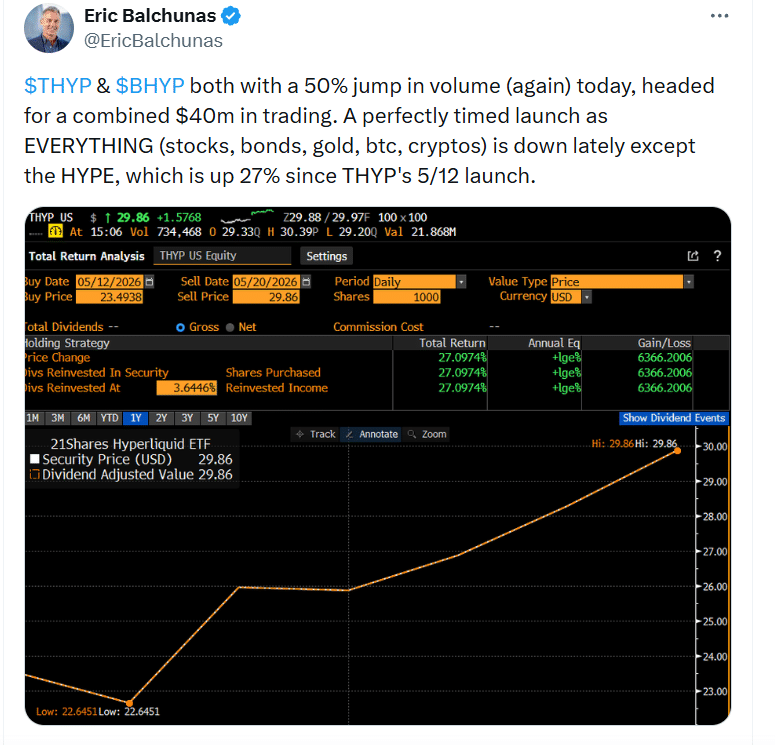
The growing interest in the Hyperliquid ETF segment is closely linked to the recent performance of HYPE and the expanding role of the Hyperliquid platform within crypto derivatives trading. Bloomberg ETF analyst Eric Balchunas stated in an X post that the steady increase in trading activity was “very rare” for newly launched ETFs. He noted that many funds usually experience a large first-day spike before volumes slow sharply or remain inactive for months.

Balchunas also linked the momentum to market timing. He said the funds launched during a period when most major assets were declining while HYPE continued moving higher. The HYPE token has gained 120% since the start of the year and rose 16.31% over the past 24 hours $56.50. However, the token’s rapid appreciation has also increased valuation concerns. Analysts have cautioned that assets experiencing steep short-term rallies can face elevated volatility if market sentiment weakens or broader crypto conditions deteriorate.
How Did The First Hyperliquid ETF Launches Perform?
21Shares launched the first-ever US-listed Hyperliquid ETF, the 21Shares Hyperliquid ETF (THYP), on May 12. The product debuted on Nasdaq and initially attracted $1.2 million in net inflows. Bitwise followed later that week with the Bitwise Hyperliquid ETF under the ticker BHYP on May 14. The product launched on NYSE Arca and recorded $750,000 in initial net inflows.
Both THYP and BHYP are staking-enabled spot-HYPE ETFs, with a portion of HYPE staked on the Hyperliquid platform and rewards distributed according to the funds’ underlying structures. The products later recorded their strongest inflow session on Wednesday. Combined net inflows reached $25.5 million, marking the largest single-day inflow recorded so far for altcoin ETFs. The 21Shares product added $16.6 million while Bitwise’s ETF attracted $8.8 million.
What Is Supporting HYPE’s Strong Market Performance?
Traders have increasingly shifted toward Hyperliquid because of the platform’s growing influence within decentralized perpetual futures trading. Some market participants now view Hyperliquid as one of the more prominent trading-focused crypto ecosystems due to its increasing share of perpetual futures activity. 21Shares stated that Hyperliquid controls more than 50% of decentralized perpetual futures open interest while processing around $8 billion in daily trading volume.
Over the past year, the S&P 500 gained 8.6% while the Nasdaq 100 advanced 16%. Bitcoin, meanwhile, declined 11% during the same period. Balchunas stated in another X post that THYP’s trading volume increased daily after launch and eventually reached the tens of millions. He described the trend as a sign of “organic interest” from investors. The fund’s turnover rose from about $1.8 million on May 12 to $14.1 million by May 19, while its price increased from $23.49 to $28.28 during the same period.
Why Did Bitwise Describe HYPE As Mispriced?
Bitwise argued that traders may be mispricing HYPE by treating Hyperliquid as little more than a crypto exchange, saying instead that it functions as a multi-asset “super-app.”The asset manager’s comments came as institutional interest in the Hyperliquid ETF category continued expanding beyond early launch activity.
That positioning has become part of the broader narrative surrounding HYPE, especially as issuers attempt to distinguish the platform from other crypto assets focused primarily on speculative trading. At the same time, analysts continue monitoring whether investor enthusiasm can remain sustainable if crypto market conditions weaken further.
Could More Institutional Products Enter The Market?
Institutional participation around Hyperliquid ETF products could continue expanding as additional issuers explore similar offerings. Crypto asset manager Grayscale filed for a Hyperliquid ETF in March. The proposed fund remains under review by US regulators, meaning the structure, fees, or launch timeline could still change before approval.
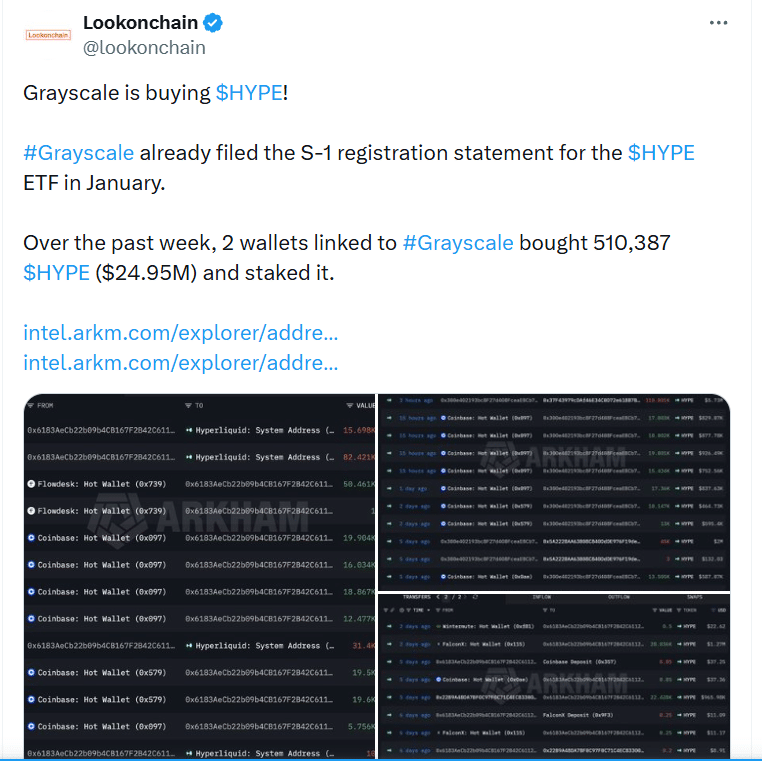
Blockchain analytics account Lookonchain stated on X that two wallets linked to Grayscale purchased around $25 million worth of HYPE during the past week before staking the assets. The wallets reportedly accumulated 510,387 HYPE tokens valued at $24.95 million. However, it remains unclear whether the purchases are directly connected to Grayscale’s pending ETF plans. If Grayscale’s Hyperliquid ETF is approved, the category could face additional fee competition and liquidity fragmentation.
The market also faces broader risks. Hyperliquid’s strong presence in perpetual futures trading ties the ecosystem closely to leveraged crypto activity, which can experience rapid shifts in demand during periods of volatility or regulatory scrutiny. Analysts said that if multiple issuers enter the category, fee pressure and product overlap could further complicate investor decisions.
What Could The Recent ETF Momentum Mean For Crypto Markets?
The recent growth in Hyperliquid ETF trading volumes highlights how quickly crypto-native trading platforms are moving into traditional investment products. Although total inflows remain relatively small compared with the largest Bitcoin ETFs, the steady increase in trading activity during the first week stands out for a newly launched altcoin-linked fund category.

The trend may indicate that investor interest is gradually expanding beyond Bitcoin-focused products toward crypto infrastructure projects tied to derivatives trading and onchain financial services. Still, analysts noted that the sector remains early-stage. Future competition from additional issuers, fee pressure, regulatory developments, and broader market volatility could influence how these products evolve over time.
Conclusion
Hyperliquid ETF products have quickly become one of the most closely watched areas within the crypto ETF market after recording an uncommon post-launch increase in trading volume. Rising HYPE prices, expanding perpetual futures activity, and growing institutional participation have helped drive attention toward the category even as broader markets struggled.
With nearly $41 million in traded value already recorded and additional ETF proposals under regulatory review, the Hyperliquid ETF segment is increasingly being viewed as an early test of investor appetite for crypto trading infrastructure products beyond Bitcoin and traditional large-cap digital assets.
Glossary
Hyperliquid ETF: Funds tied to the value of HYPE-related assets.
HYPE Token: The core cryptocurrency of the Hyperliquid platform.
ETF Inflows: Fresh investor money entering an ETF.
Staking Rewards: Earnings from locking crypto tokens on a network.
Crypto Derivatives: Contracts linked to cryptocurrency price changes.
Frequently Asked Questions About Hyperliquid ETF
Why did Hyperliquid ETF volume increase?
Hyperliquid ETF volume increased as investor demand for HYPE-linked funds continued rising.
Which companies launched Hyperliquid ETFs?
21Shares and Bitwise launched the first Hyperliquid ETFs in the United States.
How much did Hyperliquid ETF trading volume rise?
Combined Hyperliquid ETF trading volume jumped 50% on Wednesday.
What makes the recent ETF growth unusual?
Analysts said most new ETFs slow down after launch, but Hyperliquid ETF activity kept growing.
Could HYPE remain volatile?
Yes, analysts believe rapid HYPE price gains could lead to stronger market volatility.