


Hyperliquid whale liquidation activity has become a closely watched market signal as traders track how transparent leverage data can influence short-term decision-making. A recent ETH long position linked to the account identified as Machi Big Brother showed how a single high-leverage trade can become a wider market reference when liquidation information, address activity, and social attention are publicly available.
- What does Hyperliquid whale liquidation reveal about large leveraged positions?
- Why are liquidation maps becoming important for crypto traders?
- What do current ETH and Hyperliquid market figures show?
- What previous Hyperliquid events show about visible whale trades?
- How should traders interpret public liquidation signals?
- Conclusion
- Glossary
- Frequently Asked Questions About Hyperliquid Whale Liquidation
The event does not confirm ETH’s future direction or prove that a specific liquidation level will be reached. Instead, it highlights how crypto traders are increasingly using public derivatives data to identify possible areas of market pressure.
What does Hyperliquid whale liquidation reveal about large leveraged positions?
Hyperliquid whale liquidation refers to the forced closure of a large leveraged position that becomes visible to other traders through public market data. The recent case involved an ETH long position connected by Lookonchain to the account identified as Machi Big Brother.

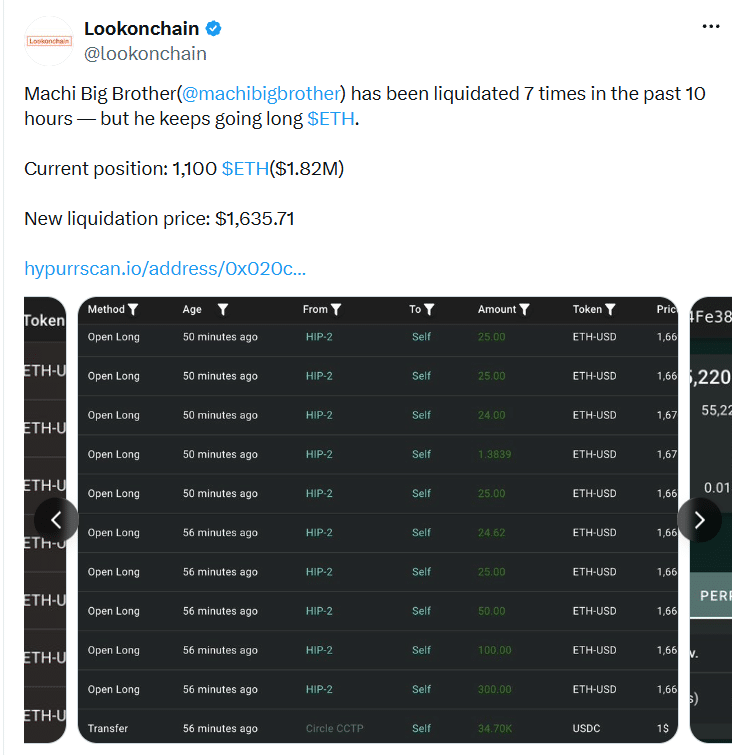
On June 23, 2026, Lookonchain posted on X that the account had been liquidated seven times within 10 hours while continuing to hold ETH long positions. The post showed a current position of 1,100 $ETH worth $1.82M, with a new liquidation price of $1,635.71.
The address associated with the position was shared through HypurrScan, allowing traders to monitor the account activity and review the publicly available position data. Multiple liquidation records do not always represent one single trading failure.
Partial liquidations, margin top-ups, position re-entries and exchange-specific liquidation rules can create several recorded liquidation events while an overall position remains active. The Hyperliquid whale liquidation event gained attention because the platform provides public visibility into account activity and liquidation levels. This transparency allows traders to observe possible stress points before a forced exit occurs.
Why are liquidation maps becoming important for crypto traders?
Hyperliquid’s public trading environment has changed how market participants analyse large leveraged positions. Liquidation risks that were once mainly visible to traders and exchanges can now be tracked through dashboards, address explorers, and liquidation maps. A liquidation map shows where large amounts of leveraged positions may face pressure at different price levels.
This information can help traders identify areas where forced selling or buying could potentially increase volatility. However, visible liquidation zones do not guarantee market movement. Many public liquidation clusters remain untouched as prices move in another direction. Social attention can also influence how traders view these levels.
Screenshots, dashboards, and X posts can increase awareness around a position, creating a stronger market narrative. But higher attention does not prove coordination between traders or confirm that price will react in a specific way. The value of this information comes from improved visibility, not from predicting future price action.
What do current ETH and Hyperliquid market figures show?
ETH is currently trading around $1,607, with the asset down 3% over the past 24 hours. The market capitalisation is currently near $194 billion, while 24-hour trading volume is around $13.5 billion. Current Ethereum derivatives data shows spot trading volume at around $2,959,436,916 over the past 24 hours.
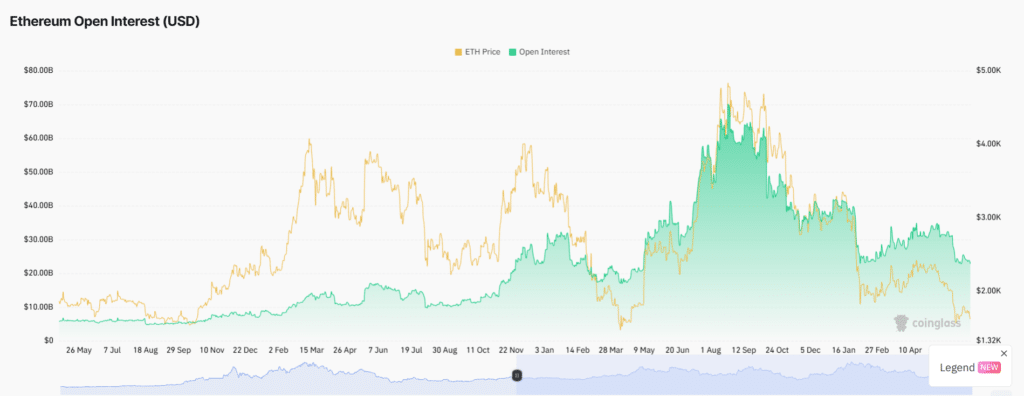
Ethereum futures trading volume is around $54,283,907,097 during the same period, while approximately $226,172,631 in Ethereum futures positions have been liquidated. Ethereum open interest is currently around $23,091,454,657.
Hyperliquid market data shows spot trading volume at around $261,916,787 and futures trading volume at around $3,447,941,592 over the past 24 hours. Around $9,260,811 in Hyperliquid futures positions have been liquidated during the same period. Hyperliquid’s 24-hour liquidation figures currently show around $9.29M in total liquidations.
Long liquidations account for approximately $7.32M, while short liquidations represent around $1.96M. The platform’s futures open interest is currently around $2,566,502,496. These figures indicate that leverage conditions are adjusting across the market. They do not prove that a single whale position caused broader price movements.
What previous Hyperliquid events show about visible whale trades?
The importance of public leveraged positions has also appeared in previous Hyperliquid-related incidents. A March 2025 Hyperliquid event involving venue-level losses and a June 2025 Bitcoin whale loss showed how large leveraged trades can develop into wider discussions around platform risks and market exposure. These examples explain why traders continue monitoring large positions.
A whale trade may begin as an individual strategy, but public visibility can turn it into a market-wide reference point when liquidation risks become noticeable. Still, past events do not mean every large position creates similar consequences. Some highly visible trades attract attention without causing major market disruption.
How should traders interpret public liquidation signals?
Public liquidation data can provide useful market context, but it should not be treated as a guaranteed trading signal. A visible liquidation level shows where pressure could develop, but it does not reveal whether a trader will add margin, reduce exposure, or exit the position.
Traders can use liquidation bands as one input in risk management, including stop placement and scenario analysis. However, they should not be considered the only reason to open leveraged positions. The Hyperliquid whale liquidation case demonstrates the difference between observing market information and predicting market outcomes.

Public data can show where risk may exist, but it cannot remove uncertainty from leveraged trading. The broader impact is that crypto markets now operate in a more transparent environment. Traders can monitor large positions in real time, but interpretation remains essential.
Conclusion
Hyperliquid whale liquidation activity has added another layer to how traders watch leveraged markets. Large positions are no longer only a matter between a trader and an exchange. Once liquidation levels become public, they can become part of the wider market conversation.
Liquidation data can highlight vulnerable price zones, but traders still cannot know whether those levels will come into play. Traders still need to consider broader market conditions, liquidity and risk factors before drawing conclusions. Greater access to live position data gives traders more information, but it also makes careful interpretation more important
Glossary
Hyperliquid Whale Liquidation- Forced closure of a large whale trade.
ETH Leverage- Borrowed funds used to amplify an ETH position.
Liquidation Map- Price zones where leveraged trades may be closed.
Whale Trader- A trader controlling large crypto positions.
Margin Top-Up- Extra funds added to avoid liquidation.
Frequently Asked Questions About Hyperliquid Whale Liquidation
Who was involved in the recent Hyperliquid whale liquidation?
The position was linked by Lookonchain to the account identified as Machi Big Brother.
How many times was the ETH position liquidated?
Lookonchain reported that the ETH position was liquidated seven times within 10 hours.
Can public liquidation data predict ETH’s next move?
No public liquidation data can show risk areas, but it cannot predict future prices.
Did the whale completely close the ETH position?
No. The account continued holding ETH long positions after the liquidation events.
What does this event show about crypto markets?
It shows that public trading data can become an important market signal for traders.