

CZ Hyperliquid has become a major talking point in the crypto market after Binance founder Changpeng Zhao praised the decentralized exchange’s technology while warning that its operating model could face regulatory pressure similar to the challenges Binance experienced. Zhao’s comments highlighted the growing divide between permissionless trading platforms and compliance-focused centralized exchanges.
- What is CZ Hyperliquid and why is it gaining attention?
- Why did CZ warn about regulatory pressure on Hyperliquid?
- How has Hyperliquid responded to regulatory concerns?
- Why did Star Xu criticize CZ’s support for rival DEX platforms?
- Can HYPE continue its recent price momentum?
- What does CZ Hyperliquid’s debate mean for the future of crypto exchanges?
- Conclusion
- Glossary
- Frequently Asked Questions About CZ Hyperliquid
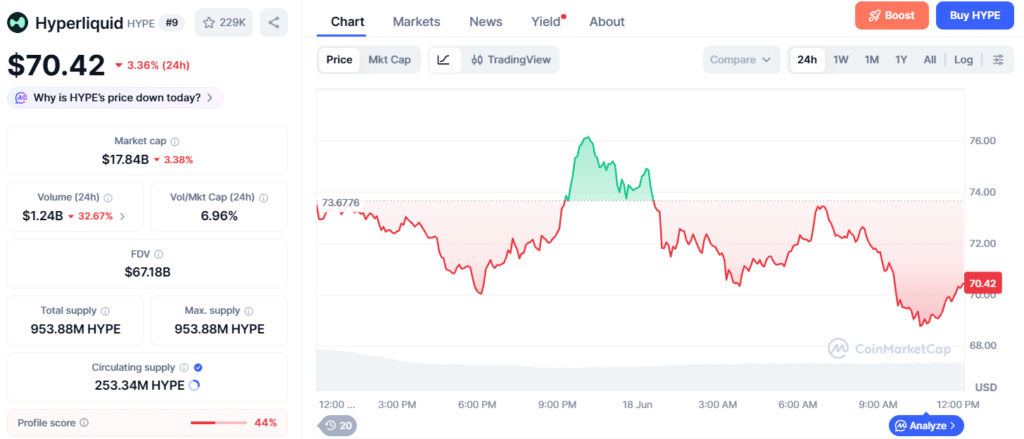
The remarks came as HYPE continued to attract market attention following renewed spot ETF demand. The token recently reached a new all-time high of $76.9, while it is currently trading around $69.62, down 5.79% in the last 24 hours but still up 24.69% over the past week.
What is CZ Hyperliquid and why is it gaining attention?
CZ Hyperliquid refers to the growing discussion around Hyperliquid’s decentralized exchange model and its position in the crypto trading sector. The platform has built a reputation for offering high-speed trading features similar to centralized exchanges while operating without traditional KYC requirements.

In an interview with Galaxy Digital Head of Research Alex Thorn, Changpeng Zhao described Hyperliquid’s creation as a strong technological development. He said the platform serves a market segment where Binance cannot compete because of its different operational approach. “I think the Hyperliquid invention is actually awesome. They occupy a niche that Binance cannot compete with. They don’t have KYC,” Zhao said.
The difference largely comes down to compliance structures. KYC, or know your customer procedures, are used by regulated platforms as part of anti-money laundering systems. These rules help exchanges verify users and meet government requirements related to financial crime prevention and sanctions enforcement.
Why did CZ warn about regulatory pressure on Hyperliquid?
Zhao’s comments were not only recognition of Hyperliquid’s innovation but also a warning about potential regulatory challenges. He pointed to the risks involved with operating a decentralized platform that does not follow the same compliance framework as centralized exchanges. “They claim they’re decentralized… I would never do what they do, given what I’ve experienced… I assume they have good lawyers,” Zhao said.
The statement carries significant weight because CZ was referring to his own sentencing and the $4 billion Binance fine linked to weak anti-money laundering systems. His experience with regulators has shaped Binance’s current compliance-focused approach.
The CZ Hyperliquid debate reflects a wider industry question about whether decentralized platforms can maintain open access while managing increasing regulatory expectations. Hyperliquid’s model allows users to trade without traditional identity verification. However, regulators globally continue to examine how decentralized financial services fit within existing legal frameworks.
How has Hyperliquid responded to regulatory concerns?
Hyperliquid has also established the Hyperliquid Policy Center (HPC), a lobby arm created to advocate for clearer U.S. regulatory guidelines as the platform navigates increasing attention from regulators. The platform has also moved to block sanctioned entities, indicating that even decentralized projects are taking regulatory requirements into account while operating differently from traditional centralized exchanges.
The CZ Hyperliquid debate has also brought attention to the race among decentralized exchanges. Hyperliquid has built its position by offering tools that traders usually expect from centralized platforms including faster transactions and leveraged trading services.
Why did Star Xu criticize CZ’s support for rival DEX platforms?
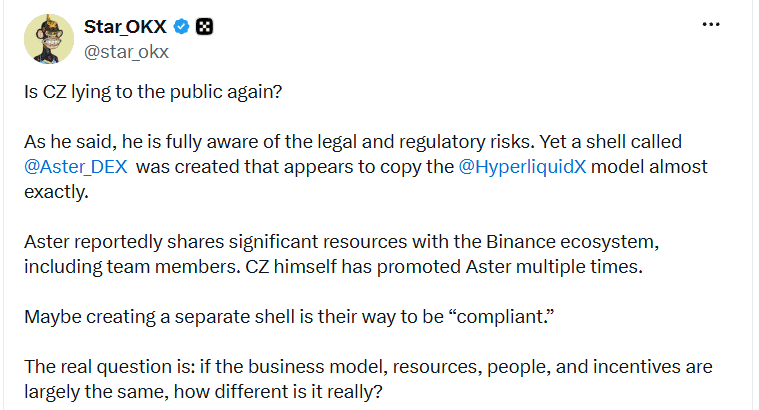
The comments from Zhao also attracted criticism from OKX founder Star Xu, who accused CZ of not fully applying the lessons from his previous regulatory experience. Xu criticized Zhao’s public support for Aster, another decentralized exchange that he described as a “shell” appearing to copy the HyperliquidX model almost exactly.
According to Xu, Aster reportedly shares significant resources with the Binance ecosystem, including team members. He questioned whether creating a separate platform changes the underlying business model and regulatory risks. Worth noting, this rivalry is personal. Star Xu was CZ’s former boss at OKX, which adds further context to the criticism and the ongoing disagreement between the two figures.
Beyond the personal dispute, Xu’s comments focused on a broader issue: whether decentralized platforms with similar structures can genuinely separate themselves from the regulatory challenges faced by centralized exchanges.
Can HYPE continue its recent price momentum?
HYPE has seen renewed market strength following increased interest from spot ETF products. The products attracted $26 million in inflows over two days helping push the token to a fresh all-time high of $76.9. Bitwise has also reported activity involving HYPE through its spot ETF product, BHYP.
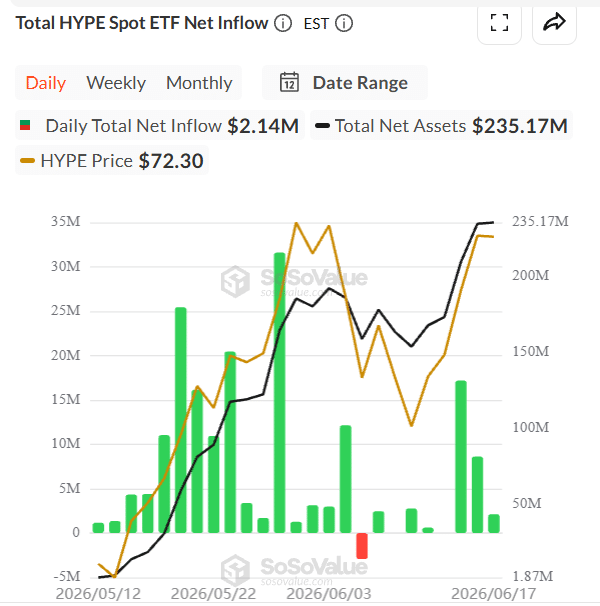
The asset manager stated that it currently stakes 1 million HYPE for the product as part of 7.8 million HYPE being staked through its validator services. The token had spent a period consolidating between the $60 and $75 levels before breaking higher. Market participants are now watching whether broader market conditions could support further movement toward $80 and potentially $100 levels.
What does CZ Hyperliquid’s debate mean for the future of crypto exchanges?
CZ Hyperliquid has brought a wider debate into focus for the crypto industry about how platforms can continue developing new ideas while dealing with stricter regulatory expectations. Changpeng Zhao acknowledged Hyperliquid’s technological progress but also made it clear that Binance would continue following a different approach focused on its own operating and compliance structure.

Centralized exchanges continue to prioritize compliance infrastructure, while decentralized platforms are exploring alternative approaches. Centralized and decentralized exchanges are likely to compete on different fronts in the coming years. Along with attracting users and improving technology their ability to handle regulatory requirements could influence their growth and adoption.
Conclusion
CZ Hyperliquid discussion highlights a key tension in crypto between advancing decentralized innovation and meeting stricter regulatory compliance demands. Changpeng Zhao recognized Hyperliquid’s progress but cautioned that decentralized platforms may face regulatory challenges similar to those encountered by Binance.
As HYPE attracts increased attention from traders and investors, decentralized exchanges are becoming a more significant segment of the crypto market. The industry’s next phase will depend on how platforms balance technological advancement, user demand, and evolving regulatory requirements.
Glossary
KYC: Identity check used by exchanges for compliance
AML: Rules to stop illegal money flows in finance
DEX: Peer-to-peer crypto trading without a central exchange
Bitwise BHYP: Bitwise ETF tracking Hyperliquid exposure
Spot ETF: Fund that directly follows an asset’s price
Frequently Asked Questions About CZ Hyperliquid
Why is CZ talking about Hyperliquid?
CZ is talking about Hyperliquid because it is a fast-growing decentralized exchange in crypto trading
What did CZ say about Hyperliquid?
CZ said Hyperliquid is a strong idea and fills a niche Binance does not focus on.
Why did HYPE reach a new high?
HYPE reached a new high because of strong ETF inflows and increased investor interest.
What warning did CZ give about Hyperliquid?
CZ warned that Hyperliquid may face regulatory pressure in the future.
Can HYPE go higher in price?
HYPE may go higher if market demand stays strong and positive trends continue.