

Grayscale Makes a Bold Call on a Battered Token
Grayscale Research has put its weight behind one of DeFi’s most established lending protocols, arguing that AAVE price is trading well below what its fundamentals actually justify. The asset manager’s conventional discounted cash flow analysis places the token’s current fair value between $80 and $100, compared to a spot price of around $75 at the time of writing. That alone would be a modest but meaningful premium, but the real headline is what Grayscale believes becomes possible under a more favorable regulatory environment: an AAVE price target of approximately $175 within 12 months.
That is not a fringe forecast from an anonymous account on social media. Grayscale manages billions in digital asset products, and when it publishes a DCF-based AAVE price analysis with a specific token valuation, institutional desks pay attention. The question is whether the underlying data supports that level of conviction or whether this is optimism outpacing reality.
What Grayscale’s DCF Model Actually Says
Discounted cash flow analysis is a framework borrowed straight from traditional equity investing, and applying it to a DeFi protocol is a useful way to cut through the noise around token prices.
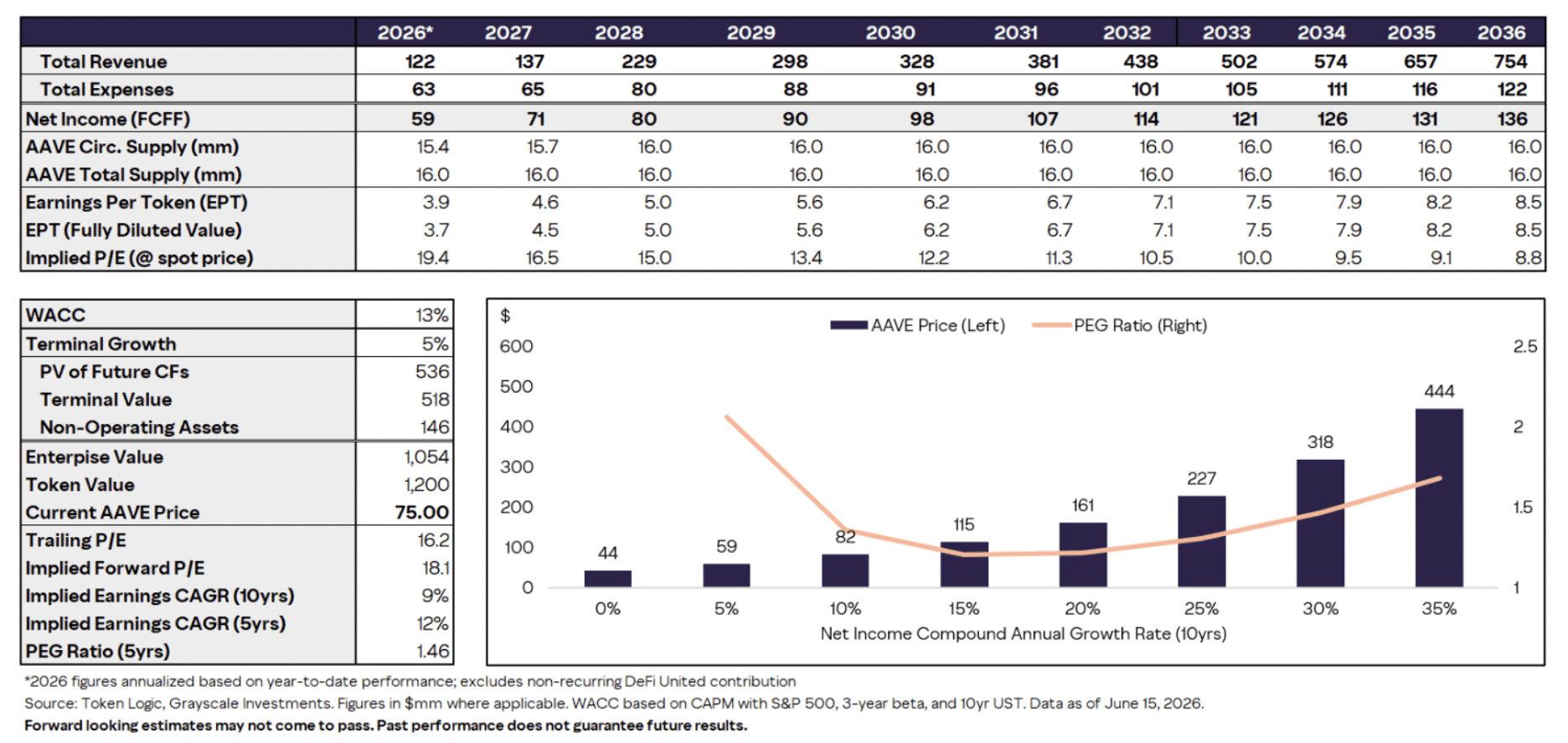
Grayscale projects Aave will generate around $60 million in protocol revenue through 2026, and when fintech sector valuation multiples of 20x to 25x are applied to that figure, the implied market cap lands somewhere between $1.2 billion and $1.5 billion. At current circulating supply figures, that translates to an AAVE price in the $80 to $100 range.
The $175 target is the base case scenario and it is conditional. Grayscale specifically ties that projection to regulatory clarity accelerating adoption of tokenized real-world assets. In practical terms, this would mean clearer frameworks for on-chain lending, wider institutional participation in DeFi, and the kind of capital inflows that push TVL higher across protocols like Aave. That is not a guaranteed outcome, but it is a plausible one given the direction of regulatory conversations in Washington and Brussels over the past several months.
The TVL Collapse That Nobody Should Ignore
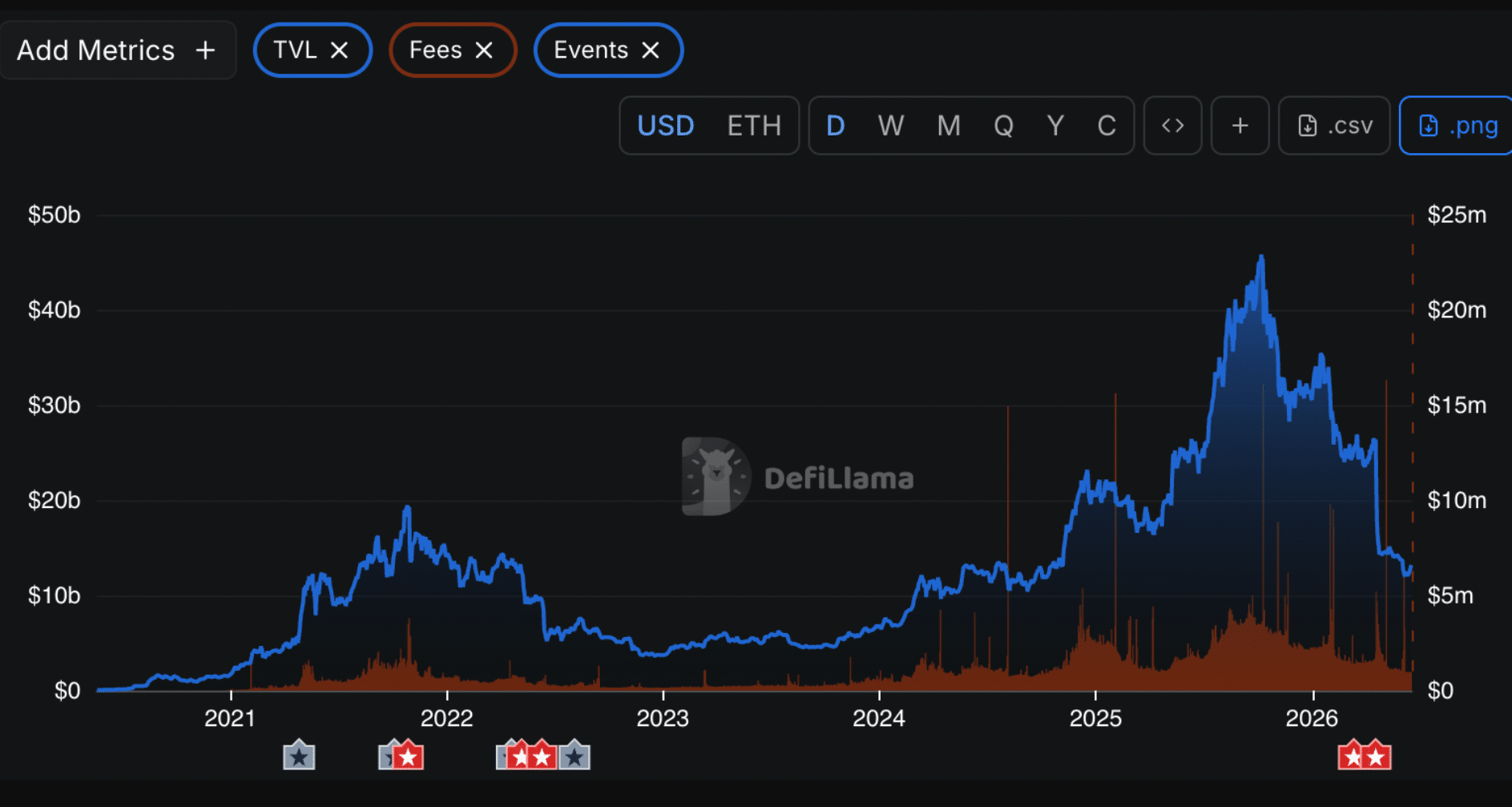
Any honest reading of this AAVE price analysis has to wrestle with the protocol’s total value locked, because the numbers tell a sobering secondary story. At its peak in 2025, Aave held $45 billion in TVL. As of mid-June 2026, that figure has dropped to $13.043 billion, a contraction of more than 70% that cannot be fully explained away by broader market weakness alone.
The trigger was the Kelp DAO rsETH exploit in April 2026, which, while not a direct attack on Aave, caused significant downstream disruption across DeFi liquidity pools. Aave’s exposure was indirect, but protocol activity fell sharply in the aftermath.
Token buybacks, one of the governance mechanisms token holders had been anticipating, are currently paused pending a comprehensive governance review. Aave founder Stani Kulechov has since presented a new risk framework designed to better assess and manage cross-protocol exposure going forward, which suggests the team understands the structural vulnerability the incident exposed.
Aave V4 Is Gaining Traction Where It Matters
Despite the TVL decline, Aave V4 is delivering numbers that give the bull case some teeth. Active borrows on the newest version of the protocol have crossed $50 million, representing a 140% increase within a single month. That is not cosmetic growth. Active borrows reflect real user demand, the kind of metric that speaks to whether a protocol is being used rather than simply holding parked liquidity.
The Aave DAO treasury also peaked at over $360 million, funded primarily through protocol revenue and AAVE token appreciation over previous cycles. Unlike many DeFi competitors that operate without meaningful financial reserves, the DAO has the balance sheet to fund expansion, integrations, and risk mitigation without diluting token holders or relying on external fundraising. That governance infrastructure is part of what makes Grayscale’s AAVE price analysis credible rather than aspirational.
What Technical Indicators Are Signaling Right Now
The technical picture heading into late June 2026 is mixed, and that is probably the most honest way to describe it. AAVE price has fallen more than 71% over the trailing 12-month period, which puts any near-term price recovery in the context of a deep drawdown rather than a correction from recent highs.
Both the RSI and MACD are showing some bullish momentum, which is encouraging, but the MACD line remains below the neutral zone, meaning the momentum has not crossed the threshold that typically signals a sustained directional move. The 90-day Spot Taker Cumulative Volume Delta is printing green bars as of June 2026, confirming that buyers are absorbing more volume than sellers in aggregate.
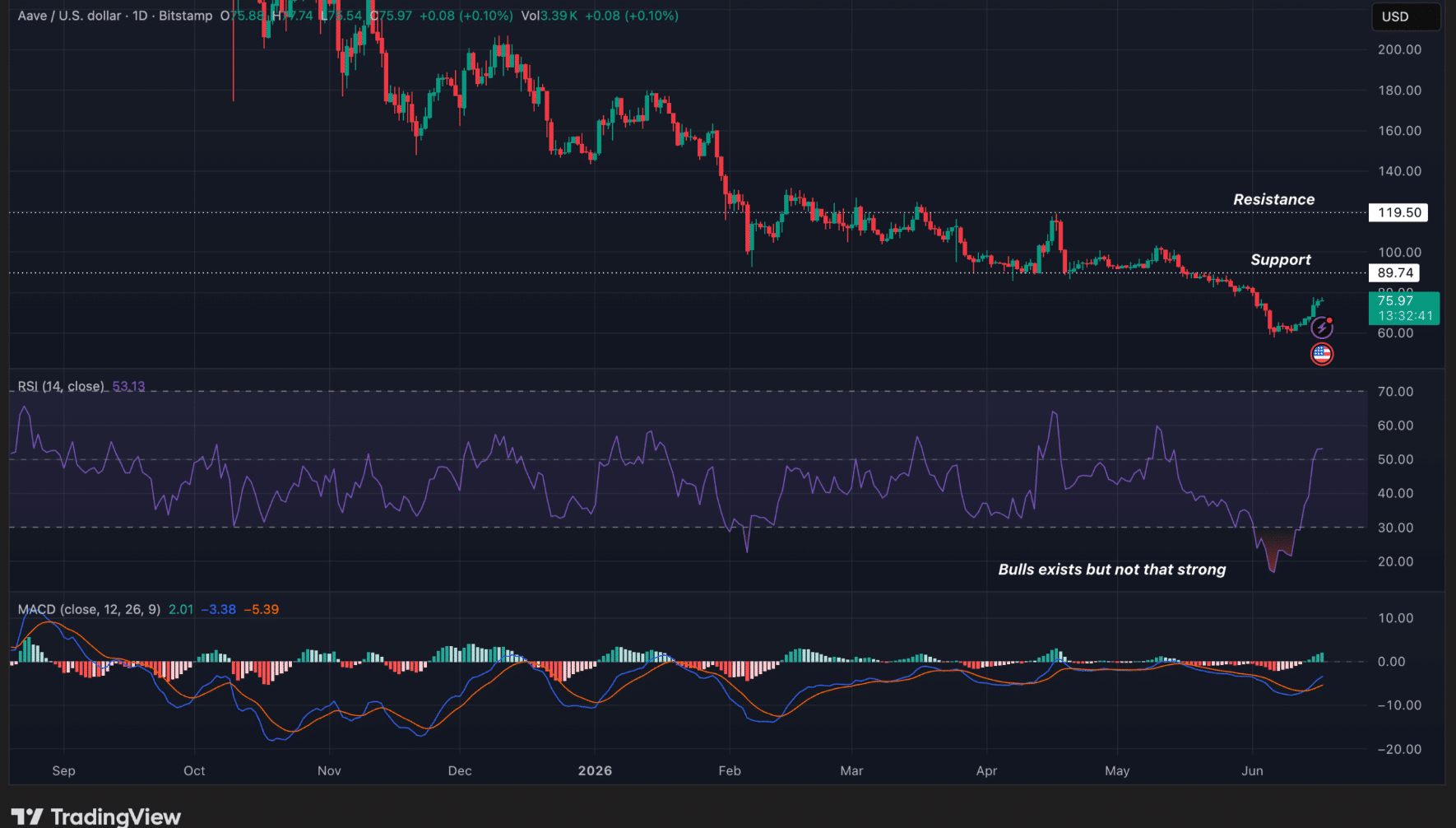
The concern is that those green bars are shrinking in height month over month, which suggests buying pressure is present but gradually fading rather than accelerating. What that combination usually means in practice is that a consolidation phase is more likely than a breakout in the immediate term, unless fresh catalysts bring new capital into the token.
Why the Regulatory Wildcard Could Change Everything
The $175 AAVE price target is fundamentally a regulatory story, and that context matters enormously. Tokenized real-world assets, think on-chain representations of treasuries, real estate, or credit instruments, require lending infrastructure to function efficiently at scale. Aave is the most battle-tested lending protocol in DeFi, and if institutional-grade RWA adoption accelerates, Aave becomes the obvious counterparty layer for that capital. Grayscale is essentially making a sector rotation argument wrapped in a DCF model: if DeFi lending goes mainstream, Aave wins disproportionately.
Conclusion
Grayscale’s AAVE price analysis is rigorous enough to take seriously and conditional enough to approach with measured expectations. The protocol has genuine structural strengths: a well-capitalized DAO, growing activity on V4, and a dominant position built across multiple market cycles.
The TVL contraction and paused buybacks are real risks that the market is clearly pricing in at current levels. If regulatory clarity materializes and RWA adoption accelerates on the timeline Grayscale envisions, the $175 target is achievable. If those catalysts are delayed, the $80 to $100 near-term fair value range is where fundamentals point. Either way, the AAVE price analysis published by Grayscale gives long-term holders a credible framework to evaluate the protocol beyond short-term price noise.
Frequently Asked Questions
What is Grayscale’s AAVE price target for 2026?
Grayscale Research projects a near-term fair value of $80 to $100 for AAVE based on DCF analysis, with a base case 12-month target of approximately $175 if regulatory clarity accelerates RWA adoption.
Why did AAVE’s TVL drop so sharply in 2026?
The Kelp DAO rsETH exploit in April 2026 caused downstream disruption that reduced protocol activity, contributing to a TVL decline from $45 billion in 2025 to around $13 billion by mid-2026.
What does the Aave V4 $50 million milestone mean?
Active borrows crossing $50 million on Aave V4 with 140% month-over-month growth signals genuine user demand, which is a stronger indicator of protocol health than TVL figures alone.
Is AAVE currently a good investment?
This article does not constitute investment advice. Readers should consult a licensed financial professional and conduct their own research before making any investment decisions.
What is a DCF model in crypto?
Discounted cash flow (DCF) is a traditional valuation method that estimates an asset’s fair value based on projected future cash flows, applied here to Aave’s protocol revenue.
Glossary of Key Terms
AAVE Price Analysis: The process of evaluating AAVE’s fair market value using fundamental and technical data, as applied in Grayscale’s June 2026 report.
Discounted Cash Flow (DCF): A valuation framework that calculates present value based on projected future earnings, commonly used in equity markets and increasingly applied to DeFi protocols.
Total Value Locked (TVL): The total amount of cryptocurrency assets deposited and actively used within a DeFi protocol, a key health indicator for platforms like Aave.
Cumulative Volume Delta (CVD): A metric that tracks the net difference between buy and sell volume over time, used to assess the directional pressure in a market.
Tokenized Real-World Assets (RWAs): On-chain representations of traditional financial instruments such as government bonds, real estate, or private credit, increasingly integrated into DeFi protocols.
MACD (Moving Average Convergence Divergence): A momentum indicator that tracks the relationship between two exponential moving averages to identify trend direction and strength.
RSI (Relative Strength Index): A momentum oscillator measuring the speed and change of price movements, typically on a scale from 0 to 100, where readings above 70 suggest overbought conditions and below 30 suggest oversold.
DAO Treasury: A collectively governed reserve of funds held by a decentralized autonomous organization and used to fund protocol development, risk mitigation, and expansion.
Sources
Disclaimer: This article is for informational purposes only and does not constitute financial or investment advice.