



The KelpDAO exploit has shaken the crypto market, exposing how quickly one weak link can ripple across the entire system. What started as a technical failure has now turned into a broader test of resilience and trust.
According to the source, the KelpDAO exploit began on April 18 after a LayerZero bridge breach created over 116,000 unbacked rsETH. This sudden imbalance triggered rising DeFi risks, spreading pressure across lending platforms and forcing urgent recovery efforts.
Aave Faces Mounting Pressure as Losses Deepen
The KelpDAO exploit hit Aave at its core, where rsETH was widely used as collateral. Once the backing weakened, loan positions became unstable and losses quickly surfaced.
Market data highlighted in this report shows bad debt on Aave now sits between $177 million and over $200 million. This sharp loss reflects deeper DeFi risks tied to how collateral moves across platforms.
At the same time, confidence dropped fast. Users rushed to withdraw funds, pulling billions from the platform within days. This reaction shows how quickly liquidity can dry up when trust breaks.
KelpDAO Exploit Forces Lido’s All or Nothing Proposal
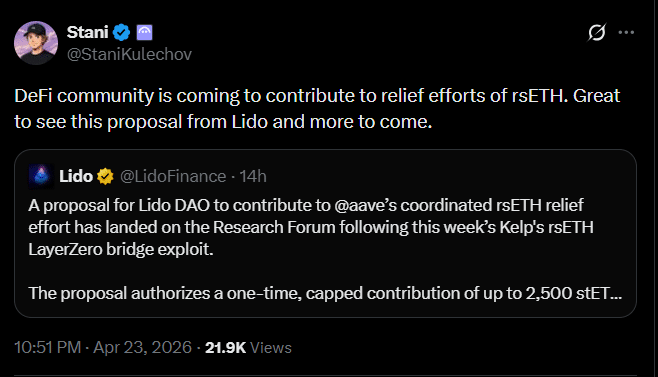
The KelpDAO exploit pushed Lido DAO to step in with a recovery proposal, but under strict conditions. Lido plans to contribute up to 2,500 stETH, yet only if the full recovery plan is funded.
This all or nothing approach aims to avoid partial fixes that leave users exposed. In simple terms, if the full gap is not covered, Lido will not release funds.
As Stani Kulechov noted in a public statement, “DeFi community is coming to contribute to relief efforts of rsETH… great to see this proposal from Lido and more to come.” This response reflects growing coordination but also highlights rising DeFi risks.
Inside the Governance Process and Fund Flow
The KelpDAO exploit response also sheds light on governance mechanics. The proposal will go through an on-chain vote using Aragon. If approved, the fund transfer will follow a strict path.
Assets will move from the Lido DAO Agent to the Lido Labs Foundation multisig. From there, the funds must be sent to a dedicated relief vehicle. The transaction must be publicly confirmed within 48 hours.
Any unused portion will return to the DAO. This structured approach improves transparency and helps reduce DeFi risks tied to fund management.
What the Relief Plan Covers and What It Does Not
The KelpDAO exploit revealed a focused recovery strategy. Lido’s funds will only address the rsETH backing deficit, which sits at the center of the crisis.
The proposal clearly avoids covering health factors, secondary losses, or liquidation damage. This narrow scope ensures resources target the root issue rather than spreading thin.
Data shared in this analysis shows the total deficit exceeds 100,000 ETH. This scale explains why multiple contributors are needed and why DeFi risks grow in interconnected systems.

EarnETH Exposure Shows Why Full Recovery Matters
The KelpDAO exploit has also affected products linked to rsETH, including the EarnETH vault. This system relies on stable collateral to function smoothly.
Due to the imbalance, users may face forced liquidations. Losses in this vault alone could reach around 9,000 ETH if the issue remains unresolved. This highlights how serious the situation has become.
It also shows how DeFi risks extend beyond one platform. When one part fails, others feel the pressure almost immediately.
Conclusion
The KelpDAO exploit now stands as a critical moment for decentralized finance. It reveals both the strength and fragility of a system built on shared trust.
Lido’s strict conditions signal a shift toward disciplined recovery efforts. Full solutions matter more than quick fixes. As the ecosystem responds, attention turns to stronger safeguards and smarter design.
The path ahead remains uncertain, but one lesson is clear. Managing DeFi risks will shape the future of crypto markets.
Glossary of Key Terms
DeFi: Financial services built on blockchain without central control.
rsETH: A token backed by staked Ethereum used in DeFi systems.
stETH: A liquid staking token issued by Lido representing staked ETH.
Bad Debt: Losses that occur when loans cannot be repaid.
Bridge Exploit: A security breach in systems connecting blockchains.
FAQs About KelpDAO Exploit
What is the KelpDAO exploit?
The KelpDAO exploit is a bridge breach that created unbacked rsETH, causing losses across DeFi platforms.
Why is Lido’s contribution conditional?
Lido will only contribute if the full recovery plan is funded to avoid incomplete solutions.
How did the exploit affect Aave?
It created large bad debt because rsETH used as collateral lost its real backing.
What are the main DeFi risks highlighted?
The event exposed risks in bridge security, collateral systems, and interconnected platforms.