

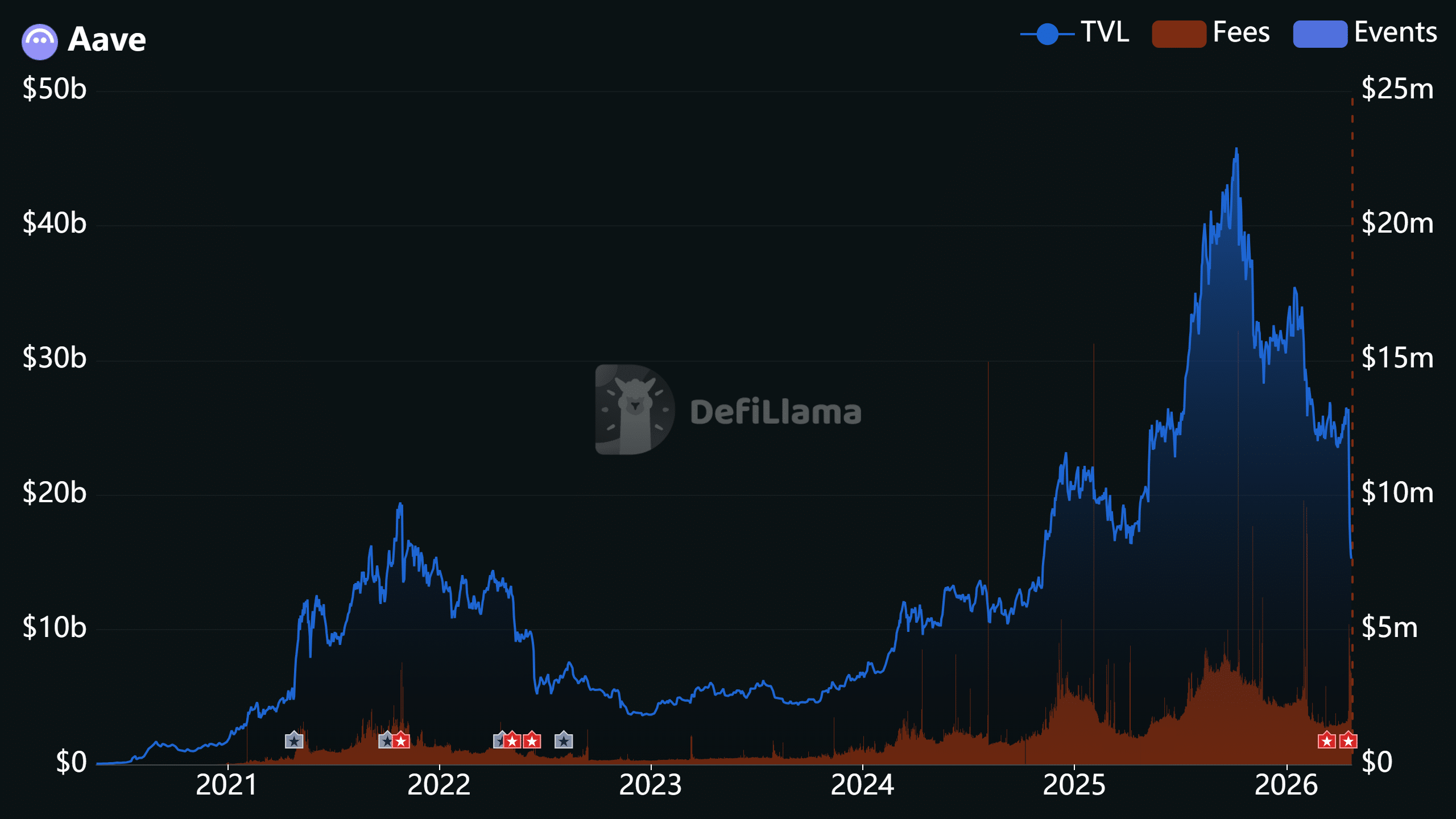
Aave outflows have surged to $15 billion, raising fresh concerns about DeFi risks and testing confidence across both crypto markets and Wall Street. What seemed like steady growth now faces a sudden reality check.
According to the source, the Kelp DAO $293M exploit exposed deep weaknesses in decentralized finance. This event did not stay isolated. It spread pressure across the ecosystem, showing how fast DeFi risks can turn into system-wide stress.
The Exploit That Turned Into a System Shock
The crisis began when attackers minted 116.5K rsETH out of thin air and used it as worthless collateral. With this fake backing, they borrowed more than $190 million worth of assets, including Wrapped Ethereum (WETH), from Aave.
This was not a simple hack. It was a structural failure. The protocol could not detect the invalid collateral in time. As a result, Aave was left holding over $200 million in bad debt, turning a technical loophole into a direct financial threat.
Recent data shows over $600 million lost to hacks in just sixty days, as highlighted in this blockchain analytics dataset. These repeated events continue to amplify DeFi risks across platforms.
Aave Outflows Reveal More Than Panic
The sharp rise in Aave outflows is not just about fear. It reflects deeper concerns about DeFi risks and systemic exposure. Investors rushed to withdraw funds, but the pattern also points to DeFi contagion, where one failure spreads across protocols.
Liquidity leaving the system weakens lending activity. It reduces confidence and slows recovery. Analysts warn that such conditions often signal stress beneath the surface, not just short-term panic.
A recent digital asset risk study notes that large-scale withdrawals often follow trust breakdowns, especially when collateral systems fail.
Wall Street Slows as DeFi Risks Enter the Spotlight
Institutional momentum in blockchain has not stopped, but it has slowed. Firms like BlackRock, Fidelity Investments, and Franklin Templeton were early adopters of tokenized assets. Others, including Morgan Stanley, New York Stock Exchange, Nasdaq, and JPMorgan Chase, are now exploring the same path.
The tokenized market has grown from $5 billion in 2024 to $30 billion today, marking a 6x increase. Projections suggest it could reach $2 trillion by 2028, showing strong long-term potential.
However, a key concern remains. Many of these systems rely on the same blockchain bridges currently being exploited. This overlap increases DeFi risks and forces institutions to rethink their strategies.
Research analyst Andrew Moss noted that firms are unlikely to abandon crypto, but expansion plans may slow as risk assessments take priority.
Aave Outflows and the Future of DeFi Trust
The surge in Aave outflows highlights a simple reality. Trust moves faster than technology. When confidence drops, liquidity follows quickly.
Still, this moment may lead to stronger systems. Developers are now under pressure to improve security, refine collateral checks, and reduce exposure to hidden vulnerabilities. These steps are essential to manage rising DeFi risks.
The road ahead may be slower, but it is not closed. Institutional players are expected to stay engaged, though with greater caution and deeper scrutiny.

Conclusion
Aave outflows is not just a mere statistic, it becomes a signal. They demonstrate the fragility of confidence when unchecked DeFi risks abound. Wall Street and crypto platforms are rethinking assumptions in the wake of the latest shock, at Kelp DAO, a $293M exploit.
The timing of that next phase will depend on how fast the industry is able to adjust. Enhancing protections, improving transparency and tapping more sophisticated risk models will help restore trust. And without that, stasis may shape the future more than invention.
Glossary of Key Terms
Aave outflows: The total funds withdrawn from Aave during a specific period.
DeFi risks: Threats in decentralized finance, including hacks and system flaws.
rsETH: A token linked to staked Ethereum, used as collateral in DeFi.
Bad debt: Loans that cannot be recovered due to failed collateral.
Tokenization: Converting real-world assets into blockchain-based tokens.
FAQs About Aave Outflows
What caused the recent Aave outflows?
A major exploit used fake rsETH collateral to borrow real assets, triggering panic and withdrawals.
Why are DeFi risks increasing now?
Hackers are exploiting complex systems like collateral models and blockchain bridges.
Will Wall Street stop investing in crypto?
No, but firms may slow down and reassess risks before expanding further.
What is the future of tokenized assets?
Growth remains strong, but security concerns may delay large-scale adoption.