

Kelp DAO rsETH recovery entered a critical stage after Kelp DAO and Aave completed the burn of 17,132 rsETH tied to the April 18 exploit. The move marked a major recovery milestone since the incident disrupted withdrawals and cross-chain operations across the ecosystem. Aave’s DeFi United initiative also raised 137,000 ETH valued at nearly $317 million to support stabilization efforts and address the liquidity shortfall created after the exploit.
- How is Kelp DAO rsETH recovery reshaping protocol operations?
- What role did Aave play in the stabilization effort?
- What security upgrades were introduced after the exploit?
- Why does the market remain cautious despite recovery progress?
- What comes next for withdrawals and ecosystem activity?
- Conclusion
- Glossary
- Frequently Asked Questions About Kelp DAO rsETH Recovery
Kelp DAO stated that rsETH on both Mainnet and Layer 2 networks remained fully backed throughout the recovery process despite the exploit-related disruptions. The protocols are now preparing to gradually restore withdrawals, deposits, redemptions, claims, and bridging operations over the coming days Despite the operational progress, liquidity conditions remain below pre-exploit levels, reflecting continued caution among decentralized finance participants.
How is Kelp DAO rsETH recovery reshaping protocol operations?
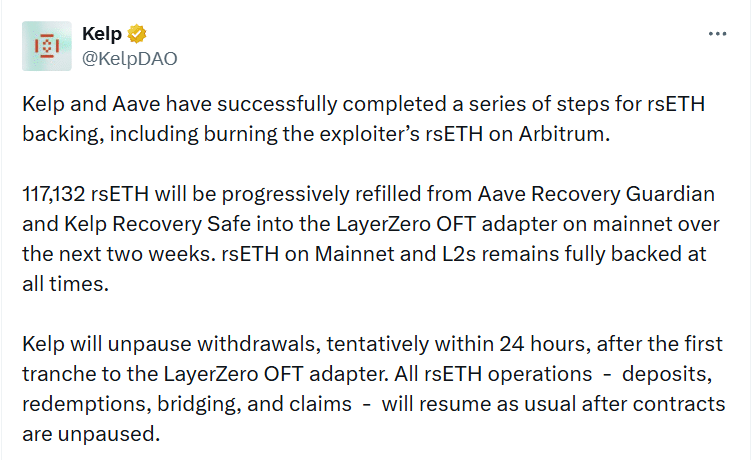
Kelp DAO rsETH recovery focuses on restoring rsETH functionality while strengthening infrastructure after the exploit disrupted ecosystem activity in April. The latest recovery phase involved burning the exploiter’s 17,132 rsETH on Arbitrum. Following the burn, Kelp DAO confirmed that rsETH liquidity would be progressively replenished through the Aave Recovery Guardian and Kelp Recovery Safe. The refill process into the LayerZero OFT adapter on Mainnet is expected to continue over the next two weeks.
Withdrawals from rsETH into ETH are expected to resume within 24 hours after the first tranche is routed through the adapter. The protocols also stated that deposits, bridging, claims, and redemptions would gradually reopen once contracts are unpaused. The phased reopening process means some ecosystem operations may continue stabilizing over the coming weeks as liquidity is progressively restored.
What role did Aave play in the stabilization effort?
Aave became one of the central participants in the recovery process through liquidity coordination and technical support initiatives. The protocol launched DeFi United after the exploit to help support affected ecosystem operations. The initiative raised 137,000 ETH worth nearly $317 million to address the shortfall linked to the exploit.
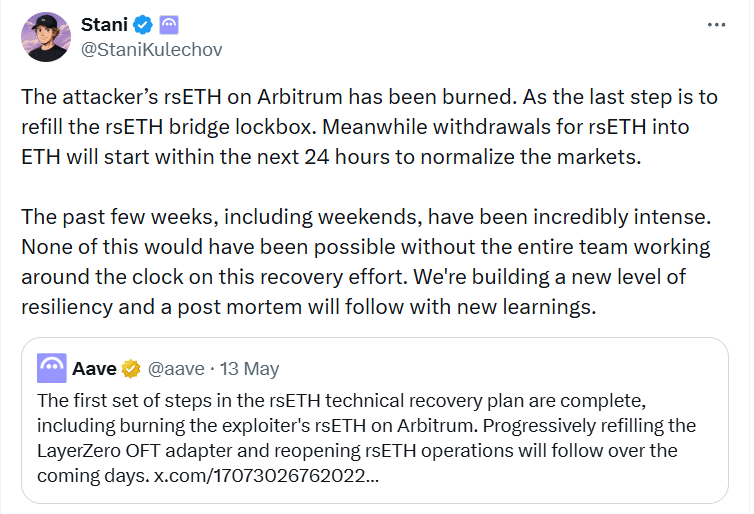
Aave founder and CEO Stani Kulechov said the teams had been working continuously to build “a new level of resiliency” during the recovery process. Aave also confirmed that the initial steps of the technical restoration plan had been completed successfully, including the Arbitrum burn event tied to the exploiter’s holdings.
What security upgrades were introduced after the exploit?
The protocols implemented several security changes as part of the broader Kelp DAO rsETH recovery effort. Kelp DAO stated that it completed a security hardening process across all LayerZero bridging configurations. Verification requirements were increased to four independent attestors as part of the update. Block confirmations were also raised from 42 to 64. In addition, all L2-to-L2 routes were deprecated to reduce cross-chain exposure risks.
The protocol confirmed that these updated security configurations were audited by BailSec before implementation. Kelp DAO is also preparing a migration toward CCIP infrastructure to strengthen cross-chain bridging security further. The security measures are intended to reduce operational vulnerabilities following the exploit while supporting the gradual reopening of ecosystem functions.
Why does the market remain cautious despite recovery progress?
Market conditions have stabilized compared with the immediate aftermath of the exploit, but investor sentiment remains restrained. Total deposits on Aave stood near $27.8 billion at press time. That remains significantly below the nearly $45 billion recorded before the exploit disrupted the ecosystem. At the same time, stablecoin supply on Aave recovered from around $7.3 billion to approximately $8.7 billion, representing an increase of more than $1.4 billion during the recovery period.
While the protocols have restored key functions, investor confidence has not fully recovered. Market participants continue monitoring whether liquidity levels and user activity can return to pre-exploit conditions. The cautious market approach also reflects concerns around how quickly cross-chain operations and liquidity depth can normalize during the phased restoration process.
What comes next for withdrawals and ecosystem activity?
The next stage of Kelp DAO rsETH recovery will focus on progressively reopening ecosystem functionality while maintaining liquidity backing. Kelp DAO reiterated that rsETH across Mainnet and Layer 2 environments remains fully backed during the restoration process.

The first phase is expected to prioritize withdrawals before broader functionality resumes. The LayerZero OFT adapter refill process will continue gradually over the next two weeks. Deposits, claims, bridging services, and redemptions are also expected to resume in phases after contracts are unpaused.
Conclusion
Kelp DAO rsETH recovery has become a major test of how decentralized finance protocols respond to large-scale security incidents while attempting to preserve liquidity stability. The coordinated burn of 17,132 rsETH and the recovery support initiative represent major steps in the stabilization effort following the exploit.
However, market conditions remain below pre-exploit levels and liquidity recovery is still ongoing. Whether confidence fully returns will likely depend on how smoothly withdrawals, liquidity restoration, and cross-chain operations resume in the coming weeks.
Glossary
Kelp DAO: An Ethereum liquid restaking platform.
rsETH: A restaked Ethereum-backed liquid token.
Aave: A decentralized crypto lending protocol.
DeFi United: A recovery initiative supporting post-exploit stabilization.
Arbitrum: An Ethereum Layer 2 scaling network.
Frequently Asked Questions About Kelp DAO rsETH Recovery
Why did Kelp DAO and Aave burn 17,132 rsETH?
They burned the exploiter’s rsETH to help stabilize the protocol and support recovery efforts.
When will rsETH withdrawals resume?
Withdrawals are expected to resume after the first refill tranche reaches the LayerZero adapter.
How much funding was raised for the recovery?
DeFi United raised 137,000 ETH worth about $317 million for stabilization efforts.
What security upgrades were added after the exploit?
The protocols added stronger verification rules, higher confirmations, and updated bridge protections.
What services will reopen during recovery?
Withdrawals, deposits, bridging, claims, and redemptions are expected to reopen in phases.