

AI impact on jobs is increasingly shaping labour market realities, as fresh U.S. employment data highlights a widening disconnect between technological promise and actual hiring outcomes. In March, the U.S. economy added 178,000 jobs, showing little movement from the previous month.
- What does AI impact on jobs reveal about current labour trends?
- Why is AI impact on jobs limiting entry-level opportunities?
- Is AI impact on jobs leading to measurable job losses?
- Why does tech optimism still persist?
- Are rising job openings masking deeper hiring issues?
- How is AI changing day-to-day work for employees?
- Why is there a divide between leaders and workers?
- What policy discussions are emerging around AI?
- Conclusion
- Glossary
- Frequently Asked Questions About AI Impact on Jobs
The numbers reflect a labour market navigating policy uncertainty, rising energy costs tied to geopolitical tensions, and the growing influence of artificial intelligence on workforce demand. Further insights from labour data and industry research reveal that while AI adoption is accelerating across businesses, its effect on hiring, productivity, and job quality remains uneven and, in some cases, disruptive.
What does AI impact on jobs reveal about current labour trends?
The latest labour data draws a sharp contrast between where jobs are being created and where expectations were set. Hiring gains remained concentrated in traditional sectors. Healthcare alone accounted for 76,000 new roles in March. Construction followed with 26,000 additions, while transportation and warehousing contributed 21,000. Social assistance roles rose by 14,000.

In comparison, technology-linked employment failed to keep pace. Computer systems design and related services shed 13,000 jobs. Roles tied to computing infrastructure declined by 1,500, reflecting little to no growth. This divergence underscores a key shift. AI impact on jobs is not yet translating into meaningful hiring strength within the very sectors leading its adoption.
Why is AI impact on jobs limiting entry-level opportunities?
The decline in early-career hiring is one of the most visible shifts. A 2025 SignalFire study stated that new graduate hiring has dropped 50% compared to pre-pandemic levels. It noted, “The door to tech once swung wide open for new grads. Today, it’s barely cracked.”
Firms are operating with smaller teams and fewer graduate programs. Automation tools are increasingly replacing junior-level tasks. As a result AI impact on jobs is narrowing entry points into the workforce. raising concerns about long-term talent pipelines.
Is AI impact on jobs leading to measurable job losses?
Data suggests that the impact goes beyond hiring slowdowns. Goldman Sachs research indicates that AI has actually axed 16,000 jobs per month over the past year. This reflects both direct displacement and reduced hiring demand.
The same research warned that displaced workers often shift into lower-skilled roles a trend that can weaken long-term earnings potential. AI impact on jobs is changing roles and career paths.
Why does tech optimism still persist?
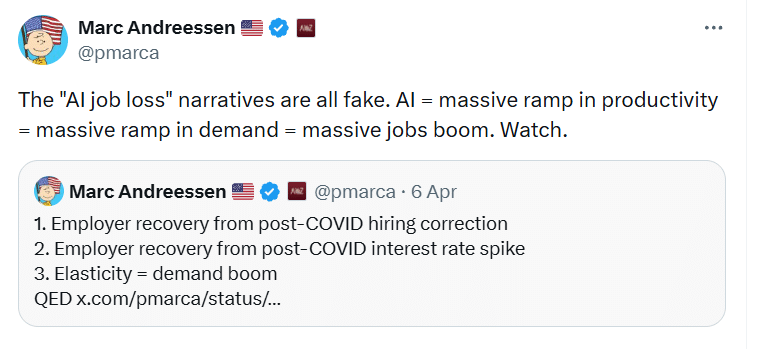
Despite labour market signals strong optimism remains among influential voices. On March 6, venture capitalist Marc Andreessen dismissed concerns, stating on X that fears around AI job losses were “overblown.” He pointed to data showing tech job openings have doubled to 67,000 since 2023.
However openings have not translated into hiring. Labour data shows that tech employment either declined or remained flat during the same period. This divide highlights how AI impact on jobs is being interpreted differently by market participants and real-world data.
Are rising job openings masking deeper hiring issues?
The contrast between vacancies and actual hiring reveals a deeper structural shift. Tech job listings rise, but employment data reveals a gap as firms post roles amid AI-led restructuring.
Block exemplifies this by slashing 4,000 jobs to pivot toward AI efficiency. This pattern indicates AI’s job impact curbs hiring needs even when demand appears robust.
How is AI changing day-to-day work for employees?
Worker experience reflects growing friction rather than seamless efficiency. A Mercer study found that 43% of employees report increased frustration due to AI tools. A Workday report noted that for every 10 hours saved nearly four hours are spent correcting AI outputs.
Harvard Business Review researchers described a phenomenon called “workslop,” where AI-generated content appears polished but lacks substance. Around 41% of workers encounter such outputs leading to nearly two hours of rework per instance.
Brian Solis, head of global innovation at ServiceNow, described this burden as an “AI tax,” stating it leads to “More checking. More rework. More anxiety. Faster pace. AI slop. Less trust.” In this sense AI impact on jobs is affecting not only employment levels but also workplace efficiency and morale.
Why is there a divide between leaders and workers?
The difference lies in how AI is being used across organizational levels. Senior leaders typically use AI for high-level synthesis, strategy, and decision support areas where the technology performs well.
Frontline workers, however deal with complex workflows and tasks that require consistent accuracy. In these environments AI often introduces errors and inefficiencies. This gap shows why AI impact on jobs looks positive to executives but feels difficult in everyday work.
What policy discussions are emerging around AI?
The growing disconnect has triggered early policy considerations. OpenAI has acknowledged the labour implications of its technology and proposed initial ideas to address them. These steps include wider healthcare support stronger retirement systems and new industrial policies.

The company said these ideas are still early and meant to start a wider discussion. It also warned that if policy does not evolve alongside technology existing support systems may fall behind.
Conclusion
AI impact on Jobs defines a critical labor market phase where growth expectations clash with tangible disruptions. Hiring slowdowns, fewer entry-level roles, and growing workplace inefficiencies signal a complex transition not a simple productivity surge.
Yet sustained investment and executive optimism point to deeper AI adoption. Outcomes hinge on managing workforce shifts and institutional adaptation speed.
Glossary
Job displacement: Jobs lost due to automation, tech, or restructuring.
Workforce automation: AI or machines doing tasks humans used to do.
Productivity gap: Difference between expected AI gains and real results.
Occupational downgrading: Moving to lower-skilled after displacement.
Labour market: Place where people get jobs and employers hire workers.
Frequently Asked Questions About AI Impact on Jobs
Is AI affecting jobs in the US?
Yes AI is affecting jobs in the US by changing hiring patterns and reducing some roles.
Which sectors are hiring the most?
Healthcare, construction, transport, and social services are hiring the most.
Why are companies using AI more?
Companies use AI to save time, reduce costs, and improve efficiency.
Does AI always improve productivity?
No AI does not always improve productivity because it can also cause mistakes and extra work.
Will AI change future jobs?
Yes, AI will continue to change jobs and may reshape many careers in the future.