
Uniswap price prediction discussions are gaining momentum after Standard Chartered issued one of the boldest forecasts seen in the decentralized finance sector. The banking giant believes UNI could surge nearly 3,400% from current levels and reach $100 by the end of 2030. While crypto markets often witness ambitious projections, this forecast is drawing attention because it is rooted in a broader transformation of financial markets rather than short-term speculation.
- A Powerful Rally Signals More Than Market Hype
- Uniswap Price Prediction Gains Strength From Rising Network Utility
- Why Tokenized Assets Could Transform Uniswap’s Future
- Why Wall Street May View Uniswap as Financial Infrastructure
- Institutional Adoption and Liquidity Could Fuel the Next Chapter
- Conclusion
- Glossary of Key Terms
- FAQs About Uniswap price prediction
According to the source, Standard Chartered views Uniswap as a major beneficiary of the growing shift toward tokenized real-world assets. As traditional finance increasingly explores blockchain technology, the latest Uniswap price prediction reflects a belief that decentralized infrastructure could play a larger role in global markets over the coming years.
A Powerful Rally Signals More Than Market Hype
Geoff Kendrick, Standard Chartered’s Global Head of Digital Assets Research, expects UNI to reach $6.50 by the end of this year. Although the $100 target has captured most headlines, the near-term forecast suggests institutional participation in decentralized finance may already be accelerating.
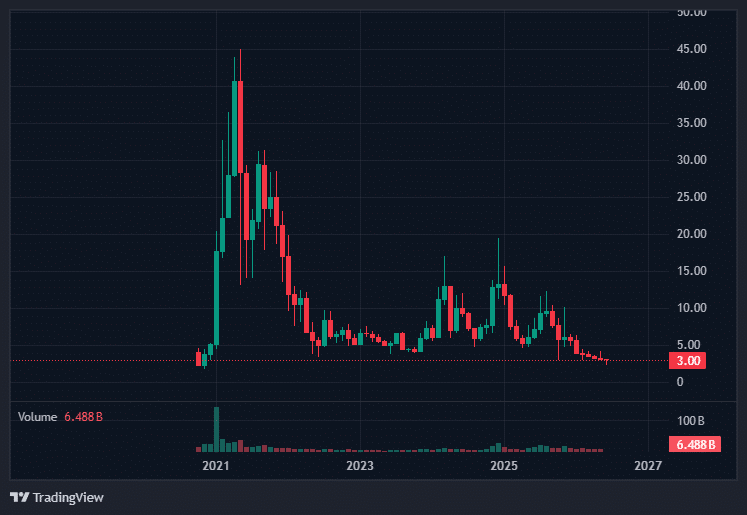
According to verified data, UNI recently climbed 15.53% to approximately $3.00, while its 24-hour trading volume surged more than 268% to around $321.8 million. Notably, UNI significantly outperformed both a relatively flat broader crypto market and a largely stagnant Bitcoin during the same period. The strong performance highlighted growing investor interest in decentralized finance, with rising trading activity signaling increased engagement with the Uniswap ecosystem rather than a broader market-wide rally.
The rally also coincided with a rising Altcoin Season Index, which suggested capital was gradually rotating away from Bitcoin and into alternative digital assets. These conditions often create opportunities for DeFi-focused projects. As a result, the latest UNI forecast has gained traction among market participants.
Uniswap Price Prediction Gains Strength From Rising Network Utility
The surge in trading volume did more than boost market sentiment. Rising decentralized exchange activity is often viewed as a sign of growing protocol utility because it reflects more users actively trading, swapping assets, and providing liquidity within the ecosystem.
For investors and analysts, increased DEX volume serves as a real-world indicator that a platform is being used rather than simply traded as a speculative asset. This organic growth in network activity has become an important factor supporting the current Uniswap price prediction and the broader UNI forecast.

Why Tokenized Assets Could Transform Uniswap’s Future
The foundation of Standard Chartered’s thesis centers on tokenized real-world assets. The bank believes stocks, bonds, funds, and other traditional financial products will increasingly migrate onto blockchain networks over the next decade.
Supporting this view, Citigroup has estimated that tokenized assets could reach $5.5 trillion by 2030, with projections ranging between $2.7 trillion and $8.2 trillion depending on adoption and regulation. As more assets move on-chain, decentralized exchanges could capture a growing share of global trading activity. This expectation remains central to the latest Uniswap price prediction and long-term UNI forecast.
Why Wall Street May View Uniswap as Financial Infrastructure
Kendrick argues that Uniswap should be viewed as infrastructure rather than a retail trading application. To illustrate the point, he compared Uniswap to YouTube and Coinbase to Netflix. In this analogy, Uniswap provides the underlying network while others build consumer-facing experiences on top of it.
Importantly, Kendrick noted that Uniswap can support tokenized assets without requiring major changes to its core framework. This matters because institutions typically prefer infrastructure that is proven, stable, and already operating at scale.
As Kendrick explained, “Uniswap should be viewed less as a retail DEX app and more as market infrastructure that TradFi can integrate with once tokenized assets scale.” That perspective has become a key pillar behind the latest UNI forecast.
Institutional Adoption and Liquidity Could Fuel the Next Chapter
Signs of institutional engagement are already beginning to emerge. Fidelity Digital Dollar recently added liquidity to both Curve Finance and Uniswap. On-chain analyst LytninCrypto described the move as Fidelity’s first known step into permissionless decentralized finance, offering a glimpse into how traditional financial firms may begin interacting with open blockchain ecosystems.
Standard Chartered estimates that as much as $2.7 trillion could eventually flow into decentralized finance protocols. If that occurs, capital within Uniswap’s liquidity pools could increase roughly 37-fold from current levels. The bank believes this opportunity could expand further as trillions of dollars in U.S. Treasuries, corporate bonds, and equity funds transition onto public ledgers.
Meanwhile, Uniswap’s upcoming UNIfication upgrade could increase token burns as activity grows. Combined with a circulating supply that has already declined from one billion to around 895 million tokens, these developments continue to strengthen the long-term Uniswap price prediction outlook.
Conclusion
The latest Uniswap price prediction represents more than a bullish forecast for a single token. It reflects a growing belief that decentralized infrastructure could become a foundational layer of modern finance. Rising network activity, increasing institutional experimentation, deeper liquidity pools, and the expansion of tokenized assets all support Standard Chartered’s thesis.
While competition and regulatory uncertainty remain important risks, Uniswap appears increasingly positioned to benefit from the next phase of blockchain adoption. If Wall Street’s migration on-chain continues, today’s UNI forecast may be remembered as an early signal of a much larger transformation unfolding across global financial markets.
Glossary of Key Terms
Tokenized Assets: Traditional assets such as stocks or bonds represented on a blockchain.
DeFi: Decentralized finance applications that operate without traditional intermediaries.
Liquidity Pool: A collection of digital assets used to facilitate trading on decentralized exchanges.
DEX: A decentralized exchange that enables peer-to-peer crypto trading.
Token Burn: The permanent removal of tokens from circulation to reduce supply.
FAQs About Uniswap price prediction
What is Standard Chartered’s UNI price target?
The bank forecasts UNI could reach $100 by the end of 2030.
Why did UNI outperform Bitcoin recently?
Growing DeFi activity, rising trading volume, and increased investor interest helped UNI outperform a relatively flat Bitcoin market.
Why is trading volume important for Uniswap?
Higher volume often signals stronger protocol utility and greater user activity across the platform.
What role does tokenization play in the forecast?
Standard Chartered believes tokenized stocks, bonds, and funds could drive significant trading activity toward decentralized platforms like Uniswap.