



This article was first published on Deythere.
- A Weak Yen and Strong Dollar Are Squeezing Risk Assets
- Strategy’s Bitcoin Sale Authorization Changes the Conversation
- On-Chain Activity Suggests Buyers are Playing it Safe
- What Traders are Watching Next
- Conclusion
- Glossary
- Frequently Asked Questions About Crypto Markets
- Why is the crypto market falling?
- Did Strategy actually sell Bitcoin?
- Why does a strong dollar hurt Bitcoin?
- Why is Solana outperforming other cryptocurrencies?
- References
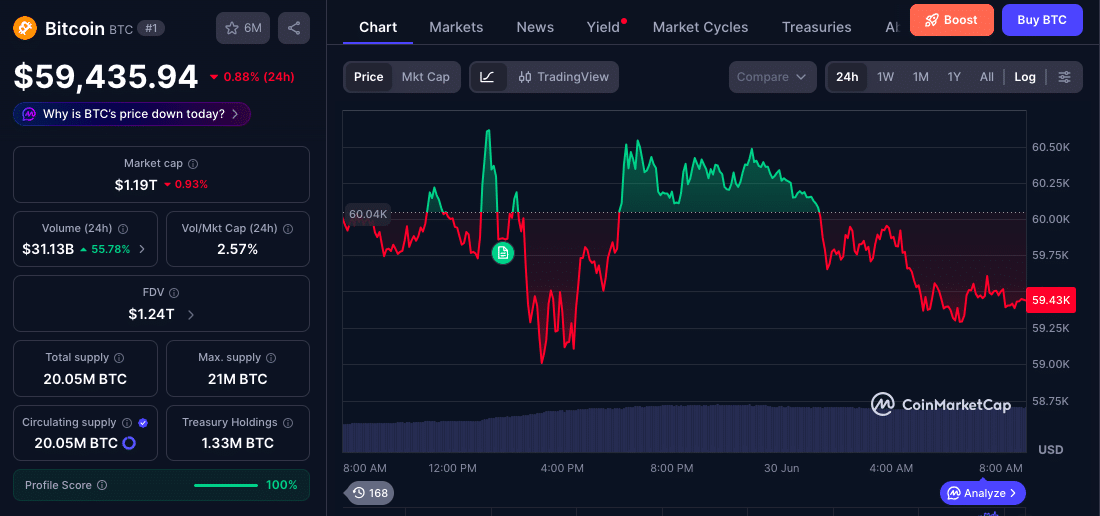
The crypto market slid into the final days of June with even more uncertainty. Bitcoin is stubbornly stuck below $60,000, dragging all the major digital assets down with it. While a strong US dollar and a rapidly collapsing Japanese yen had investors on edge, to say the least, there’s another cause for worry which is the possibility that Strategy could sell up to $1.25 billion worth of Bitcoin.
This has left traders wondering what they need to do next as the whole crypto market seems to be stuck and confidence is at rock bottom.
At press time, Bitcoin was trading around $59,400 after losing around 7% in the space of just a week. The weakness spread across large-cap cryptocurrencies, with Ether falling 8.2% over seven days to around $1,587, XRP declining 7.1% to $1.04, and Dogecoin shedding 11.9% to $0.072. BNB also lost 6.5% during the same period.
Solana was one of the few exceptions. The token gained roughly 3% on the day and 2.9% for the week, changing hands near $74 despite broader market weakness.
A Weak Yen and Strong Dollar Are Squeezing Risk Assets
It is worth noting that this latest crypto market selloff isn’t being driven by a single event.
Currency markets also have a hand in this. The Japanese yen recently weakened beyond ¥162 against the U.S. dollar, its lowest level since 1986.
That has put a lot of pressure on the dollar and tightened up financial conditions for investors round the world.
Historically, a strong dollar creates challenges for Bitcoin and other cryptos, it makes them more expensive for international buyers and sends investors running when it is on the rise.
The concern now extends beyond foreign exchange markets. Analysts are now wondering whether or not the Japanese authorities will step in and try to support the yen. If they do, that could affect global liquidity conditions and potentially disrupt all the borrowing strategies that have helped fund speculative investments for years.
Strategy’s Bitcoin Sale Authorization Changes the Conversation
Another source of caution emerged from Strategy, the company formerly known as MicroStrategy and the largest corporate holder of Bitcoin.
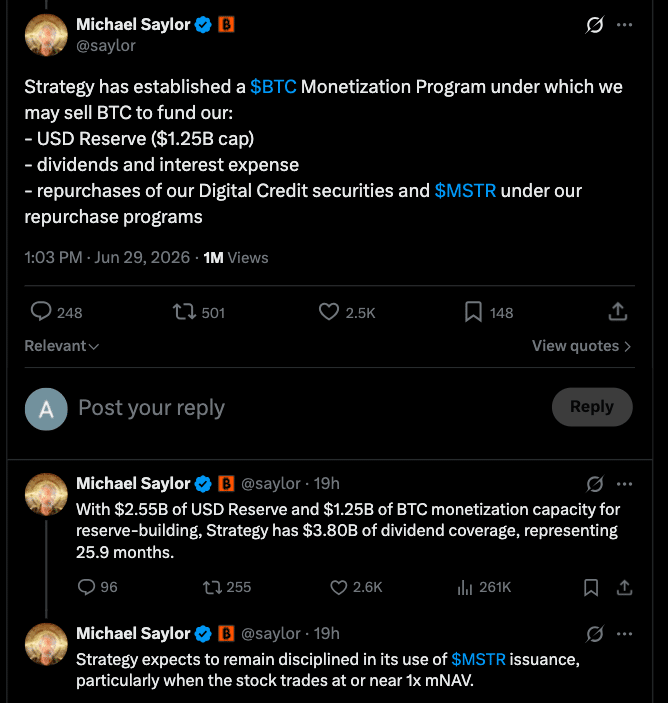
The company has just announced a new capital framework that would see up to $1.25 billion worth of Bitcoin sold off under very specific circumstances. The proceeds can then be used to shore up its cash reserves, pay out dividends, fund share buybacks and improve its overall financial flexibility.
The announcement is a far cry from what the firm’s Executive Chairman Michael Saylor has been saying for years i.e. that Bitcoin should never be sold off.
Strategy emphasized that Bitcoin remains its primary treasury reserve asset and that any sales would be limited to defined corporate purposes. Still, the mere possibility of a large seller entering the market has created uncertainty.
This is because Strategy currently owns more than 847,000 BTC, making what they do very relevant to market sentiment. The firm has also recently announced a change in focus towards keeping $2.55 billion in cash while authorizing up to $2 billion in share repurchases.
On-Chain Activity Suggests Buyers are Playing it Safe
Perhaps the most concerning signal for the crypto market right now is the absence of strong demand.
Numbers from Glassnode show active Bitcoin addresses hovering around 618,000, sitting comfortably within recent ranges rather than expanding during the selloff.
The value transferred across the network remained near $4.2 billion, only slightly above the lower end of its recent range around $3.6 billion.
There’s also the transaction fees which have continued to decline suggesting there isn’t a lot of competition for block space and there’s no real surge in network activity.
All of those metrics point out a market that is not experiencing panic, but also not attracting aggressive dip-buying. Instead, participation appears muted as traders wait for clearer direction.
That lack of enthusiasm is probably the reason why lower prices have not generated the kind of buying pressure that often accompanies major corrections.
What Traders are Watching Next
Bitcoin is still stuck below $60,000, a price point that has a lot of psychological significance. However, there’s no sign of sellers panicking and bailing on their positions.
The next main variables are likely to come from outside crypto itself. Currency markets, U.S. monetary policy expectations, and any response from Japanese authorities could heavily influence risk appetite in the weeks ahead.
Meanwhile, investors are still bent on knowing what Strategy would do next. Although the authorization to sell Bitcoin does not mean immediate liquidation, but it has introduced a new fear into a market already struggling to find momentum.
Right now, there is weak demand, a strong US dollar and the prospect of even more Bitcoin being pumped into the market, all of which are keeping investors cautious.
Conclusion
The latest crypto market price slide is a result of a mix of macro-economic factors and industry-specific concerns.
A strong dollar, a weak yen, and Strategy’s newly approved Bitcoin monetization program have all contributed to a cautious trading environment.
Until demand starts to pick up and Bitcoin gets back above that crucial $60,000 level, traders may remain defensive and play it safe.
Glossary
Crypto Market: The global marketplace where people trade in cryptocurrencies.
On-Chain Activity: Blockchain-based transactions and network usage metrics.
Active Addresses: Wallet addresses that are used to make transactions during a given time.
Bitcoin Treasury Company: A company that holds Bitcoin as a significant reserve asset on its balance sheet.
Liquidity: The ease with which an asset can be bought or sold without significantly affecting its price.
Frequently Asked Questions About Crypto Markets
Why is the crypto market falling?
The crypto market is facing pressure from a stronger U.S. dollar, weak on-chain demand, and concerns surrounding Strategy’s authorization to potentially sell up to $1.25 billion in Bitcoin.
Did Strategy actually sell Bitcoin?
Strategy has authorized future Bitcoin sales under its new capital framework. The company has not announced large-scale sales under the program yet, but the possibility is influencing market sentiment.
Why does a strong dollar hurt Bitcoin?
If the dollar gets stronger, it makes it more expensive for international investors to get their hands on some Bitcoin, which in turn reduces the appetite for taking on risk assets.
Why is Solana outperforming other cryptocurrencies?
Despite broader market weakness, Solana recorded gains during the week, suggesting investors continue to show interest in selected ecosystem-specific opportunities even as overall sentiment remains cautious.