

The Worldcoin price has taken a beating over the past fourteen days, and anyone holding WLD through this stretch knows it has not been pretty. What started as a promising rally above $0.65 in June turned into one of the sharper altcoin drawdowns of the summer, wiping out nearly half the token’s value in two weeks. Buried underneath the red candles and the liquidation charts, though, a few technical clues suggest the worst of the selling pressure could be running out of steam.
A Brutal Two-Week Slide for Worldcoin Price
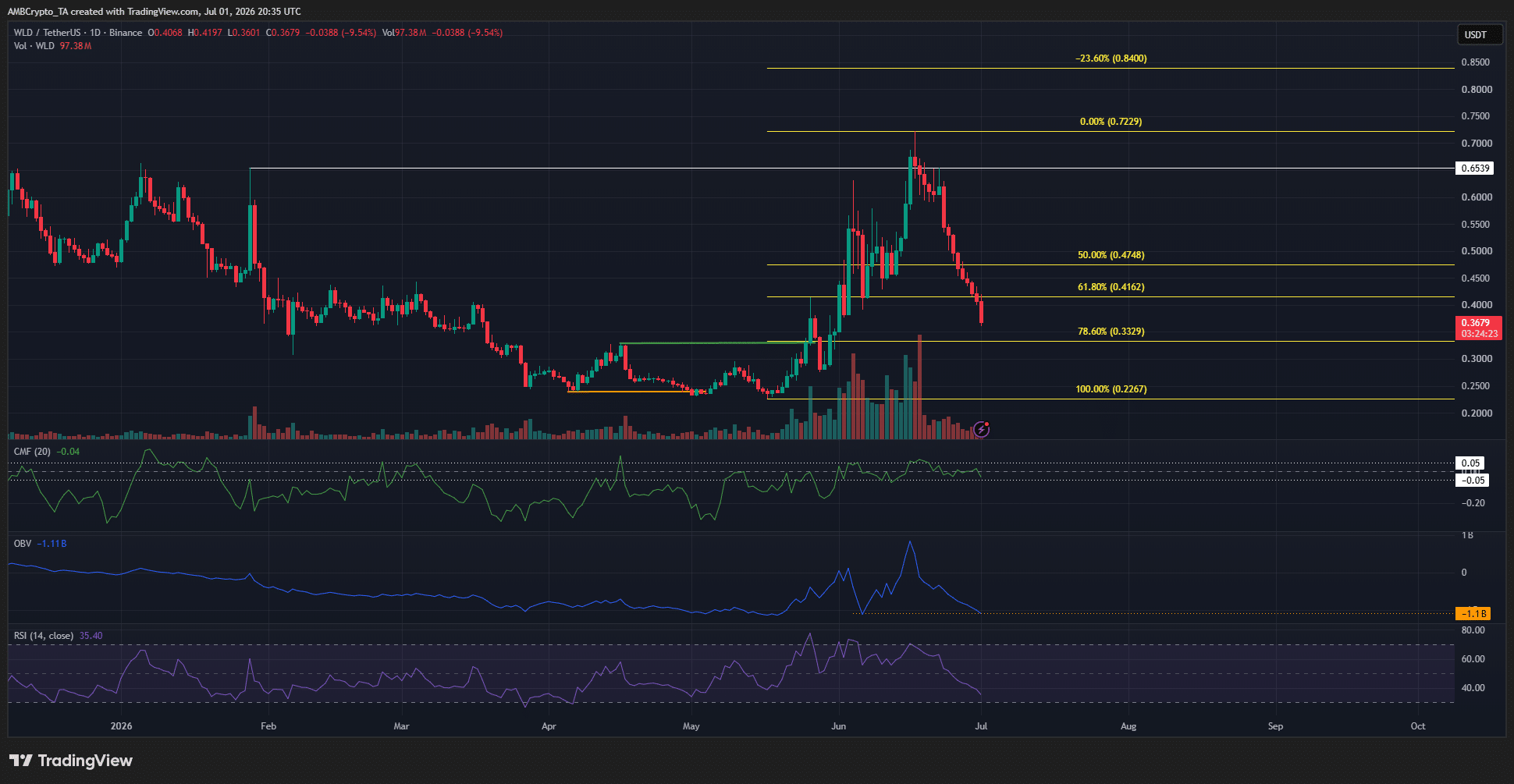
The numbers tell a stark tale as the Worldcoin price dropped from 0.7229 dollars down to 0.3686 dollars, a fall of roughly 49 percent in two weeks. That kind of move is not a typical dip, it is closer to a full-blown flush, the sort that shakes out weak hands and forces even patient holders to second-guess their positions.
Leverage accelerated the damage, on June 30 alone, close to 410 million dollars worth of leveraged positions were liquidated across the crypto market. Worldcoin was not spared, with 8.3 million dollars in WLD positions wiped out, and most of that, about 8.06 million dollars, came from traders who had bet long and got caught leaning the wrong way.
Bitcoin’s Wobble Adds to the Pressure
No altcoin exists in a vacuum, and the Worldcoin price has clearly been dragged around by Bitcoin’s own choppy behavior. Bitcoin slipped to a local low of 57,800 dollars before bouncing to 60,536 dollars, a gain of 4.73 percent that has already started fading, with BTC trading around 60,048 dollars at the time of writing. When the market leader gets shaky, smaller tokens usually feel it first and hardest, and WLD has been no exception.
Reading the Technical Tea Leaves
This is where things get genuinely interesting. Despite the sharp drawdown, the bigger picture trend for Worldcoin price has not broken down. The token has fallen into what chartists call the golden pocket, the zone between the 61.8 percent and 78.6 percent Fibonacci retracement levels. This band is typically where buyers reappear if the underlying uptrend is still alive, sort of like a safety net that catches price before it falls further.
The Relative Strength Index, or RSI, has been sliding toward the oversold threshold near 30, a level that often signals selling has become overextended. On-Balance Volume, a tool tracking buying and selling pressure through volume flow, has revisited its June lows, which looks discouraging on the surface. However, the Chaikin Money Flow, another momentum gauge measuring the intensity of buying versus selling, is hinting at short-term stability even while OBV looks weak. That kind of divergence often shows up right before a trend shifts direction.
Traders should still keep their guard up, if the Chaikin Money Flow drops below negative 0.05, or if OBV breaks its current local low, a bearish continuation becomes far more likely, with 0.333 dollars marked as the next major level to watch.
What the Shorter Timeframe Is Showing
Zooming into the four-hour chart paints a rougher picture as the most recent leg higher, running from 0.416 dollars up to 0.723 dollars, has essentially been erased, and short-term support at 0.416 dollars gave way without much of a fight. Indicators on this timeframe have stayed firmly bearish throughout the correction, a reminder that near-term and structural pictures do not always agree.
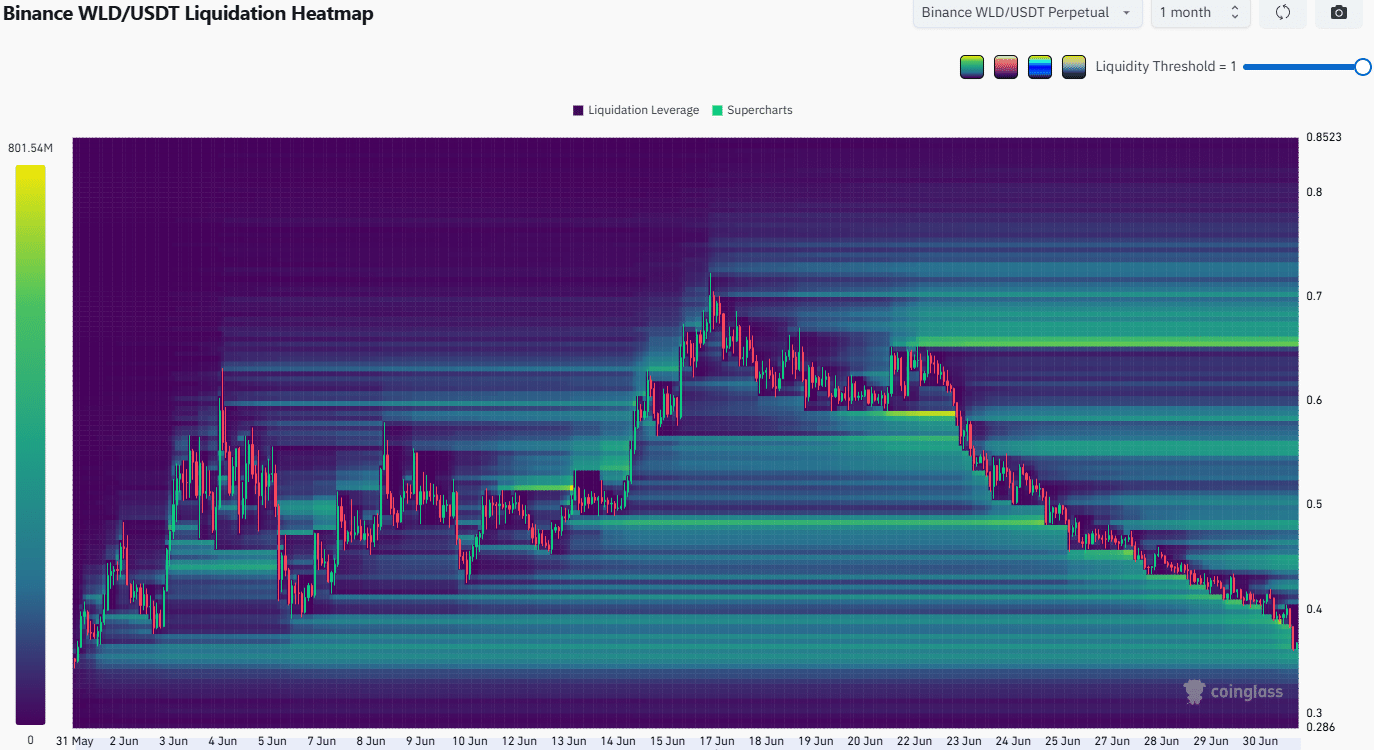
Liquidation heatmap data adds one more layer of context. Most clusters built up over the past month have already been swept clean, and 0.348 dollars now stands out as the next zone likely to attract price action. In plain terms, much of the leveraged fuel that could have pushed the price lower has already been burned through.
Cautious Optimism, Not a Green Light
Taken together, the setup for the Worldcoin price looks cautiously bullish rather than outright bearish, though nobody should mistake that for a guaranteed bounce. A renewed Bitcoin sell-off remains the biggest wildcard, and it could easily drag WLD lower regardless of how clean the token’s own chart looks. Analysts have pointed to a reclaim of 0.416 dollars as the trigger level that would give buyers real conviction to step back in.
Conclusion
The past two weeks have tested the patience of anyone tracking the Worldcoin price, and the scale of the drop caught plenty of traders off guard. Still, the fact that the broader trend structure remains intact, combined with signs of stabilizing money flow and a largely cleared liquidation map, gives bulls a genuine case to make. The next few sessions, particularly how Bitcoin behaves and whether WLD can reclaim key support, will likely decide whether this turns into a recovery or just a pause before more downside.
Frequently Asked Questions
Why did the Worldcoin price drop so sharply?
Heavy liquidations, fading momentum after the June rally, and weakness across the broader crypto market combined to push WLD down nearly 49 percent in two weeks.
What is the golden pocket in trading?
It is the price zone between the 61.8 percent and 78.6 percent Fibonacci retracement levels, often seen as a strong area for buyers to step back in during an uptrend.
What level would confirm a Worldcoin price recovery?
A move back above 0.416 dollars is being watched as the signal that buyers have regained control.
What would signal further downside for WLD?
A drop in the Chaikin Money Flow below negative 0.05, a break of the current OBV low, or a fall under 0.333 dollars would all point toward continued weakness.
Glossary of Key Terms
RSI (Relative Strength Index): A momentum indicator that measures how fast and how far a price has moved, used to spot overbought or oversold conditions.
Fibonacci Retracement: A charting tool that identifies potential support and resistance levels based on key mathematical ratios.
OBV (On-Balance Volume): A volume-based indicator that tracks cumulative buying and selling pressure to gauge trend strength.
CMF (Chaikin Money Flow): An indicator that measures the volume-weighted average of buying and selling pressure over a set period.
Liquidation Heatmap: A visual tool showing where large clusters of leveraged positions are likely to be forced closed, often acting as price magnets.