



This article was first published on Deythere.
- Five Crypto ETFs Now Hold Barely More Than Two Did in 2024
- Bitcoin ETF Inflows Reversed After a Brief April Lift
- Coinbase Premium Signals a Weak US Demand
- Inflation and Geopolitical Risks Keep Investors Playing it Safe
- Conclusion
- Glossary
- Frequently Asked Questions About Bitcoin ETF Inflows
- What are Bitcoin ETF inflows?
- How much has actually left U.S. crypto ETFs since 2025?
- Why are Bitcoin ETF inflows falling?
- What is the Coinbase Premium Index?
- References
The enthusiasm that once pulled billions into U.S. crypto exchange-traded funds is starting to fade away and it seems to be getting worse by the day. New figures show that assets under management across American crypto ETFs have plummeted from their 2025 highs.
Bitcoin ETF inflows have seen the most of this decline. Latest industry data just revealed that June 2026 was the worst month on record for spot Bitcoin ETFs, with almost $4.5 billion in net outflows.
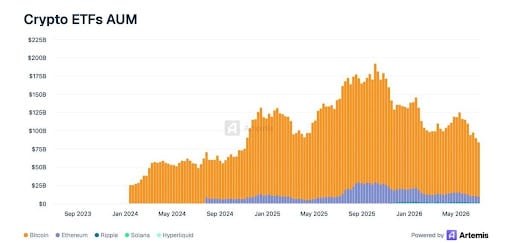
According to Artemis data, U.S. crypto ETF AUM has nosedived from a peak of $191.4 billion in October 2025 to roughly $84 billion today, $107 billion in capital leaving the sector at what is proving to be one of the toughest times for crypto since the 2022 bear market.
Five Crypto ETFs Now Hold Barely More Than Two Did in 2024
One single statistic really shows how much market sentiment has changed.
Just 19 months ago, U.S. crypto ETF assets were made up entirely of ETFs linked to Bitcoin and Ethereum products, together they held around $75.1 billion in assets.
Today, investors have got access to ETFs linked to Bitcoin, Ethereum, XRP, Solana and Hyperliquid. However, despite having three more products on the market, the total AUM is still only around $84 billion.
This meager increase shows just how tough the past few months have been for digital assets. The crypto bear market that kicked off back in October 2025 has wiped out around $2.24 trillion in market capitalization excluding stablecoins.
Rather than expanding, many investors seem to be cutting back on their exposure.
Bitcoin ETF Inflows Reversed After a Brief April Lift
This wasn’t something that just happened overnight.
There was a brief glimmer of hope in April. Bitcoin ETFs started to attract attention that month, as improving sentiment and institutional buying tended to lift sentiment, and reports put the figure at more than $1.7 billion flowing into spot Bitcoin ETFs during April.
However, the momentum didn’t last long. U.S. spot Bitcoin ETFs recorded their second-largest weekly inflow around April 17 but since then, Bitcoin ETF inflows have crashed.
Spot Bitcoin ETFs have been experiencing record redemption streaks during May and June including 13 consecutive sessions of outflows in which more than $4 billion was pulled from the sector.
The result has been unrelenting pressure on both ETF assets and Bitcoin’s market price.
Coinbase Premium Signals a Weak US Demand
Another warning sign comes from the Coinbase Premium Index, a widely watched measure of U.S. investor appetite.
The metric compares Bitcoin prices on Coinbase with prices on offshore exchanges like Binance. When it’s positive, it generally means that US demand is strong and when it is negative, it suggests American buyers are backing off.
According to the latest figures, the seven-day moving average has plummeted to -0.086, with the decline beginning around April 15 and accelerating after April 23.
Market observers have pointed out that a persisting negative Coinbase Premium Index is often a sign that institutional participation is weakening and demand from U.S.-based investors is soft.
Ethereum’s premium index has been following a similar path, while Spot Ethereum ETF inflows have also taken a hit since mid-April.

Inflation and Geopolitical Risks Keep Investors Playing it Safe
Market conditions outside crypto have also contributed to the retreat.
The conflict involving Iran, Israel and the US added to worries about global growth and energy-driven inflation. Higher oil prices also added pressure to consumer prices, making risk assets less attractive.
Report states that U.S. inflation shot up to 4.2%, which is up from 3.8% in April, while the 10-year Treasury note reached 4.68%, its highest level since January 2025.
When government bonds start paying higher returns with a lower risk, a lot of institutional investors tend to pull back on more volatile assets like crypto.
Report has pointed out that lately, investors have been driving more interest in sectors like artificial intelligence and large tech firms over Bitcoin, which is partly why ETF demand has been weakening.
Conclusion
The collapse in Bitcoin ETF inflows is worth noticing because ETFs have become one of the primary links between traditional finance and the crypto markets.
When investors put a lot of money into ETFs, it usually means there’s buying pressure and a more optimistic outlook. Conversely, persistent outflows can send the opposite message.
For now, both ETF flows and demand indicators are sending a cautious message.
For the market to level out during the second half of 2026, it will be a factor of inflation trends, how interest rates are perceived, geopolitical developments and whether institutional investors start to trust digital assets again.
Until then, the $107 billion that has left U.S. crypto ETFs serves as a reminder that traditional investors are still willing to bail when things get too out of hand.
Glossary
AUM: Assets under management held by investment funds.
Bitcoin ETF: A fund that lets you get exposure to Bitcoin through a stock exchange.
Coinbase Premium Index: A metric used to gauge how U.S. Bitcoin demand is doing.
Spot ETF: An ETF that’s backed by the actual asset rather than any derivatives.
Treasury Yield: The return on U.S. government bonds that investors get.
Frequently Asked Questions About Bitcoin ETF Inflows
What are Bitcoin ETF inflows?
Bitcoin ETF inflows are new capital coming into funds that track Bitcoin.
How much has actually left U.S. crypto ETFs since 2025?
Approximately $107 billion has bailed out of U.S. crypto ETF products since the peak in October 2025.
Why are Bitcoin ETF inflows falling?
Higher inflation, rising Treasury yields, the ongoing tensions and weaker investor confidence have all been part of the problem.
What is the Coinbase Premium Index?
It measures the price gap between Bitcoin on Coinbase and other offshore exchanges; a useful tool for tracking how U.S. investor demand is doing.