

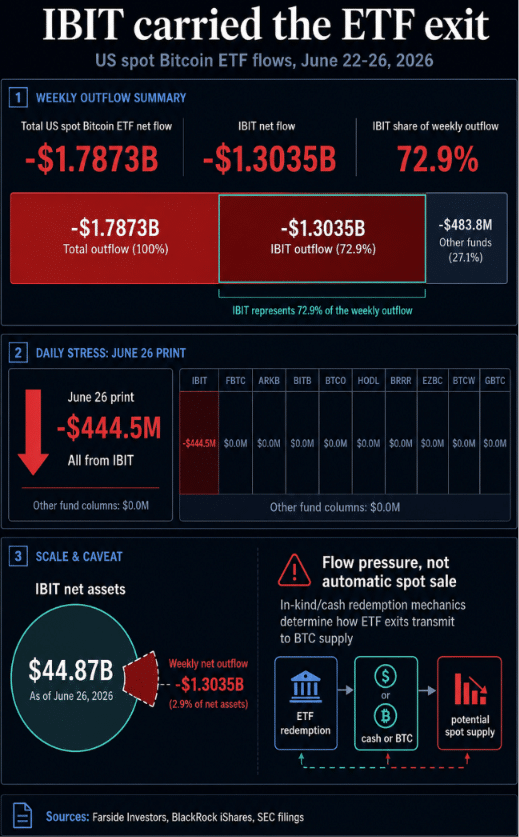
BlackRock’s iShares Bitcoin Trust, long celebrated as the product that finally brought institutional money into Bitcoin, is now showing up in the data as a source of selling pressure at a moment when the market can least afford it. The fund that once validated Bitcoin as a serious asset class for brokerage-account investors recorded $1.30 billion in outflows during the week of June 22 to 26, accounting for nearly 73% of the $1.79 billion that left the entire US spot Bitcoin ETF complex in that same period.
That is not a small footnote. That is a market-structure shift worth paying close attention to.
What the Flow Data Is Actually Saying About Bitcoin ETF Pressure
Bitcoin was hovering around $60,000 during this period, already under pressure from negative 7-day and 30-day performance metrics. Into that fragile setup, the largest Bitcoin ETF in existence posted a $444.5 million outflow on June 26 alone, a figure that represented the entire net outflow across all US spot funds on that trading day.
The concentration matters because IBIT is not just another vehicle in the ETF complex. It is the most visible and liquid regulated access point Bitcoin has through traditional brokerage accounts, which means its redemptions carry a different weight than a smaller fund shedding assets. When a fund with $44.87 billion in net assets logs this kind of exit week, the market cannot quietly absorb it without some price-level consequence.
The early Bitcoin ETF thesis was clean and compelling: regulated access expanded the buyer base, reduced circulating supply through institutional accumulation, and gave Bitcoin a foothold in mainstream portfolios. What the latest flow data introduces is the other side of that equation. The same vehicle that made it easy to buy Bitcoin also makes it straightforward to exit, and at scale, those exits generate real spot-market pressure.
IBIT Dominance Means ETF Outflows Hit Harder Than Usual
Not all Bitcoin ETF outflows are created equal. A smaller fund losing $50 million in a week might not register beyond a line in a data table. IBIT shedding $1.30 billion in five trading sessions reshapes how analysts read institutional sentiment heading into the next recovery attempt.
Think of it like this: if a mid-tier player exits a trade, the market adjusts and moves on. If the biggest player at the table starts reducing exposure, everyone else at the table recalibrates. That is the dynamic currently unfolding around IBIT. Its size was always the reason its inflows mattered so much to the Bitcoin bull narrative. That same size is now the reason its outflows command serious attention.

What This Means for Bitcoin Recovery Around $60,000
The $59,000 to $62,000 range has emerged as the critical band for Bitcoin. Bulls need to reclaim and hold this area convincingly before any meaningful recovery thesis can take shape. The challenge is that sustained Bitcoin ETF redemptions, particularly from the largest fund in the space, translate into ongoing supply-side pressure that non-ETF spot buyers have to absorb without assistance from the institutional demand channel that once powered Bitcoin higher.
There are two plausible interpretations going forward. The first is that the worst of the selling has passed, that IBIT holders who wanted to reduce exposure have already done so, and that a stabilization above $59,000 would confirm absorption. The second is that any price recovery has to climb through continued ETF redemptions before it can gain real traction, making each bounce a heavier lift than the previous one.
Conclusion
The Bitcoin ETF product that defined Bitcoin’s institutional arrival has revealed its double-edged nature. IBIT remains one of the most significant financial products launched in recent years, and nothing about last week’s outflows changes the long-term structural case for Bitcoin. What it does change is the short-term market calculus.
Bulls cannot simply lean on institutional demand as a tailwind while the market’s largest Bitcoin ETF is functioning as a headwind. Watching whether IBIT flows stabilize or continue to bleed will tell observers more about the next directional move than almost any other single data point available right now.
Disclaimer: This article is for informational purposes only and does not constitute financial advice. Cryptocurrency investments carry significant risk, including the possibility of total loss.
FAQs
What is IBIT?
IBIT is BlackRock’s iShares Bitcoin Trust, the largest US spot Bitcoin ETF by assets under management, currently holding $44.87 billion in net assets.
How much did Bitcoin ETF outflows total last week?
US spot Bitcoin ETF products recorded approximately $1.79 billion in net outflows during the week of June 22 to 26, 2026.
Why do IBIT outflows affect Bitcoin prices?
Because IBIT is the largest regulated Bitcoin access point, its redemptions require the broader spot market to absorb displaced exposure, creating downward supply pressure.
Is Bitcoin still above $60,000?
Bitcoin was trading around $59,567, hovering just below the key $60,000 support level with negative weekly and monthly performance.
Glossary of Key Terms
Bitcoin ETF: An exchange-traded fund that holds Bitcoin or tracks its price, allowing investors to gain exposure through traditional brokerage accounts without holding the asset directly.
Net Outflow: The total value of assets that leave a fund when redemptions exceed new investments during a given period.
Spot Bitcoin ETF: A fund that holds actual Bitcoin rather than futures contracts, making its demand and supply dynamics directly relevant to spot market prices.
Redemption: The process by which an investor sells their ETF shares back to the fund, triggering the fund to reduce its holdings accordingly.
Support Level: A price zone where buying interest historically tends to emerge strongly enough to slow or reverse a downtrend, in this case approximately $59,000 to $62,000 for Bitcoin.
Market Structure: The broader framework of how participants, products, and liquidity interact to determine price behavior across a financial market.
Sources