

This article was first published on Deythere.
- Leading Platforms: OpenSea, Blur and Magic Eden
- OpenSea: The All-Purpose Marketplace
- Blur: Pro-Trader Focus and Zero Fees
- Magic Eden: Gaming and Multi-Chain Oriented
- Other Noteworthy Marketplaces
- Platform Features and Fee Structures
- Expert Take: Specialization and Market Maturation
- Conclusion
- Glossary
- Frequently Asked Questions About NFT Marketplaces
- What is an NFT marketplace?
- What are the top NFT marketplaces in 2026?
- What keeps the new NFT marketplaces coming?
- How can beginners choose an NFT marketplace?
- References
NFT marketplaces are online platforms for minting, buying and selling digital collectibles These platforms have experienced massive growth since 2021.
OpenSea, founded in 2017, has continued to dominate the markets with a cumulative trading volume of over $23billion through 2024. However, newer entrants have taken up some of the share.
OpenSea was down to just over 29.7% of all NFT trading volume by mid-2025 as increased competition came from players like Blur and Magic Eden.
In fact, when open-source NFT aggregator Blur (which debuted in 2022), had recorded its 30-day volume to be $520million compared to OpenSea’s $340million. The Solana-origin NFT platform Magic Eden, also scooped $6.39billion in cumulative trades and reached a 37% peak market share over the course of 2024.
The massive figures show the growth of NFT marketplaces. In particular, Blur captured 68.8% of Ethereum NFT volume for trades in 2025 while OpenSea was far behind at only 18.2%. Charting out this growth shows how these leading marketplaces have become a new standard.
OpenSea still lists over 80 million NFTs and draws casual collectors, while Blur has engineered features for “pro traders” (fast trading, bulk buying, advanced charts). Magic Eden also became the go to place for gaming and multi-chain NFTs which pointed to a change in user interest.
Simply put, NFT marketplaces are still the main infrastructure behind digital ownership and 2026 sees this industry maturing with growing levels of diversity.
Leading Platforms: OpenSea, Blur and Magic Eden
OpenSea: The All-Purpose Marketplace
OpenSea is considered the largest NFT marketplace and remains a widely used platform. It supports dozens of blockchains ( Ethereum, Polygon, Arbitrum, Solana and more), covering every single type of NFT ( art, gaming assets, domain names and many more ).
Its ease of use and wide support makes OpenSea a common starting place for new users. Basically, OpenSea lists more than 80million tokens and completes hundreds of thousands transactions every month.
It enforces a 2.5% seller fee (most recently cut to 0.5% on its OpenSea 2.0 Pro plan) and has long enforced creator royalty fees by default.
But OpenSea is not scaling as rapidly as others. OpenSea has continued to be one of the most popular NFT marketplaces, providing a wide range of assets but newer high-performance platforms pose competitive pressure.
Blur and Magic Eden have slowly eaten away at OpenSea’s market share since 2023. Although, it does retain some important benefits such as easy access and a familiar collector-oriented interface. Opensea is strong in terms of breadth, covering more NFT categories / chains than any other marketplace.
It has always been the “default” marketplace for many casual users and artists; easy to use, trusting in its network effects.
Blur: Pro-Trader Focus and Zero Fees
Blur was created particularly for NFT traders and launched in 2022 by Tieshun Roquerre. More than anything, Blur stands for speed and sophistication. It has 0% marketplace fees for the users (the platform rewards a native BLUR token as incentives instead).
The interface emphasizes data: live price charts, advanced filters, and “sweeper” tools to buy entire collections at once.
According to reports, Blur is the premier marketplace for pro NFT traders. Due to its deep liquidity on high-value Ethereum collections, it has therefore become the primary Ethereum NFT venue by volume.
Blur managed around $8.54billion in overall volume during the 2022-2024 period. In 2025, its monthly trading volume frequently doubled OpenSea’s. Blur also incorporated lending (the Blend protocol which provides borrowers with the ability to lend against NFTs) and exclusive rewards (seasonal BLUR token airdrops).
Traders who do not mind a little complexity for profit are drawn to its reliance on token incentives and data-driven design. The issue is that Blur can be confusing for beginners.
Fees are another disadvantage. The platform does not enforce creator royalties above 0.5%, which has drawn criticism from artists.
“We wanted to create a kind of Binance for NFTs,” Blur’s CEO said in 2022, speaking on the ambition to become a one-stop shop for active traders.
For 2026, Blur must maintain that same focus on performance dominance. Now industry experts say that successful platforms are now those that achieve deep liquidity and superior user experience within a specific vertical or ecosystem.
Magic Eden: Gaming and Multi-Chain Oriented
Started in 2021, Magic Eden is the largest NFT Marketplace on Solana. This expanded quickly to also include support for Ethereum, Polygon, Avalanche and also Bitcoin NFTs ( through the Ordinals/Runes scheme). By mid 2024, Magic Eden briefly achieved the status of #1 marketplace globally by volume with over $734million in one month. In fact, Magic Eden integrated deeply into play-to-earn games and saw huge Solana NFT activity (e.g., $212million traded on Solana in May 2024).
Though Magic Eden expanded widely; it ran into challenges. In early 2026, the company announced that it was going to close its Bitcoin and Ethereum marketplaces to focus solely on Solana.
Analysis shows that 85 % of the Magic Eden volume was already on Solana and Bitcoin/Ethereum segments only contributed less than 15%.
Nonetheless, Magic Eden is still big when it comes to Solana NFTs and gaming projects. It has 0% listing fees, and 2% transaction fees on Solana and Bitcoin NFTs (0.5% on EVM chains). Its marketplace is known for low fees and high integrations with games.
Magic Eden ranked first among public markets in terms of Bitcoin NFT trading so far in 2025. So Magic Eden’s journey, the rise and the refocus shows that NFT marketplaces must double down on core audiences and ecosystems to stay relevant.
Other Noteworthy Marketplaces
In addition to these top three, there are several other specialized NFT marketplaces that serve important niches:
Binance NFT Marketplace: This is integrated with Binance, benefitting from its vast user base. It allows minting of Ethereum and Binance Smart Chain NFTs with very low fees (1% trading fee). Since the platform has existing crypto users, Binance NFT is gaining popularity among these users because it is convenient and cheaper compared to rivals.
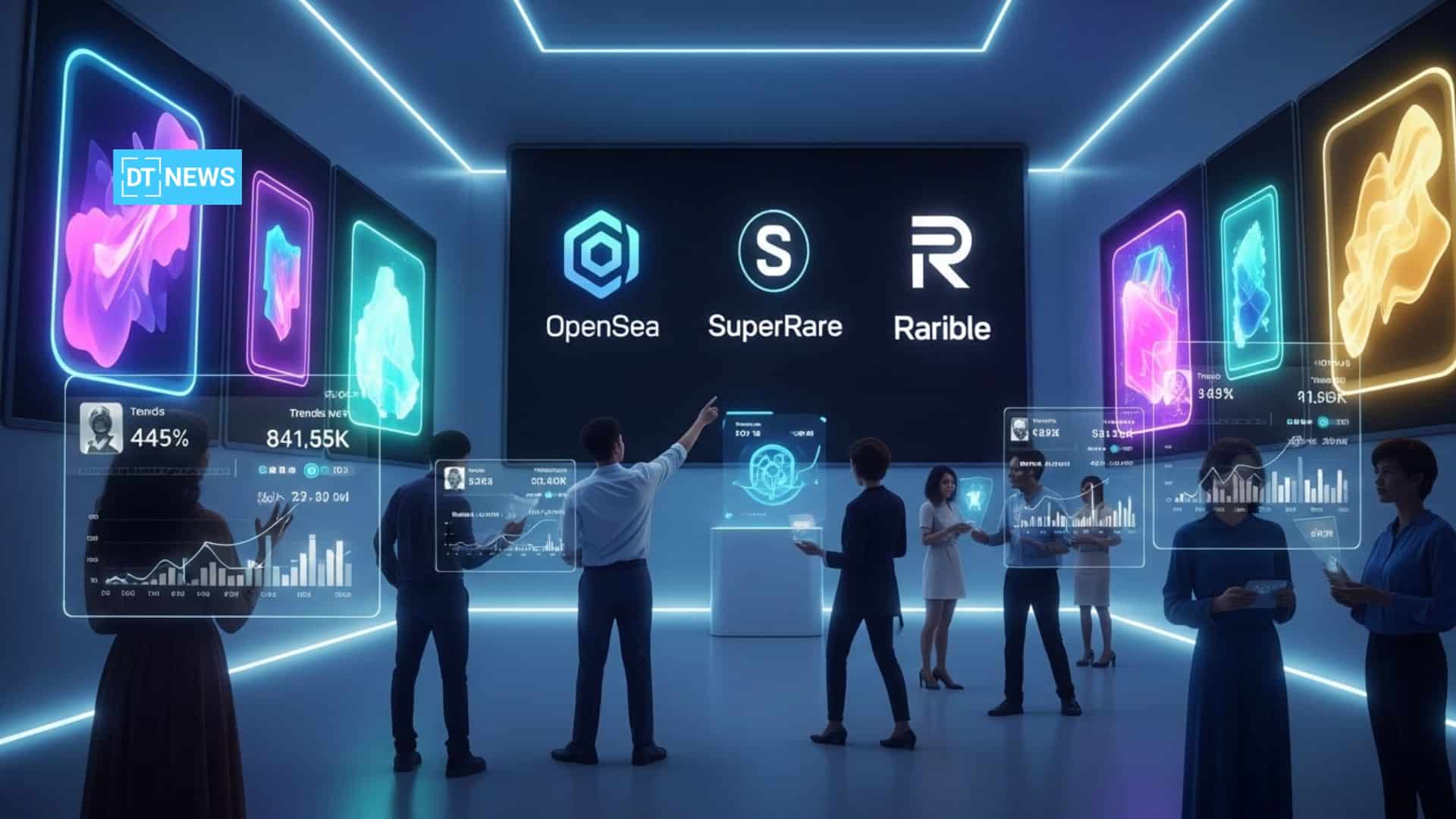
Rarible: A community owned, multi-chain marketplace for NFTs on Ethereum, Polygon and more. Rarible lets anybody mint NFTs and trade them, with an explicit focus on decentralization and tools for creators. It is attractive to artists and collectors who value openness and share of platform governance.
SuperRare: A premium marketplace with an emphasis on high-end digital art. SuperRare is a luxury “gallery” for collectors with only approved artists minting here. It takes a 3% platform fee and enforces creator royalties typically 10%.
LooksRare: A community-oriented Ethereum NFT marketplace that rewards traders with the LOOKS token. LooksRare launched in 2021. It became a template of its own by providing “rewards-based” trading, creating incentives for buying/selling.
These platforms cut across certain strategies: SuperRare for scarcity; Rarible for open minting. They are for artists or collectors with certain needs.
Platform Features and Fee Structures
NFT marketplaces compete not only on overall volume, but fees and features as well. The table below summarizes key points:
| Marketplace | Focus/Chains | Fee Structure | Key Features |
| OpenSea | Multi-chain (Ethereum, Polygon, etc.) | 2.5% seller fee (0.5% on Pro plan) | Broad asset coverage; fiat on-ramps; multi-chain wallet support. |
| Blur | Ethereum (+ Blast L2) | 0% marketplace fee (creators get 0.5%) | Pro-trader tools (floor sweeps, analytics); token rewards (BLUR). |
| Magic Eden | Solana (formerly multi) | 0% listing; 2% on Solana/Bitcoin, 0.5% on EVM | Focus on gaming NFTs; low fees; supports Bitcoin Ordinals (until Feb 2026). |
| Binance NFT | Ethereum, BNB Chain | 1% fee or less (varies by payment token) | Integrated with Binance exchange; very low fees; large user pool. |
| Rarible | Ethereum, Polygon | 2.5% seller fee; optional royalties | Decentralized, open minting; strong community governance. |
| LooksRare | Ethereum | 0.5% buyer fee, 2% seller fee (enforced as LOOKS token) | Rewards-based trading (LOOKS token incentives); community-owned. |
| SuperRare | Ethereum | 3% marketplace fee + royalties | Curated premium art; enforced royalties; gallery-like curation. |
Table 1: Comparison of top NFT marketplaces (as of 2026) by focus, fees, and features.
Main differences: OpenSea and Magic Eden focus on Volume through broad listings, but Blur or LooksRare rely a lot on token-based incentives. Binance leverages exchange integration for fees. SuperRare and Rarible emphasize creative control. Users must assess these attributes.
Artists valuing royalties might prefer to use Rarible or SuperRare while traders looking for low-cost speed may utilize Blur or even Binance NFT.
Expert Take: Specialization and Market Maturation
Analysts said the NFT market is maturing and seeking specialization. Now, the successful platforms are those that obtain deep liquidity and a better user experience in a particular vertical or ecosystem. The most recent example of this is the switch by Magic Eden, closing its Bitcoin and Ethereum markets to focus on Solana core.
Although it had multi-chain plans from the get-go, data indicates 85% of its activity was already on Solana and so it is reallocating resources.
In the same way, Blur’s Approach is an example of niche supremacy. In 2025, Blur captured about 69% of Ethereum NFT volume by focusing exclusively on market makers via pro tools and high token incentives.
OpenSea was unquestionably the market leader in 2020-2021 but today, it faces pressures due to its generalist approach. Different users want different things (e.g. most gaming NFTs are better experienced within a tailored product like Magic Eden and advanced trading can be found elsewhere Blur).
Beyond strategy, experts emphasize technical evolution. Many NFT marketplaces are implementing bridge features as well as layer-2 solutions.
Tools like XP.Network now allow listing a single NFT across multiple blockchains to capture wider demand. User experience improvements like instant fiat buys, streamlined wallets, and mobile apps are important trends for 2026.
For instance, integrating Binance NFT and the mobile app of its larger crypto exchange means that users can trade NFTs right within the same app they use to buy and sell crypto.
Conclusion
For NFT marketplaces currently, the era of one-size-fits-all has come to a halt. Industry observers envision a future with a few major platforms each focused on a certain segment, could be institutional art, gaming, trading, with many smaller niche market places.
The uniqueness of this specialization is based around the millions of new users as recent surveys estimate more than 11million unique NFT holders, with adoption projected to continue upward.
As competition intensifies, market share will likely concentrate around platforms with strong network effects in their niche.
Glossary
NFT (Non-Fungible Token): A one of a kind digital token on a blockchain that represents ownership of an item or content (like digital art, music; or in-game items). All NFTs have unique metadata and cannot be directly exchanged for another token.
NFT Marketplace: Where NFTs are listed, purchased; sold or auctioned. These include OpenSea; Blur and Magic Eden.
Blockchain: A decentralized digital ledger that cannot be faked or changed.
Tokenomics (NFT token): Economic characteristics of a marketplace’s native asset; An example is Blur, which employs its BLUR token to incentivize users of the platform.
Layer-2 (L2): A layer on top of another blockchain protocol (like Ethereum) that aims to solve scalability and fee issues.
Frequently Asked Questions About NFT Marketplaces
What is an NFT marketplace?
An NFT marketplace is a digital platform where users can create (mint); purchase and sell NFTs, which are digital tokens used to represent ownership of unique digital items like art, collectibles, game items, etc.
What are the top NFT marketplaces in 2026?
OpenSea, Blur and Magic Eden are generally the largest by trading volume; as of early 2026.
What keeps the new NFT marketplaces coming?
New marketplaces tend to focus on serving unsaturated market niches. Blur expanded by providing pro trading tools and incentives. Magic Eden grew due to targeting gamers and the zzolana/NFT chains.
How can beginners choose an NFT marketplace?
Things to watch for beginners are user experience, supported blockchains and fees. OpenSea is very commonly recommended for convenience & variety. If you’re focused on gaming NFTs or Solana; Magic Eden might be preferable. If you’re interested in trading strategies or pro features (and you’re comfortable with crypto trading), Blur offers advanced tools. Always ensure the marketplace supports a wallet you have; and be cautious of scams or fake listings on less-regulated platforms.
References
Disclaimer: This article is for l informational purposes only and does not constitute investment advice. Investments in NFTs and cryptocurrencies are high risk.