



Meta stablecoin payouts mark a renewed phase of digital payment integration within the company’s ecosystem, as stated on Meta’s official webpage. The initiative introduces stablecoin-based earnings for select creators, focusing on improving cross-border payment efficiency.
- How do Meta stablecoin payouts reshape creator payments?
- What defines Meta stablecoin payouts in this rollout phase?
- Why has Meta avoided launching its own stablecoin?
- How does the payment infrastructure operate behind the scenes?
- What role do stablecoins and micropayments play in this system?
- What challenges could affect adoption among creators?
- Conclusion
- Glossary
- Frequently Asked Questions About Meta Stablecoin Payouts
It is being piloted in Colombia and the Philippines, where traditional financial systems often create delays and high transaction costs. The move reflects a cautious return to crypto integration without revisiting earlier risks tied to proprietary digital currencies.
How do Meta stablecoin payouts reshape creator payments?
Meta stablecoin payouts introduce a blockchain-based option for creators to receive earnings in USDC instead of fiat currency. The rollout is currently limited to select creators on Facebook and Instagram in Colombia and the Philippines. Payments are processed through Stripe and settled on the Solana and Polygon networks. These networks enable faster transfers and lower fees compared to conventional banking systems.

Creators must opt in through existing monetization settings and link a compatible crypto wallet. Once payouts are issued, funds are transferred directly in USDC. However, Meta does not provide built-in off-ramp services. Creators must use external exchanges to convert USDC into local currency, adding an extra step in the process.
What defines Meta stablecoin payouts in this rollout phase?
Meta stablecoin payouts are being tested on a limited scale rather than introduced as a full rollout. The company has made it clear that expansion beyond Colombia and the Philippines will depend on regulatory approvals and performance during the trial phase. The system runs on established blockchain networks instead of introducing new technology.
This allows Meta to test efficiency gains while keeping operational and regulatory exposure in check. The focus stays on solving payment delays and lowering transaction costs for creators in regions where banking access is often inconsistent or expensive.
Why has Meta avoided launching its own stablecoin?
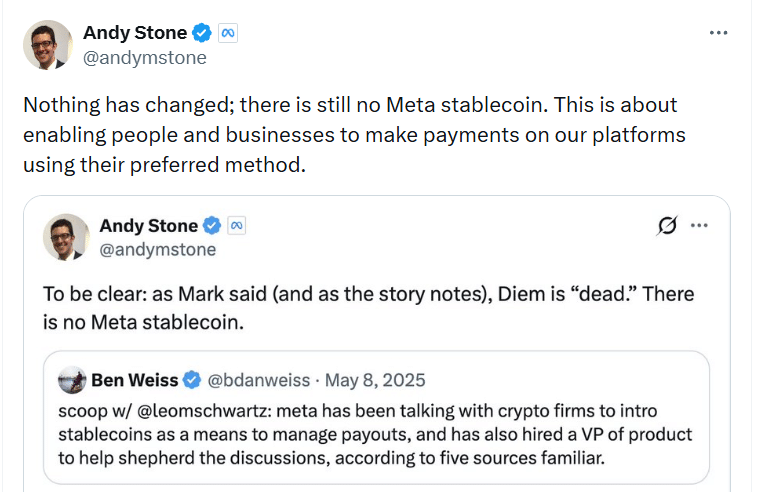
Meta stablecoin payouts exclude any in-house digital currency, as Meta has stated it has no plans to issue its own stablecoin. This represents a clear shift from its earlier Libra initiative, later rebranded as Diem, which was shut down in 2022 following significant regulatory pushback.
Concerns at the time centered on financial stability, privacy risks, and the broader implications of a global digital currency controlled by a major technology company. A Meta spokesperson stated that the company’s approach now centers on enabling payment networks chosen by users and merchants, without creating a token of its own.
How does the payment infrastructure operate behind the scenes?
Meta stablecoin payouts rely entirely on external partners. Stripe handles the conversion of creator earnings into USDC and facilitates transfers to user wallets. The payments run on Solana and Polygon, public blockchains known for fast speeds and low transaction costs.
This setup allows Meta to benefit from blockchain efficiency without managing financial infrastructure directly. Supported wallets include widely used platforms such as MetaMask and Phantom along with region-specific services like GCrypto and Coins.ph.
What role do stablecoins and micropayments play in this system?
Meta stablecoin payouts are built around USDC, a stablecoin pegged to maintain a 1:1 value with the U.S. dollar and backed by reserve assets, which makes it well suited for cross‑border payments. In parallel, Circle has introduced a Nanopayments feature on its mainnet.
This system allows transactions as small as $0.000001 across 11 blockchains, including Ethereum, Arbitrum, Base, Optimism, Polygon, Avalanche, Sei, Sonic, Unichain, HyperEVM, and WorldChain. The feature batches transactions off-chain before settling them on-chain. This reduces costs and supports use cases such as microtransactions, API access, and pay-per-use digital services.
What challenges could affect adoption among creators?
Meta stablecoin payouts address speed and cost issues but introduce new considerations for users. Wallet setup, private key management, and reliance on external exchanges may create friction for some creators. The absence of built-in conversion tools means users must navigate additional platforms to access local currency.

This could impact ease of use, particularly for those unfamiliar with crypto systems. The pilot nature of the rollout also means adoption levels will be closely monitored. Creator preference for traditional payout methods may influence future expansion decisions.
Conclusion
Meta stablecoin payouts represent a cautious, infrastructure-led return to crypto integration. The pilot in Colombia and the Philippines highlights potential gains in speed and cost for cross-border creator earnings while maintaining reliance on established partners. At the same time, the system introduces added steps through external wallets and exchanges.
Wider adoption will depend on regulatory responses, user experience, and whether creators find this model more practical than existing payout methods. If the trial proves effective, Meta stablecoin payouts could serve as a reference case for how large platforms integrate blockchain-based payments without issuing their own digital currency.
Glossary
USDC: Dollar-pegged stablecoin backed 1:1 by reserves
Stripe: Platform for processing online payments and payouts
Off-ramp: Tool to convert crypto into local currency
Polygon: Fast and low-cost blockchain network
Fiat Currency: Government-issued money like USD or INR
Pilot Program: Small-scale test before full launch
Frequently Asked Questions About Meta Stablecoin Payouts
What are Meta stablecoin payouts?
Meta stablecoin payouts are payments where creators receive earnings in digital currency instead of normal money.
Who can receive these payouts?
Only selected creators on Meta platforms can receive these payouts in the pilot phase.
Which countries are included in the pilot?
The pilot is currently available in Colombia and the Philippines.
Why is Meta using stablecoin payouts?
Meta is using stablecoin payouts to make payments faster and cheaper for creators.
Will Meta expand this system to more countries?
Meta may expand this system if the pilot works well and gets approval from regulators.