

Cardano governance has returned to the spotlight after fresh comments from Cardano founder Charles Hoskinson reignited debate over a disputed 1,096 BTC linked to the project’s early organizational structure. What started as a historical question about Bitcoin transfers has evolved into a broader conversation about transparency, accountability, and the importance of documentation in decentralized networks.
According to the source, Charles Hoskinson recently discussed the matter during an AMA focused on Discord, governance, and community management. The discussion was part of a wider effort to shift community engagement from X toward dedicated Cardano and Midnight Discord channels. While the AMA provided additional context, it also prompted renewed calls for records and intensified discussions surrounding Cardano governance.
A Forgotten 2016 Email Has Become the Center of Attention
The controversy centers on 1,096 BTC associated with Cardano’s early Isle of Man Foundation. During the AMA, Charles Hoskinson linked the disputed Bitcoin to a March 2016 email involving Michael Parsons, who was connected to the foundation structure at the time.
According to Charles Hoskinson, the Bitcoin was used during 2016 and 2017 for obligations tied to Parsons and an original audit process. He also emphasized that Bitcoin traded at much lower prices during that period, meaning the transaction carried far less value than it would today.
However, the reference to the email has not ended the debate. Instead, it has increased interest in understanding exactly how the Bitcoin was used and whether supporting records exist to verify the explanation.

Why Cardano Governance Now Hinges on Documentation
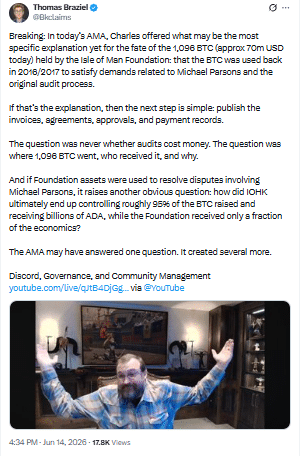
The dispute has shifted beyond the Bitcoin itself and toward the records connected to it. Thomas Braziel, founder of 117 Partners and known online as Bkclaims, has repeatedly requested invoices, agreements, approvals, audit documents, and payment records associated with the transfer.
Importantly, Braziel has not completely dismissed Hoskinson’s explanation. He has suggested that the AMA may answer one part of the long-running question. However, he argues that the explanation does not resolve the entire record trail. In his view, the community still lacks the documentation needed to verify where the Bitcoin went, who received it, and why the payment was approved.
That distinction is significant because Cardano governance ultimately depends on verifiable information. Across the blockchain industry, transparency remains a key factor in maintaining community trust and investor confidence.
Braziel Challenges the Numbers While Hoskinson Defends the Context
Beyond requesting records, Braziel has questioned the timing behind the alleged audit expenses. He argues that audits would likely have occurred later, when Bitcoin traded at much higher prices than during the project’s earliest fundraising rounds.
Because of this, Braziel believes the size of the 1,096 BTC payment appears unusually large compared with normal audit costs. He has publicly stated that the numbers do not seem to add up, raising doubts about whether audit expenses alone can explain the transfer.
Today, the disputed Bitcoin is estimated to be worth nearly $70 million. Yet the controversy is not centered on spending that amount in the present. Instead, the focus remains on historical accountability and whether a complete paper trail exists.
Meanwhile, Charles Hoskinson has defended his position by arguing that repeated public allegations consume valuable time and resources. He maintains that ongoing accusations distract developers, community leaders, and ecosystem participants from advancing Cardano’s broader goals.
Cardano Governance Debate Expands Beyond a Single Transaction
The controversy has also sparked disagreement over who should provide answers. A Cardano community member known as Cardano_G argued that questions should be directed to the Cardano Foundation rather than Charles Hoskinson. According to that view, the Isle of Man Foundation operated as a separate legal entity, and its successor organization should possess the relevant records.
Braziel responded by stating that he had already raised concerns through private channels. He also revealed that former employees had contacted him regarding the matter, which contributed to his decision to continue discussing the issue publicly.
At the same time, Cardano governance debates have expanded into broader discussions about treasury spending, ecosystem priorities, and communication channels. The rejection of a 7.8 million ADA treasury proposal tied to the planned Cardano 2026 Summit in Singapore added further tension to those discussions and ultimately led to the event’s cancellation.
Conclusion
The dispute surrounding 1,096 BTC has become about far more than a historical Bitcoin transfer. It now represents a wider test of how Cardano governance addresses accountability, preserves records, and responds to community concerns. While Charles Hoskinson has offered additional context, requests for documentation continue to shape the conversation.
In the end, the future of Cardano governance may depend on whether questions are answered through evidence rather than interpretation. In a blockchain ecosystem built on transparency, trust often grows strongest when every record can speak for itself.
Glossary of Key Terms
Cardano Governance: The framework used by the Cardano ecosystem to make decisions and allocate resources.
Charles Hoskinson: Founder of Cardano and a leading figure in the blockchain industry.
BTC: The native cryptocurrency of the Bitcoin network.
Cardano Foundation: An organization that supports Cardano’s adoption and ecosystem growth.
Treasury Proposal: A funding request submitted for community review and approval.
FAQs About Cardano Governance
What is the 1,096 BTC dispute?
It involves questions about Bitcoin linked to Cardano’s early foundation structure and the records behind its use.
Why is the controversy important?
The issue raises concerns about transparency, accountability, and historical documentation.
What documents is Braziel requesting?
He has asked for invoices, agreements, approvals, audit records, and payment documentation.
Has Braziel accused anyone of theft?
No. His public statements focus on obtaining records rather than alleging theft.