
This article was first published on Deythere.
- Standard Chartered’s Forecast For Uniswap Ignited A Price Rally
- Altcoins Gain Momentum While Bitcoin Stalls
- Falling Oil Prices Help Improve Macro Conditions
- All Eyes Turn to Kevin Warsh and the Fed
- Conclusion
- Glossary
- Frequently Asked Questions About Uniswap Price
- Why did Uniswap price rise 23%?
- What is Standard Chartered’s Uniswap price forecast?
- Why is Bitcoin trading sideways?
- How are oil prices affecting crypto markets?
- References
Bitcoin has trading been near $66,000, while the rest of the crypto market moved differently. Capital flooded into altcoins, as traders suddenly looked beyond Bitcoin ahead of the Federal Reserve’s first policy decision under new Chair Kevin Warsh.
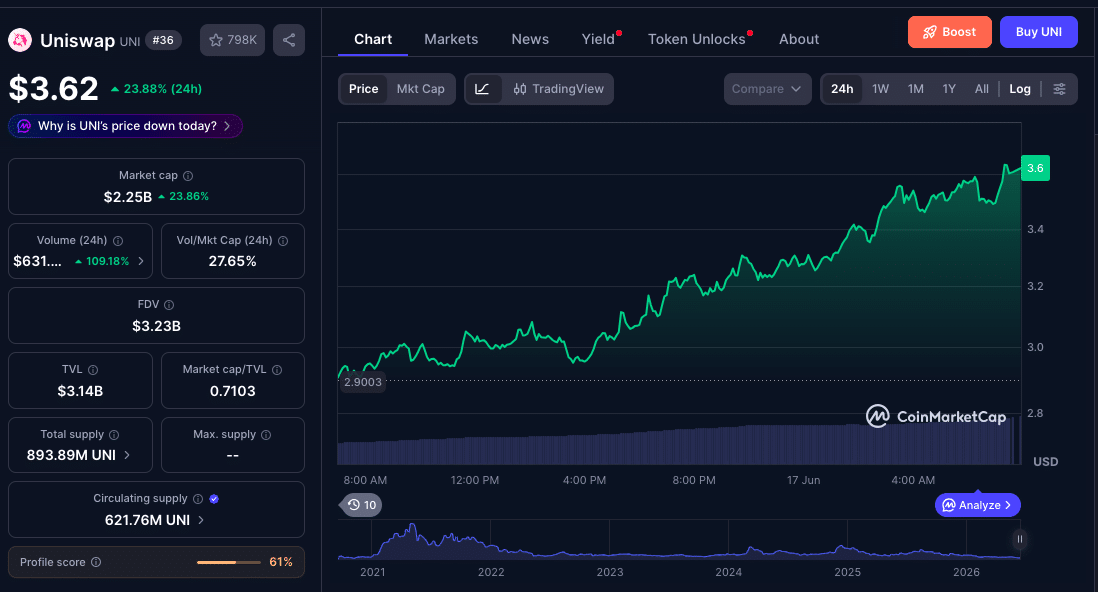
Uniswap price surged over 23% to $3.53 after Standard Chartered initiated coverage of the decentralized exchange’s token with a long-term target of $100 by 2030. Hyperliquid’s HYPE also extended its recent rally and Solana continued a strong weekly advance.
Standard Chartered’s Forecast For Uniswap Ignited A Price Rally
For Uniswap, the obvious trigger for its price surge was Standard Chartered’s new research report.
The bank’s digital assets team forecasts that UNI could go from its current price to $100 by 2030 which is roughly 40 times the current price. Their projected targets are $6.50 by the end of 2026, $20 in 2027, $40 in 2028, and $65 in 2029.
Geoff Kendrick from Standard Chartered, their Head of Digital Assets Research, says Uniswap is one of the best ways to get into on-chain finance and tokenized assets. The bank expects decentralized finance to benefit from trillions of dollars worth of assets moving onto public blockchains during the next decade.
Investors responded quickly, and Uniswap ended up outperforming every other major cryptocurrency on the day, turning a long-term institutional forecast into an immediate trading catalyst.
Altcoins Gain Momentum While Bitcoin Stalls
While Bitcoin traded $65,543, down by roughly 1.29% over 24 hours, but still 6.72% higher on the week, several major altcoins delivered stronger performances.
Hyperliquid’s HYPE was up by 7.8% on the day, and 34.3% over seven days. Solana remained flat for the day, but was still up by 14.7% for the week. Ether chipped in with a 1.4% gain, and its weekly gain now stands at 10.4%, while XRP slipped to $1.22 and a 0.9% loss.
Investors seem to be getting increasingly picky with where they put their funds. Instead of chasing Bitcoin’s modest moves, they’re willing to take on more risk by investing in sectors tied to decentralized exchanges, high-performance blockchains, and other emerging crypto infrastructure.
Falling Oil Prices Help Improve Macro Conditions
Some of the support for risk-taking assets came from outside the crypto space.
Brent crude fell below $80 per barrel reaching its lowest level in more than three months, after a sharp four-session decline. Sources reported that oil prices plummeted as markets priced in more supply following the developing US-Iran agreement and the expected reopening of the Strait of Hormuz.
The proposed agreement includes a 60-day negotiation period, potential sanctions relief, and renewed access for Iranian oil exports. Reports also suggest that Iran is going to get access to a $300B development fund while they agree not to pursue nuclear weapons during negotiations.
Lower energy prices are important because they can definitely ease inflation pressures.
Bond markets reacted well to this, with benchmark government yields in Australia and Japan dropping a bit. The improving inflation outlook raised market confidence up across the board, including the crypto markets.
All Eyes Turn to Kevin Warsh and the Fed
Despite the altcoin rally, traders are still focused on the Federal Reserve.
The Federal Reserve’s 16th and 17th of June meeting is a big one, as it is the first policy gathering with Kevin Warsh at the helm of affairs. He takes over from Jerome Powell who stepped down earlier this year. Markets overwhelmingly expect the Fed to keep interest rates unchanged, with estimates placing the probability of a hold above 95%.
What investors want is guidance. Warsh’s comments on inflation, economic growth, and future rate policy could easily influence both the crypto markets and the traditional ones too. Analysts expect his tone to matter more than the actual rate decision.
Bitcoin has been following the general mood in the market through all the recent geopolitical developments. If Warsh suggests a more relaxed path ahead, risk assets could keep on benefiting. If he puts the spotlight on inflation risks, things could get more volatile.
Conclusion
Uniswap price surge was the highlight of the market, with UNI jumping 23% following Standard Chartered’s $100 forecast. Equally, HYPE, Solana, and Ether were all outperforming Bitcoin, which was a signal that investors are rotating into higher-risk opportunities.
Oil prices currently dropping, geopolitical tensions easing, and investors are waiting for Kevin Warsh’s first Fed decision. The next phase of the market may depend on how the general macro conditions keep on supporting risk assets.
Glossary
Uniswap (UNI): The governance token for Uniswap’s decentralized exchange.
Federal Reserve: The central bank of the United States, responsible for monetary policy.
DeFi: Decentralized finance applications operating on blockchain networks.
Strait of Hormuz: A critical global oil export shipping route.
Risk Assets: Investments such as stocks and cryptocurrencies that benefit from improving economic sentiment.
Frequently Asked Questions About Uniswap Price
Why did Uniswap price rise 23%?
The reason Uniswap price went up so much was because Standard Chartered initiated coverage and they projected a $100 price target for 2030.
What is Standard Chartered’s Uniswap price forecast?
The bank predicts Uniswap price will get to $6.50 by 2026, $20 in 2027, $40 in 2028, $65 in 2029, and then $100 by 2030.
Why is Bitcoin trading sideways?
Investors are waiting for the Federal Reserve’s policy decision and some guidance from the new Fed Chair Kevin Warsh.
How are oil prices affecting crypto markets?
Lower oil prices have helped out inflation expectations and also supported risk appetite across financial markets.