



BlackRock BITA ETF has entered the Nasdaq market as a new Bitcoin investment product that combines cryptocurrency exposure with a covered-call strategy aimed at generating monthly income. The iShares Bitcoin Premium Income ETF gives investors access to Bitcoin through direct holdings and exposure to the iShares Bitcoin Trust ETF (IBIT), while using options premiums to create a potential income stream.
- What is BlackRock BITA ETF and how does the new fund work?
- How does BlackRock BITA ETF differ from traditional Bitcoin ETFs?
- Why is BlackRock focusing on Bitcoin income products now?
- What are the confirmed details and market expectations around the ETF?
- What risks should investors understand before choosing this strategy?
- How will the market judge BlackRock’s Bitcoin income strategy?
- Conclusion
- Glossary
- Frequently Asked Questions About BlackRock BITA ETF
The launch introduces a different approach to Bitcoin investing. Instead of focusing only on price appreciation, the fund attempts to use Bitcoin’s market volatility as a source of income. However, the strategy also creates a clear trade-off because selling call options can limit gains when Bitcoin moves sharply higher.
What is BlackRock BITA ETF and how does the new fund work?
BlackRock BITA ETF is a Nasdaq-listed exchange-traded fund designed to provide Bitcoin exposure while generating potential monthly income through a covered-call strategy. The fund can hold Bitcoin and IBIT directly, then write covered calls on approximately 25%-35% of portfolio assets.

The covered-call structure allows the fund to collect option premiums. These premiums can support monthly distributions, but investors give up part of the upside potential on the assets involved in the options strategy. The fund began trading on Nasdaq on June 16.
Susquehanna Securities was named the designated liquidity provider for BITA following the listing process. The launch followed several regulatory steps, including the Securities and Exchange Commission’s June 12 notice of effectiveness for the fund’s S-1 registration statement and the June 11 Form 8-A registration of shares under Section 12(b).
The ETF had a June 9 inception date. It launched with a 0.65% sponsor fee, monthly distribution frequency, $10.65 million in net assets as of June 15, and 200,000 shares outstanding as of June 15. The fund reported two holdings as of June 12.
How does BlackRock BITA ETF differ from traditional Bitcoin ETFs?
BlackRock BITA ETF is designed differently from a standard spot Bitcoin ETF because it combines Bitcoin exposure with an income-generating options overlay. The iShares Bitcoin Trust ETF (IBIT) focuses on direct spot Bitcoin exposure and aims to track Bitcoin price movements without an options-income strategy.
BITA, on the other hand, seeks to participate in most of Bitcoin’s upside while generating monthly income through covered calls. The structure creates different outcomes depending on market conditions. In flat or moderately rising markets, option premiums may help support returns.
During strong Bitcoin rallies, the covered-call strategy may reduce performance because gains above the option strike price can be limited. The product comparison highlights the difference between emerging Bitcoin income strategies: BITA uses Bitcoin and IBIT exposure with covered calls on roughly 25%-35% of assets.
IBIT provides direct spot Bitcoin exposure without an options overlay. Goldman Sachs’ Bitcoin Premium Income ETF filing describes an indirect Bitcoin ETP-linked exposure strategy with an expected overwrite range of around 40%-100%. The differences show that financial firms are testing multiple ways to combine Bitcoin exposure with income generation rather than following one standardized approach.
Why is BlackRock focusing on Bitcoin income products now?
The launch comes as investors continue exploring ways to receive cash flow from assets that traditionally do not generate regular income. BlackRock’s U.S. head of equity ETFs Jay Jacobs said the product was developed after seeing interest from investors who wanted Bitcoin exposure while also seeking income.
“This is something we’ve had as an idea for a while,” Jacobs said, explaining that investors across different categories have shown interest in generating income while maintaining a largely long position in Bitcoin. The fund may appeal to income-focused investors looking beyond traditional sources such as dividend stocks and bonds.
It may also attract Bitcoin holders who want to create a cash-flow stream from their positions. BlackRock has positioned the product as a complement to IBIT rather than a replacement. The company expects many investors to continue choosing direct Bitcoin exposure, while others may prefer a structure designed around income generation.
What are the confirmed details and market expectations around the ETF?
BlackRock’s official product details include the 0.65% sponsor fee, monthly distribution structure, covered-call strategy on approximately 25%-35% of assets, and an objective of seeking majority Bitcoin upside participation depending on market conditions. Some market expectations around potential returns are separate from BlackRock’s official claims.
Bloomberg ETF analyst Eric Balchunas has framed the launch around a possible 15%-25% annualized yield target and at least 70% upside participation. These figures are market commentary and not guaranteed returns from BlackRock. The fund’s own materials highlight that actual results can vary. Covered calls can limit gains above the exercise price, and the strategy may underperform IBIT when Bitcoin rises significantly.
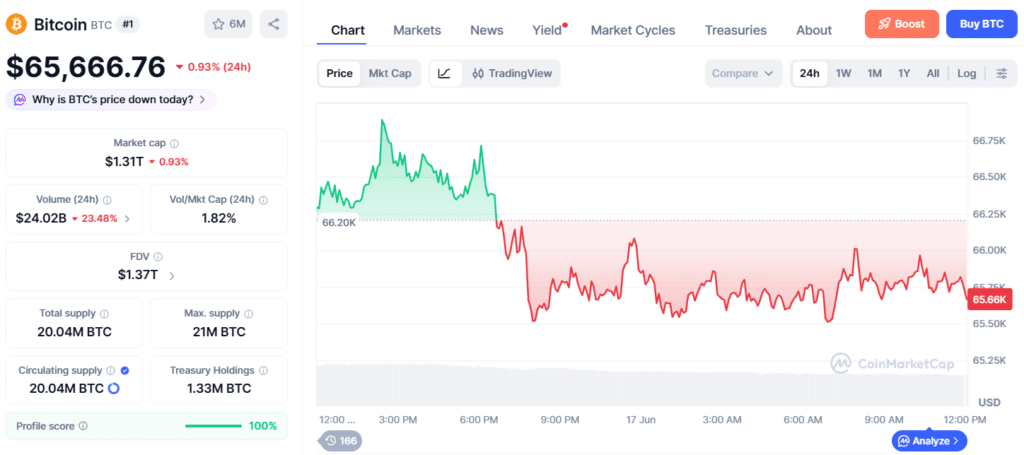
Bitcoin’s market conditions also provide context for the launch. The cryptocurrency is trading around $65,794.07, with gains over the previous seven days but a decline over the previous 30 days. Bitcoin dominance is near 58.4%, reflecting a mixed market environment where some investors may look for income opportunities during periods of consolidation.
What risks should investors understand before choosing this strategy?
BlackRock BITA ETF does not remove Bitcoin-related risks. The fund remains dependent on Bitcoin’s price movements, IBIT liquidity, options execution, tax treatment, and broader market conditions. A key risk is that income-focused messaging can reduce the perception of how much exposure remains.
The fund still relies on Bitcoin performance, and distributions may depend on whether option premium generation remains consistent or changes with market conditions. Investors will need to evaluate where returns come from over time. The important questions include how much performance comes from option premiums, how much comes from Bitcoin exposure, and how much upside is sacrificed during strong rallies.
At launch, BITA is small compared with IBIT, which had more than $50 billion in net assets and daily volume of about 53 million shares as of June 15. This makes early trading volume, bid-ask spreads, and actual monthly distribution levels important indicators for measuring demand.
How will the market judge BlackRock’s Bitcoin income strategy?
The performance of BlackRock BITA ETF will likely be measured through several factors, including investor demand, monthly distributions, trading activity, and the ability of the options market to support future growth. The next strong Bitcoin rally will be a major test for the strategy.

Market participants will evaluate whether the income approach works as a useful way to capture volatility or whether the lost upside makes the structure less attractive compared with direct Bitcoin exposure. The fund also reflects a wider development in the cryptocurrency investment sector.
The first wave of Bitcoin ETFs focused on access, custody, and institutional adoption. New products are now exploring how Bitcoin volatility can be incorporated into income-focused portfolios.
Conclusion
BlackRock BITA ETF brings a new structure to the Bitcoin ETF market by combining cryptocurrency exposure with a covered-call income strategy. The fund launched with $10.65 million in net assets as of June 15, a 0.65% sponsor fee, and a strategy targeting covered calls on around 25%-35% of portfolio assets.
The product offers investors another way to access Bitcoin, but it does not provide a guaranteed income stream or unlimited upside participation. Its success will depend on how effectively it balances monthly distributions with Bitcoin market performance. As trading develops, investors will watch whether BITA can deliver a meaningful income advantage while managing the cost of capped upside during major Bitcoin rallies.
Glossary
BlackRock BITA ETF: Bitcoin ETF that aims to earn monthly income.
Covered Call: Earning income by selling some future upside.
IBIT: BlackRock’s Bitcoin ETF that tracks Bitcoin directly.
Option Premium: Money earned from selling options contracts.
ETF Liquidity: How easily ETF shares can be bought and sold.
Frequently Asked Questions About BlackRock BITA ETF
How does BITA ETF work?
BITA ETF works by holding Bitcoin or Bitcoin-related assets and using options to earn extra income.
What is the main goal of BITA ETF?
The main goal of BITA ETF is to generate monthly income while still tracking Bitcoin.
How is BITA different from IBIT?
BITA focuses on income plus Bitcoin exposure, while IBIT only tracks Bitcoin price directly.
Can BITA ETF give high profits in strong Bitcoin rallies?
BITA ETF may limit profits in strong rallies because some upside is sold for income.
Is BITA ETF only for Bitcoin growth?
No, BITA ETF is designed for both Bitcoin exposure and regular income, not only growth.