
The battle of blockchains continues to heat up in 2026 as Solana vs Ethereum keeps coming up in many crypto circles.
- Developer Ecosystem : Solana’s Surge vs Ethereum’s Established Base
- Developer Ecosystem Solana vs Ethereum Comparison Table
- Solana vs Ethereum Network Performance and Speed: Throughput, Speed, and Fees
- The $300 SOL Debate: Will Solana’s Price Go Up?
- Expert Analysis – Solana vs Ethereum
- Conclusion
- Glossary
- Frequently Asked Questions About Solana vs Ethereum
While Ethereum has a long-established lead in decentralized finance and winning over institutional adoption, Solana’s remarkable speed and explosive growth in the developer community have some believing it could not only rival Ethereum in certain areas, but even overtake it one day.
Developer Ecosystem : Solana’s Surge vs Ethereum’s Established Base
An important metric surrounding Solana vs Ethereum in 2026 is the size and overall activity of their respective developer communities. Recent data shows Solana’s ecosystem has finally caught up with and even surpassed Ethereum in active developers. As of May 28, 2026; there were 10,775 active Solana developers compared to 9,941 on Ethereum.
This growth is being supported by ongoing investment. A report noted that Solana managed to attract 11,534 new developers in the first nine months of 2025, an 83% year on year jump; which took their active dev count to 17,708 nearly matching Ethereum’s 31,869. Ethereum only managed to grow its developer base by around 5.8% over a two-year period.
Solana Foundation grants, hackathons and easy to use frameworks (like Anchor and the Solana Mobile Stack) have helped fuel this expansion and an impressive 70%+ developer retention rate. Ethereum’s ecosystem, whilst more mature , is actually growing a lot more slowly.
These differences in approach reveal the two chains’ priorities. Solana is essentially building a “consumer-focused” development hub that is drawing in dApp creators for gaming, NFT marketplaces and social apps. Meanwhile, Ethereum is still concentrating on its huge stable of DeFi and enterprise projects.
For example, Ethereum still has roughly $61 billion in Total Value Locked (TVL), roughly seven times the $8.8 billion in Solana.
Developer Ecosystem Solana vs Ethereum Comparison Table
| Metric / Feature | Solana | Ethereum |
| Theoretical TPS | 65,000 | (Ethereum PoS low hundreds via L2) |
| Realized TPS (1h avg, May 2026) | 1,032 | 22 |
| Block Finality / Time | 12 seconds (Solana block time) | 12 seconds (Ethereum block time) |
| Average Tx Fee | <$0.01 | Variable, often $1-10+ (ETH L1) |
| Daily Active Users (2025) | 3.25 million | 410,000 |
| Daily Tx Volume (2025) | 35.99M | 1.13M |
Despite Ethereum’s larger TVL and ecosystem maturity; Solana’s dev growth is suddenly catching up. In a 2026 context, this means more new projects and innovations are rolling out on Solana at a swift rate; even if Ethereum still retains a deeper, tried-and-tested codebase.
Solana vs Ethereum Network Performance and Speed: Throughput, Speed, and Fees
Speed is Solana’s signature feature. Its mix of Proof-of-History & PoS consensus lets it hit peak throughputs that dwarfs Ethereum. Solana has a theoretical limit of 65,000 transactions per second (TPS); whereas Ethereum’s base layer maxes out at a handful, probably around 30 TPS.
Real-time data from 2026 shows Solana averaging more than 1,000 TPS (1 hour real-time average), with over 3.71 million transactions an hour; while Ethereum processes only around 22 TPS. (1-hour average)
This is a massive throughput gap, which means fees on Solana are also much lower. Network fees on Solana are usually under $0.01 per transaction, whereas Ethereum users still face higher; unpredictable gas fees.
For Solana vs Ethereum; sources note that Solana processed about 35.99 million daily transactions in 2025, way more than Ethereum’s 1.13 million. In short; Solana is optimized for high-frequency; low-costs operations making it a natural fit for use-cases like micro-payments, game transactions, and fan tokens.
On the other hand, Ethereum still has security and strength going for it, even though its transaction costs remain higher.
Experts point out that Ethereum prioritizes decentralization and security, while Solana prioritizes scalability. Solana goes with a smaller, yet more powerful group of validators (around 1,600 at present), a strategy that has helped keep the chain moving quickly, even if it means less decentralization than Ethereum. With over 64,000 validators, Ethereum is clearly more decentralized.
Ethereum’s PoS system has been proven to be strong, while Solana has had some notable outages though those were mainly in the past, a point experts warn institutional users to watch.
Overall, Solana’s performance advantages make it a “consumer chain” for speed-sensitive applications, while Ethereum’s strength is its proven security and extensive Layer-2 scaling efforts.
Ethereum is still working on new upgrades to give it more throughput and lower the costs associated with using the chain, which helps keep it competitive.
The $300 SOL Debate: Will Solana’s Price Go Up?
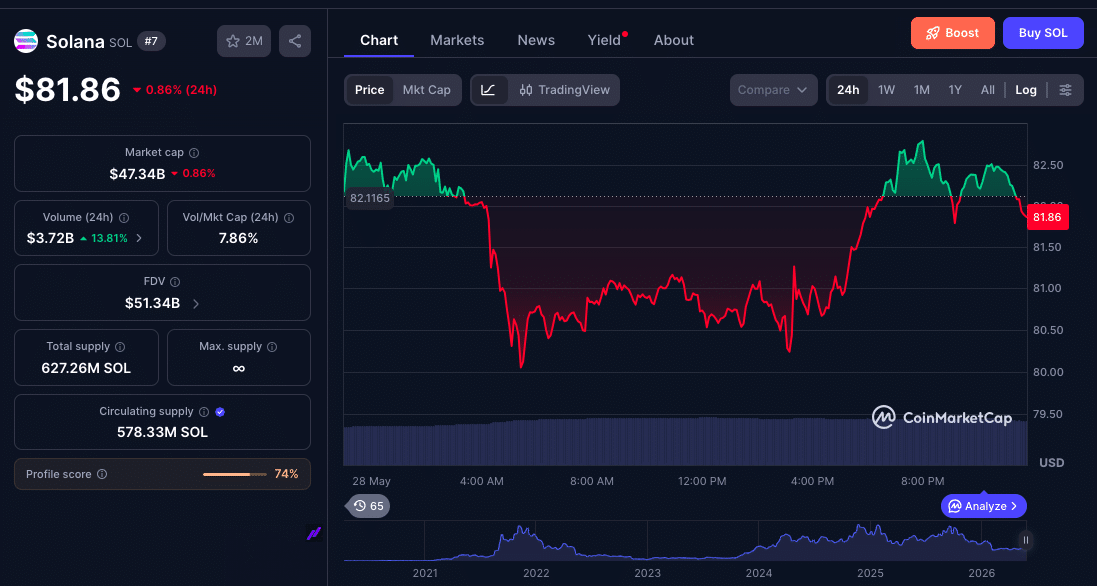
One point of interest is whether Solana’s price is going to hit $300 anytime soon. The idea of SOL at $300 is tied into some optimistic forecasts. As Solana’s ecosystem keeps growing, analysts and models are speculating about the potential for big gains. In late May, SOL trades at around $80 – $100. To get to $300; this would require the price to triple. Still, some analysts feel more optimistic about Solana’s long-term potential.
Standard Chartered’s crypto research chief Geoffrey Kendrick recently trimmed his end-2026 forecast for SOL from $310 to $250, yet still sees $2,000 by 2030. Kendrick thinks Solana is switching from meme coin hype to being a serious stablecoin micropayments hub. He notes that Solana’s stablecoin volume now surpasses Ethereum’s, which is a big deal.
Some other analysts however are saying that a $300 target is too ambitious. Solana’s price has been volatile after the 60% plunge in mid-September 2025 to about $100?
While Kendrick is still projecting a price of $400 by 2027 and $700 in 2028, he’s also acknowledging how tough the road ahead is going to be.
Looking at market data, institutional investors are definitely interested in Solana. The flows into Solana ETFs have been strong, particularly Bitwise’s BSOL ETF, which has absorbed the lion’s share of SOL inflows since Oct 2025. But there are also obstacles. Global crypto sentiment, competition from other chains and regulatory uncertainty all influence how easily SOL can triple from current levels.
Reaching the $300 SOL target is not impossible but is widely considered ambitious for 2026. Getting to that price point would take a sustained bull market, widespread adoption of Solana dApps, and continued reliability. But if that doesn’t happen, analysts note that SOL is a “high-beta” coin that is prone to volatility which in past cycles, had lost over two-thirds of its value.
Expert Analysis – Solana vs Ethereum
1. Solana’s rapid growth vs Ethereum’s maturity
Experts point out that Solana is making a compelling case as a real challenger to Ethereum. Developer engagement with Solana is increasing and that has been reflected in their numbers. Reports show that Solana outstripped Ethereum in dEX trading volume ($117B vs $52B) and daily transactions.
This growth aligns with Solana’s goal of getting high-speed, low-cost transactions for apps like games, NFTs and IoT micropayments. Looking at the numbers, it’s clear that Solana is delivering on that promise, processing 35.9 million in daily transactions compared to just 1.13 million on Ethereum.
On the other hand, Ethereum’s experts are keen to point out the tested quality of its DeFi ecosystem. Ethereum still holds the lion’s share of liquidity and institutional interest; with a reputation for being secure. Both blockchain advocates have valid points; Ethereum has the potential to ride its upgrades and capital inflows, while Solana’s explosive ecosystem growth is its ace card.
2. Risk profiles and institutional views between Solana vs Ethereum
Risks between Solana vs Ethereum is where analysts differ. Even someone as bullish on Solana as Standard Chartered’s Geoffrey Kendrick recently downgraded Solana’s 2026 price target, acknowledging that there are some transitional risks that investors will need to be aware of. On-chain experts caution that Solana’s history of outages (e.g. 2022’s high-profile downtime) may still haunt investor confidence, despite improvements.
On the other hand, Ethereum’s defenders point to its decentralized validation as security-critical for large-scale finance.
3. The $300 price action
A lot of experts are framing the $300 SOL question around how developed Solana’s use case is, not the hype it has going on. For example, Kendrick sees stablecoin micropayments as the next big thing, because Ethereum’s Layer 2 fees might be too high for tiny transactions.
If companies like Coinbase’s Base or Solana Pay can actually get real-world micro transactions on-chain, that could support a higher SOL valuation, but if Solana keeps focusing on volatile meme coins, the $300+ case weakens.
Ethereum analysts point out that ongoing upgrades could eventually help narrow the speed gap, so that Solana’s advantage isn’t as wide by the end of 2026. If that happens; SOL’s upside might get capped and ETH’s case gets stronger.
Overall, the consensus among analysts is that Solana is a higher-risk, higher-reward proposition compared to Ethereum. If the bets on consumer apps pay off, then gains could be huge but if things don’t go to plan (market downturns, outages, regulatory clampdowns) then SOL could take a harder hit than ETH.
Conclusion
Solana vs Ethereum in 2026 is a real showdown between differing strengths. Solana’s developer ecosystem is growing; its network speed is unmatched and the potential for its price trajectory is bold but not guaranteed.
Meanwhile, Ethereum has a mature developer base; massive liquidity, and a security pedigree that keeps it in the lead for institutional-grade finance and DeFi.
Right now, Ethereum may be ahead when it comes to TVL and tokenized assets; but Solana leads in everyday transaction volume and developer momentum.
For seasoned investors, Solana vs Ethereum all comes down to the risk vs rewards. If crypto adoption in 2026 favors fast consumer businesses, Solana might be the one to watch, possibly pushing Solana’s price toward the $300 targets by year end. But if institutional investors and stablecoins keep being the dominant force, then Ethereum’s resilience and its layer 2 growth could make it a more stable bet.
As with crypto, no one size fits all so diversification and due diligence are important.
Glossary
Developer Activity: A measure of how many developers are building on a blockchain (making dApps; updating code etc.).
Transactions Per Second (TPS): The number of transactions a blockchain can process through each second.
Total Value Locked (TVL): The total amount of crypto locked in DeFi protocols on a blockchain.
Proof-of-Stake (PoS): A way of securing a network where validators stake tokens to secure the network, used by both Ethereum and Solana.
Proof-of-History (PoH): A Solana-specific technique that timestamps transactions, enabling high throughput.
Layer 2 (L2) Solutions: Smaller networks built on top of Ethereum to make transactions faster and cheaper, like Arbitrum, Optimism.
Validator: A node that helps secure a proof-of-stake blockchain by validating transactions and adding new blocks.
Frequently Asked Questions About Solana vs Ethereum
What is the state of the dev ecosystem on Solana vs Ethereum?
Solana’s developer base has taken off and is quite bigger than Ethereum’s now. Solana reported 83% growth in developers last year (early 2025),;while Ethereum’s dev growth was more modest. Ethereum still has a bigger codebase and more DeFi tools at its disposal but Solana’s ecosystem is growing faster.
Why does Solana boast of being faster than Ethereum?
For Solana vs Ethereum, Solana’s advanced Proof-of-History consensus lets it process transactions at an incredibly high rate (up to 65,000 TPS). Solana manages about 1,000 TPS as of 2026; still faster than Ethereum which does about 20-30 TPS on its base layer.
What does the $300 SOL target mean?
Whether Solana’s token price can triple from where it is now to $300. Some analysts had year-end 2026 targets near $250-$310 a while back; but revisited them when the market changed. Hitting $300 all comes down to whether Solana’s ecosystem keeps on growing and the crypto markets stay strong.
How do Ethereum’s upgrades affect Solana’s challenge?
Ethereum network upgrades aim to make it faster and lower the fees. These make Ethereum more competitive on speed, potentially narrowing Solana’s lead. Some analysts note Ethereum still has a big lead on institutions and liquidity because of these developments.
References
Disclaimer: This article is for informational purposes only and the crypto market can be super unpredictable. Do your own research or talk to a financial advisor.