


The backbone of any crypto project is its tokenomics metrics, defining how tokens are distributed, issued, burned and used. For early-stage investors, these metrics are often more predictive of long-term success than price charts or market hype.
- Why Tokenomics Metrics Matter When Investing in Crypto
- Key Supply and Inflation Metrics
- Tokenomics Metrics Table
- Distribution and Vesting Strategies
- Unlock Schedules and Sell Pressure
- Demand, Velocity, and Utility Metrics – What Really Matters
- Incentives and Governance
- Conclusion
- Glossary
- Frequently Asked Questions About Giken Metrics
In fact, research suggests that poorly designed token economies have contributed to the demise of more than 80% of crypto ventures.
Why Tokenomics Metrics Matter When Investing in Crypto
Since 2021 the crypto market has seen a flood of new tokens and Web3 startups but too many of them didn’t have any staying power and failed to deliver lasting value.
Research has found that token design is a major determinant of success. Well put together tokenomics metrics align stakeholders’ interests, make users more engaged, and create a sustainable ecosystem whereas flawed designs lead to manipulation and ultimately drive users away. In other words, the rules behind a token are what decides whether a project takes off or goes under.
For early stage investors, understanding these metrics is essential. Now top cryptocurrency funds are demanding detailed token models before they will even consider funding.
They want to see beyond what happens to the price right after a launch, they want to know the fundamentals: Is the token supply capped or does it just keep on growing? How is the token split between founders, investors and the wider community? When and how will new tokens start coming onto the market? What mechanisms exist to make real demand for the token and create value? All of these questions come down to looking at tokenomics metrics.
For example projects that come out with ultra high initial valuations have often ended up disappointing when tokens unlock and prices start to drop. However, tokens with a balanced inflation rate and a good level of utility seem to handle the downsides of a bear market a lot better.
Mastering tokenomics metrics involves treating a crypto token like any financial asset, modeling its capitalization and cash flow.
For crypto, “cash flow” means utility and demand drivers (staking rewards, transaction fees and revenue share). Tokenomics metrics help quantify all of these dynamics.
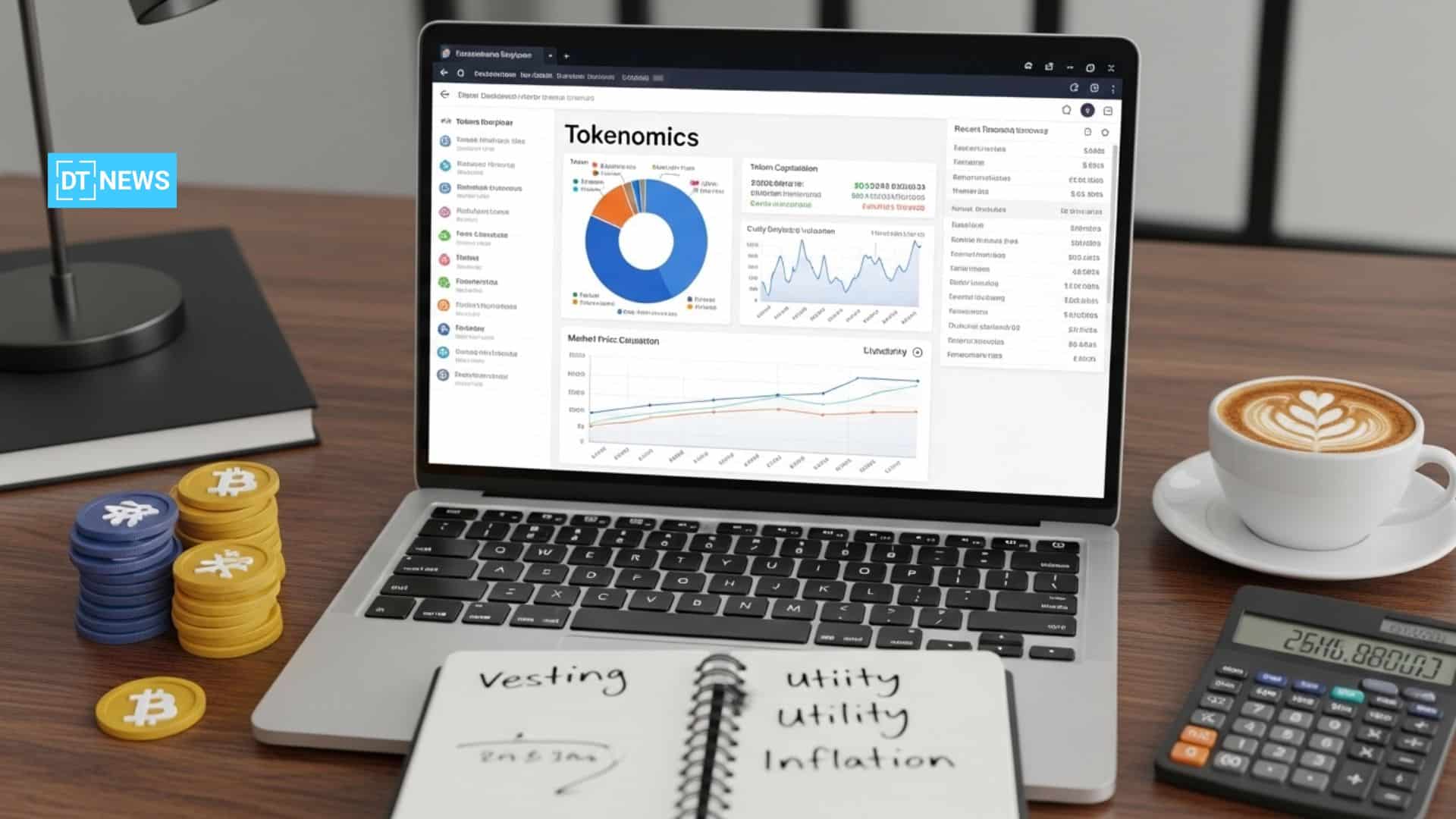
Key Supply and Inflation Metrics
Max Supply, Circulating Supply & Total Supply: These figures set the inflationary tone. Max supply is that ultimate cap (if one exists); circulating supply is the number of tokens that actually trade hands today; total supply includes all the locked up or yet to be minted tokens.
A cap that’s in place (like the 21 million Bitcoin cap) creates a deflationary scarcity, whereas not having a cap or having an inflationary model can lead to dilution. Take Bitcoin for example, it has 20.02M of 21M circulating in May 2026, whereas Ethereum doesn’t have a hard cap but uses fee burns to keep a lid on inflation (circulating 120.7M ETH at the moment)
Inflation Rate: This measures new token issuance over time. If the rate of inflation is too high (like more than 20% a year), it can erode value unless there’s real demand (like staking or using the tokens). Most modern blockchains are trying to keep their inflation rate in single digits.
Take Solana for instance, it started out with about 8% annual inflation and has tapered it all the way down to 1.5% over time. Investors will often draw these so-called “monetary policy” curves to see if the new supply is going to overwhelm the demand.
Fully Diluted Valuation (FDV): FDV is just current price x max supply. It gives an idea of the token’s valuation if all tokens were actually issued. If the FDV is huge, then it can signal hidden sell-pressure. A metric that is worth keeping an eye on is the FDV to market cap ratio. Generally, analysts say that at launch, FDV should be at most 10-15× circulating market cap.
However, what often happens is that projects which plan for massive future issuance end up seeing price drops a lot when lockups expire. A high FDV/MC ratio creates a structural sell-pressure problem, circulating supply grows a lot faster than real demand and that pushes the price down. Healthy projects plan for relatively low initial FDVs or very gradual unlocks.
Tokenomics Metrics Table
Below is a summary of all the important tokenomics metrics, what they measure and why they’re worth a look to investors:
| Metric | What It Measures | Investor Implication |
| Circulating Supply | Tokens available for trading now. | Sudden increases (unlocks) can flood markets and pressure price. |
| Total / Max Supply | All tokens created (total) or ever possible (max). | Unlimited max supply may risk dilution; fixed max supply can drive scarcity. |
| Inflation Rate | % new tokens minted per year. | High inflation requires strong demand (staking, utility) to maintain value. |
| Market Cap (MC) | Circulating Supply × Price. | Benchmark for size; must be evaluated versus tokens unlocking. |
| Fully Diluted Valuation | Max Supply × Price (the theoretical market cap at 100% issuance). | Exaggerated FDV (vs MC) often warns of future dilution. |
| FDV/MC Ratio | FDV divided by current MC. | Target <10-15× at TGE to avoid immediate dump pressure. |
| Unlock Schedule | Timeline of token releases (vesting cliff, linear vesting, etc.). | Front-loaded unlocks (>25% in 90 days) can multiply sell pressure by 2-4×. |
| Token Velocity | Rate tokens circulate in the economy (Tx volume / avg supply). | Lower velocity (holders keep tokens) indicates stronger long-term demand; high velocity can depress price. |
| Staking/Lock-up Rate | % of supply staked or locked for governance/operations. | High staking shows commitment and reduces circulating supply; low or no staking may signal less engagement. |
| Vesting/Cliff Period | Lock-up duration before team/advisors sell tokens. | Industry standard is 1-year cliff + 3-year vesting. Shorter vesting raises red flags about founder commitment. |
Many investors use circulating vs total supply as a litmus test to figure out if a project is on solid ground. If a whitepaper promises a tiny circulating supply today but a huge circulating supply later, the token will face a dilution hangover.
Likewise, projects with FDV/MC ratio above roughly 15x often struggle in the long run.
Distribution and Vesting Strategies
Beyond raw numbers, how tokens are allocated is important. Distribution shows who holds power and potential sell pressure. Fair and transparent allocations can build trust, over-concentrated tokenomics on the other hand do not.
A useful benchmark to keep in mind: no single round (team, investors, advisors) should control more than roughly 30% of total supply. If one group holds more than that, that creates centralization risk and one coordinated sell-off could send the token crashing.
For example, imagine a new blockchain token with a whopping 50% of tokens allocated to the founders even with a vesting schedule. This exposes outside investors to the risk that the founders just dump tokens as soon as the lock-up ends.
On the other hand, projects that spread tokens across multiple groups (team, private investors, community, ecosystem funds, etc.) and impose vesting can sustain demand for longer.
The vesting schedule is the timeline over which tokens are unlocked and is one of the most-watched metrics out there. Industry practice on this is roughly a 12 month cliff (no tokens released) followed by 36 month linear vesting for founders. Anything a lot shorter is seen as a lack of founder commitment.
Vesting and release schedules can be turned into charts or tables, and investors often spend a lot of time modeling “sell pressure” for each unlock event. A mature tokenomics metrics plan will show that even when locks expire, expected sell-through is manageable compared to projected demand.
Unlock Schedules and Sell Pressure
Every early-stage token faces the reality of unlock cliffs. The unlock schedule, when new tokens become tradable, can determine a project’s short term viability. An analysis in 2026 found that tokens unlocking more than 25% of supply in the first 90 days post-launch tend to face roughly 2-4 times higher sell pressure than tokens with release schedules that are more gradual.
Savvy investors therefore build sell-pressure models. These models take into account unlock timing and volume. For each group of holders (team, venture rounds, advisors, community), you assume a certain percentage will sell when unlocked.
By adding all those together and comparing against expected daily trading volume, investors can estimate if there will be a shortfall and whether a crash is likely. If projected, selling exceeds what the market can absorb, the model warns of a likely crash.
Tokenomics Calculator guides precisely this analysis; inputs include unlock schedules, sell-through percentages, and DEX liquidity depth. Without such modeling, even strong projects can suffer “predictable unlock cycles” that collapse price.
Case Example: Consider a token with 10% of supply circulating at TGE (launch) and 90% locked. If 50% of the locked tokens (i.e. 45% of supply) unlock at month 6, that’s a huge supply shock. Even if only half of those unlocked tokens actually sell, it could double the market float overnight. H
owever, a project that releases 5% monthly would have negligible monthly sell pressure. Modern investors often insist on smooth unlocking or on built-in incentives (like extended lockups or staking) that discourage immediate selling.

Demand, Velocity, and Utility Metrics – What Really Matters
On the demand side, the real value of token utilization and usage metrics is how much genuine economic activity a token actually drives. While the supply side tells about the potential for value creation, the demand side shows what is happening in reality. Key measures include:
Token Velocity: This is a metric that shows how often tokens changed hands(usually calculated by dividing transaction volume by average supply over a given period). If tokens are changing hands a lot with a high velocity , that’s often a sign of speculation, rather than genuine usage. Lower velocity suggests users hold tokens longer, signaling stronger network demand. Experts note that incentivizing long-term holding (via staking rewards, locking) can deliberately lower velocity, boosting the price.
Network Usage (Volume & Activity): Daily active addresses, transaction counts, or total value transferred on-chain are proxies for usage. A token’s value usually derives from some service: paying fees, staking, governance, or accessing features. For example, Ethereum’s tokenomics became deflationary because every transaction burns a portion of ETH (EIP-1559). Regular on-chain fees or revenue that “sink” tokens is a powerful demand driver.
Staking Participation and Yield: Many Layer-1 blockchains offer staking, which removes tokens from circulation and rewards participants. A high staking rate (e.g. >50% of supply staked) indicates security and investor commitment. The average staking yield (annual % return) shows how attractive that staking is. F
or instance, Polkadot and Kusama have always offered >10% staking rewards, encouraging holders to lock up tokens. Low staking yields or no staking may reduce holder incentives. As ZebPay notes, staking participation is one of the metrics investors watch.
Utility Cases: The “utility” of a token , what it does, and how it works, is important too. Does it actually give people something useful? Like access, or governance rights? Common utilities include: paying fees, governance voting, collateral in DeFi, or exclusive platform features.
Tokens that are merely speculative (e.g. “meme coins” or incentives without a product) tend to see higher velocity and weaker holding patterns. In Web3, experts emphasize that advanced utility models (e.g. tokenizing real-world assets, revenue-sharing mechanisms) tie token value to concrete usage.
All of these demand metrics tell users whether or not there’s any actual usage and activity backing a token. A network with growing fees, active users, and high staking participation is going to have a stronger token economy in the long run than one that’s just relying on marketing spin and hype.
Incentives and Governance
Finally, take a look at incentive systems and governance, often the key to making all those nice-sounding metrics actually work. Incentives are any token-based feature that rewards good behavior (mining/staking rewards, loyalty programs, buybacks and token burns).
Take Bitcoin as an example, its halving every few years creates a predictable scarcity, which rewards long-term holders for holding on. Many projects these days are combining staking rewards with other schemes ; some redistribute transaction fees to holders or periodically burn tokens when revenue comes in. These mechanisms reduce net inflation and give token holders a share of network growth.
The governance model also has a big impact on tokenomics health. In a fully decentralized DAO (Decentralized Autonomous Organization), token holders get a vote.
Projects usually set aside tokens for governance to make sure the community has a say in how things are run. Investors want to see community participation rates, not just a handful of whales or insiders dominating the vote. Some chains are even using quadratic voting or other fancy tools to try and level the playing field.
These days, one can use blockchain analysis tools to get a handle on some of these metrics. For instance, staking participation can be pulled from on-chain data, and “token spend ratio” approximates velocity. While not as common as financial ratios, these blockchain-native metrics are increasingly incorporated into due diligence.
Conclusion
Across the board, tokenomics metrics are the foundation of good early-stage crypto investing. Investors need to take a serious look at token supply dynamics (circulating vs total vs max), inflation rates and FDV-to-market cap ratios because all these things can give a good idea of dilution risk.
Allocation breakdowns and vesting schedules are also important because one can end up with concentration and cliff sell-offs if things aren’t set up right.
Demand and utility metrics aren’t to be ignored either: token velocity, staking rates, and real usage figures give a clear idea of whether a token’s economy is going to last in the long run.
Smart investors build out models of token unlocks and trading volume, keep an eye out for red flags (like when insiders are holding onto more than 30% of the tokens, or when there’s no cap on supply), and make sure there are solid incentives in place (like burns, staking and revenue share) tied to real growth of the network.
By getting a handle on tokenomics metrics and applying them with discipline, one can tell which crypto projects will have durable value from those that are likely short-lived.
Glossary
Tokenomics: A blend of ‘token’ and ‘economics’, and it refers to the rules and design that govern a cryptocurrency’s supply, distribution and incentives.
Circulating Supply: These are tokens that are currently available to the public and can be traded on exchanges.
Max/Total Supply: Max supply is the hard limit (if one exists) on the number of tokens, think 21 million for Bitcoin.
Fully Diluted Valuation (FDV): The hypothetical market cap if all the tokens (i.e. max supply) were suddenly floating around at the current price.
Inflationary/Deflationary Model: Inflationary means that new tokens are constantly being issued (like many proof-of-stake rewards), while deflationary means that the supply is shrinking or fixed (like when a project caps its supply or ‘burns’ tokens).
Token Velocity: How fast tokens are getting exchanged within the network (i.e. turnover).
Vesting Cliff: A time period (often one year) during which vested tokens can’t be released. Once that time is up, tokens unlock gradually over the following period (this is called vesting).
Unlock Schedule: This is the timeline of when new tokens become tradable after the vesting cliffs have passed.
Frequently Asked Questions About Giken Metrics
What are tokenomics metrics?
Tokenomics metrics are the indicators that give an idea of a crypto project’s economic design.
Why do tokenomics metrics matter for early-stage crypto investors?
Good tokenomics drive sustainable growth, but bad tokenomics can sink a project. By taking a close look at metrics like supply schedules, how much the Fully Diluted Valuation is compared to market cap, and vesting terms, investors can spot trouble before they invest.
What’s the difference between Fully Diluted Valuation (FDV) and market cap?
Market cap = current price × circulating supply. FDV = price × max supply (assuming all tokens issued). FDV shows how large the project’s value could become if all tokens were unlocked. So, if a project has a high FDV compared to its market cap, say it is 15 times higher, this can be a warning sign because it means that a lot of tokens are about to enter circulation and potentially dilute the value of the ones that are already out there.
What does token velocity mean, and why is it important?
Token velocity is a measure of how fast tokens are changing hands, calculated by dividing the total volume of transactions by the average number of tokens in circulation over a given period.
References
Disclaimer: This article is for informational purposes only and should not be taken as financial or investment advice. Do your own research or consult with a pro before you make any investment decisions.