


Iran US Israel conflict is entering a decisive phase as geopolitical tensions spill deeper into financial markets, reshaping how cryptocurrencies behave under stress. The crisis escalated after U.S. and Israeli airstrikes on Iranian military infrastructure in late February 2026.
- How is the Iran US Israel conflict reshaping geopolitical timelines?
- Why has the Strait of Hormuz become a financial flashpoint?
- How are crypto markets reacting to escalating tensions?
- How are analysts interpreting market signals amid ongoing volatility?
- Is Bitcoin evolving beyond a risk asset?
- What new use cases are emerging amid sanctions?
- What lies ahead for crypto markets?
- Conclusion
- Glossary
- Frequently Asked Questions About Iran US Israel Conflict
It has now evolved into a broader economic and strategic standoff centered around energy routes and financial systems. With the Strait of Hormuz under partial restriction and ceasefire timelines nearing expiration, traders are navigating uncertainty that has already erased hundreds of millions in leveraged positions.
How is the Iran US Israel conflict reshaping geopolitical timelines?
The Iran US Israel conflict is approaching a critical diplomatic deadline. The 14-day ceasefire window is set to expire at 00:00 GMT on April 22, 2026, even as the U.S. maintains a parallel Tuesday evening deadline. A second round of high-level peace negotiations is tentatively planned in Islamabad.

These talks are expected to be led by the U.S. Vice President JD Vance, signaling continued diplomatic engagement despite rising tensions. Recent developments have complicated progress. The U.S. seizure of an Iranian-flagged cargo vessel and ongoing skirmishes in Lebanon have pushed tensions higher. Iran has responded cautiously while maintaining pressure through strategic maritime positioning in the Strait of Hormuz.
Why has the Strait of Hormuz become a financial flashpoint?
Iran has imposed partial restrictions on movement and introduced a new policy requiring oil tankers to pay a $1-per-barrel transit toll in Bitcoin. This move marks a significant shift in how geopolitical leverage is exercised. Oil prices have reacted strongly.
CFDs on Brent Crude Oil are currently trading at $94.75 USD per barrel, up +0.96 or +1.02%, aligning with the broader trend of prices holding in the mid-to-high $90 range amid persistent supply concerns. These price pressures are feeding inflation expectations and influencing global financial conditions.
How are crypto markets reacting to escalating tensions?
Cryptocurrency markets have responded immediately to developments tied to the Iran US Israel conflict. The sector has witnessed sharp price swings driven by real-time geopolitical updates. At the onset of the conflict in late February, Bitcoin dropped nearly 24%, falling close to $63,000 as investors moved toward traditional safe assets. However, the recovery has been equally notable.
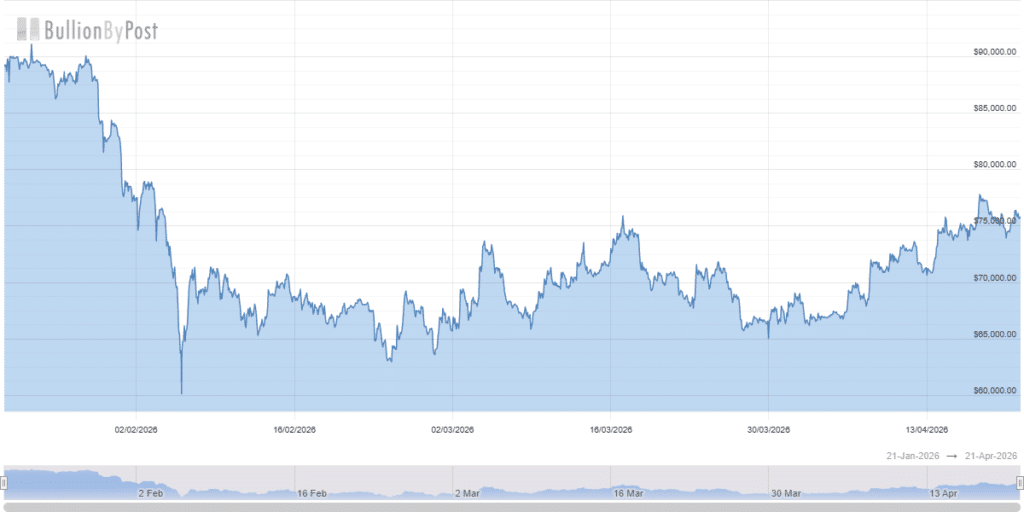
Bitcoin is currently trading at $76,003.00, up 2% in the last 24 hours, staying within the broader $76,000 to $78,000 range despite ongoing uncertainty around ceasefire negotiations. During peak escalation periods in April, liquidations reached approximately $341 million, highlighting continued volatility.
During this period, crypto markets showed a clear three-phase fluctuation pattern, influenced in part by the Iran–US–Israel conflict alongside broader macro factors. In Phase 1 (late February panic), Ethereum dropped to around $1,837, Solana fell near $77, and XRP declined to about $1.27, reflecting a sharp risk-off reaction across global markets.
In Phase 2 (March recovery), assets rebounded as conditions stabilized, with ETH rising above $2,300 (peaking near $2,375), SOL climbing toward $97, and XRP reaching around $1.60, supported by improving sentiment and institutional flows. In Phase 3 (April volatility), prices remained higher but unstable, with ETH peaking near $2,464, SOL around $90.67, and XRP near $1.50 before moderating.
Overall, the period reflects a typical cycle of initial panic, recovery, and then headline-driven volatility, where geopolitical developments acted as a key trigger while broader market forces continued to shape price direction.
How are analysts interpreting market signals amid ongoing volatility?
The Iran US Israel conflict continues to influence market sentiment, with analysts pointing to sustained uncertainty across digital assets. In a post on X, crypto analyst Michaël van de Poppe stated that ongoing tensions linked to the US-Iran war are a key driver of volatility. He noted that if this environment persists, major assets like Bitcoin, Ethereum, and Dogecoin are unlikely to perform strongly in the near term.
However, he also highlighted a contrasting macro factor. He remarked that the U.S. economy appears “sufficiently weak,” suggesting the Federal Reserve may be forced to return to monetary easing. Such a move could support risk assets, including cryptocurrencies, over time. Current market data reflects this mixed sentiment.
Ethereum is trading at $2,313.75, up 1.17% in the last 24 hours but down 3.05% over the past week. Solana stands at $85.55, gaining 1.18% in 24 hours while slipping 0.52% weekly. Dogecoin is priced at $0.09528, rising 1.05% daily and 1.94% over the week. XRP is at $1.43, marking a 1.45% increase in the last 24 hours. These movements indicate short-term recovery attempts, even as broader uncertainty tied to the Iran US Israel conflict continues to shape investor behavior.
Is Bitcoin evolving beyond a risk asset?
Bitcoin’s behavior during the Iran US Israel conflict suggests a transition in its market identity. Initially treated as a risk-off casualty, it has shown resilience supported by institutional demand. Spot Bitcoin ETFs recorded strong inflows, including about $1.7 billion in March alone.
Institutional investors appear to be using geopolitical dips as entry points rather than exit signals. Despite this shift, short-term reactions still align with risk asset behavior. Traders continue to favor gold and the U.S. dollar during acute uncertainty, indicating that Bitcoin’s evolution into a safe haven remains incomplete.
Notably, on April 17, Bitcoin surged above $78,000, reaching a two-month high after Iran signaled the reopening of the Strait of Hormuz, following a period where prices had remained capped below $76,000 earlier in the week.
What new use cases are emerging amid sanctions?
The Iran US Israel conflict has accelerated the adoption of cryptocurrency for practical and sovereign use cases. Financial isolation has forced alternative systems into active deployment. Iran has increasingly turned to Bitcoin and stablecoins such as USDT on the Tron network to facilitate international trade.
This approach helps bypass restrictions linked to traditional banking systems. Domestically citizens are also adapting. Many Iranians are moving funds into self-custody wallets and global exchanges to protect savings from the weakening rial. This reflects a growing reliance on crypto for wealth preservation during instability.
What lies ahead for crypto markets?
The direction of crypto markets now hinges on the outcome of ongoing geopolitical and diplomatic developments tied to the Iran US Israel conflict. If negotiations in Islamabad lead to de-escalation and smoother oil flows Bitcoin could test higher levels near $78,000 to $80,000.

However prolonged uncertainty or renewed military escalation may push prices toward the $70,000 range. Market participants are closely monitoring both ceasefire progress and activity in the Strait of Hormuz. These factors remain decisive for short-term sentiment.
Conclusion
The Iran US Israel conflict is reshaping the interplay between geopolitics and cryptocurrency markets, proving digital assets are inextricably linked to worldwide economic changes.
This ongoing crisis highlights both vulnerabilities and remarkable resilience in the crypto space. Markets saw initial sharp sell-offs followed by robust institutional inflows and new real-world applications, signaling a more mature asset class.
Yet, volatility persists as a key characteristic. The Iran US Israel conflict drives home a key point for investors and policymakers. Geopolitical developments now track hand-in-hand with financial indicators, both shape the future path of digital assets.
Disclaimer- This is a news report not investment advice. Crypto markets are volatile, so readers should verify data and make decisions at their own discretion.
Glossary
Strait of Hormuz: Major route for global oil supply
Liquidations: Forced closing of leveraged trades
Inflation Pressure: Rising costs from higher energy prices
Risk-Off Sentiment: Shift to safer assets during uncertainty
Ceasefire: Temporary pause in conflict
Frequently Asked Questions About Iran US Israel Conflict
What is the Iran US Israel conflict?
The Iran US Israel conflict is rising tension and military action between these countries affecting global markets.
Why are crypto prices falling during the conflict?
Crypto prices fall because investors move money to safer assets during risky global situations.
How did Bitcoin react to the conflict?
Bitcoin first dropped sharply and later recovered as market conditions improved.
Why is the Strait of Hormuz important for crypto markets?
The Strait of Hormuz is important because oil supply passes through it and affects global prices and inflation.
What could happen next to crypto markets?
Crypto markets may rise if tensions ease or fall again if the conflict becomes worse.