



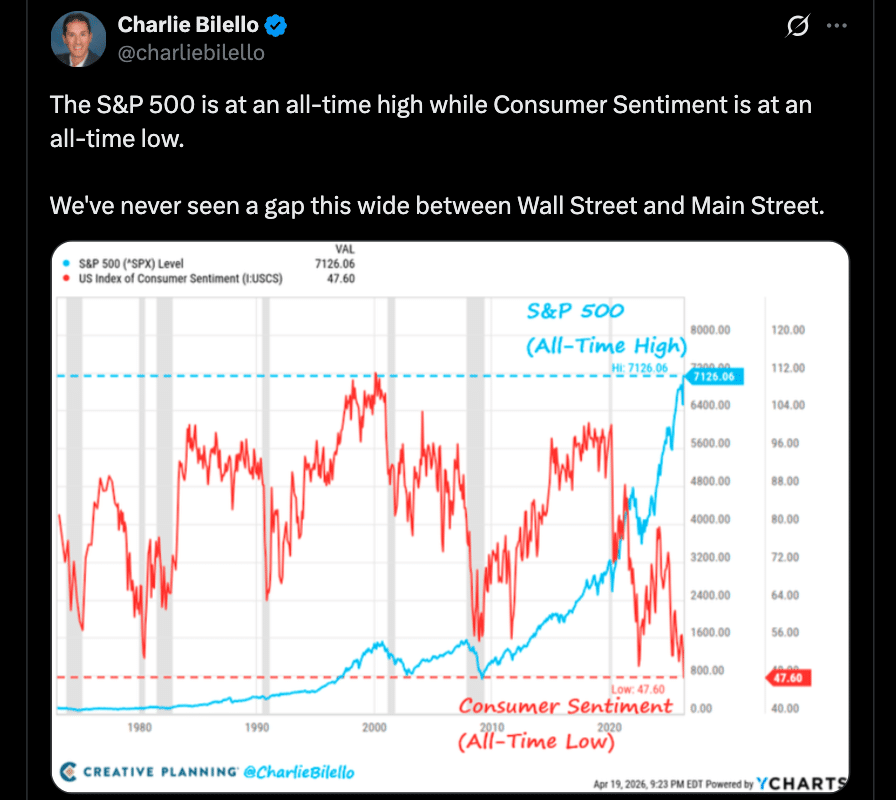
The market is currently facing a very sharp divergence so strong that it could hardly be ignored. The S&P 500 has surged to a high of 7,126, while the University of Michigan consumer sentiment index has dropped to 47.6, the lowest ever.
- Bitcoin vs S&P 500 Correlation Confirms Risk-Asset Behavior
- ETF Flows Are Tightening the Link Between Crypto and TradFi
- A Fragile Equity Rally Raises the Stakes And Consumer Weakness Adds More Risk
- Bitcoin Price Structure Shows Uncertainty
- Two Paths for Bitcoin If the Rally Breaks
- Conclusion
- Glossary
- Frequently Asked Questions About Bitcoin vs S&P 500
These two data points hardly ever move this far apart. While one reflects financial markets operating at peak optimism, the other reflects households under visible strain.
Right in the middle of these two forces is Bitcoin, and it is this Bitcoin vs S&P 500 tension that influences its price behavior today.
Bitcoin vs S&P 500 Correlation Confirms Risk-Asset Behavior
The most important signal right now is the Bitcoin vs S&P 500 correlation, which has climbed to 0.74, the highest level in 2026.
That number puts Bitcoin squarely into risk-asset territory in this current situation.
Recent analysis shows that Bitcoin is no longer moving by itself. As such, it is responding to the same liquidity flows, macro positioning and institutional behavior which are driving equities.
Over $50 billion in ETF inflows since 2024 has moved price discovery into institutional channels, meaning Bitcoin is now bought, hedged, and liquidated within the same systems as traditional assets.
This explains the particularly high correlation that is seen today. When liquidity tightens or risk appetite changes, Bitcoin reacts alongside stocks.
ETF Flows Are Tightening the Link Between Crypto and TradFi
ETFs are central to the behavior of Bitcoin. Spot Bitcoin ETFs saw inflows of around $1.6 billion in March, a sign that the tide was turning after months of outflows, which continued through April as well.
On April 6 alone, ETFs collectively took in $471 million in just one day, one of the strongest inflow sessions of the year
These inflows are doing two things. They are bringing institutional capital back into the market so that they may help price stability. They are also tightening Bitcoin to traditional markets since the same investors allocating into equities are now allocating to BTC.
That is why Bitcoin has been acting more like an independent asset and more like a leveraged extension of broader market sentiment.
A Fragile Equity Rally Raises the Stakes And Consumer Weakness Adds More Risk
Despite equities printing record highs, the structure is far from being broad based.
Recent market data show that a small group of companies is driving a large share of earnings growth and index performance. This kind of concentration can sustain rallies for a while, but it also increases fragility. If a small number of dominant stocks lose momentum, the entire index can correct quickly.
This is relevant to Bitcoin due to the heightened Bitcoin vs S&P 500 correlation. With the state of things today, any equity breakdown would likely emit directly into crypto markets.
The collapse in consumer sentiment shows actual stress in the economy. Households are dealing with higher living costs; higher fuel prices and tightening financial conditions. Also inflation expectations have jumped sharply; which further reinforces worries over purchasing power.
This creates a scenario where the markets are pricing in optimism and consumers are signaling stress. In past cycles, that kind of differing situation never lasts forever. It resolves itself either through higher demand or declining asset prices.
How everything gets resolved is a matter of time, and by extension the role Bitcoin has to play.
Bitcoin Price Structure Shows Uncertainty
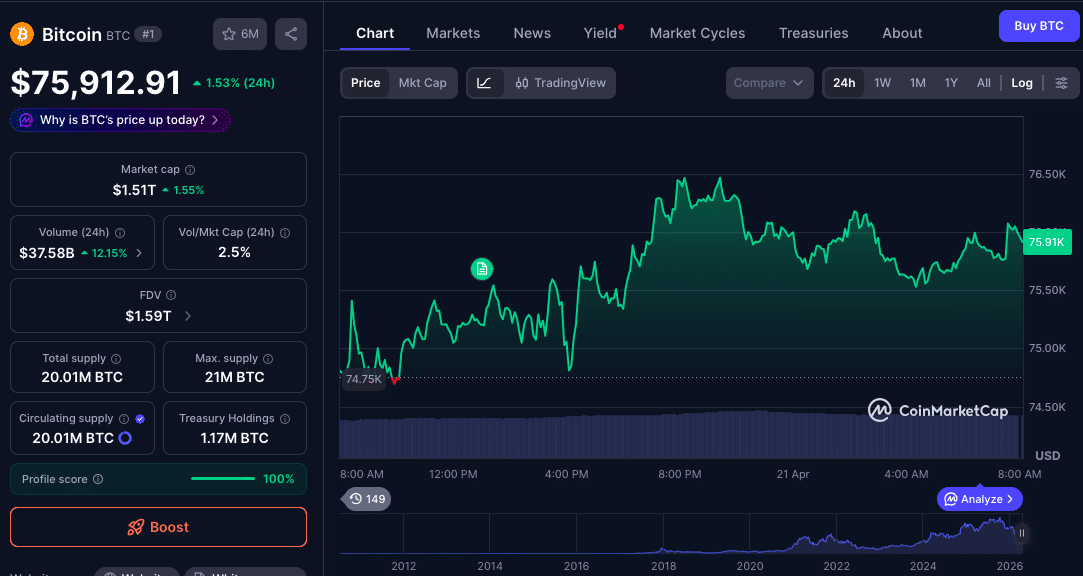
As at the time of writing, Bitcoin is trading around $75,912, where it has stabilized after a difficult first quarter where crypto suffered a decline of nearly 23% in Q1, its worst one since 2018.
BTC had traded in the mid $60,000s earlier in April before correcting as ETF inflows eased and macro conditions slightly improved.
This type of price action depicts a market that is neither fully bullish nor clearly bearish. Instead the market is waiting for a clear macro signal.
Two Paths for Bitcoin If the Rally Breaks
This arrangement has resulted in two separate consequences, both of which have been supported by data.
Should the equity rally fail, from either thinning leadership or macro pressure, Bitcoin will likely follow lower. The extended correlation implies BTC will behave as a high Beta risk asset, and amplify moves present in equities
This is the path that best fits current market activity.
The other version of things involves a change of attitude. If consumer stress continues and confidence in traditional financial systems weakens without triggering full-scale liquidation, Bitcoin could begin to trade as an alternative store of value.
There is little evidence at this point to support that. Bitcoin is still being priced in the same risk complex by the market. As of now, Bitcoin is closely tied to macro conditions.
Liquidity; interest rate expectations; and geopolitical developments are all feeding into the same system. Analysts note that crypto remains “downstream of macro liquidity,” meaning it reacts to broader financial conditions rather than setting its own path.
As long as this structure holds, Bitcoin will keep tracking with global risk sentiment.
Conclusion
The current market is forcing Bitcoin to make a choice. The Bitcoin vs S&P 500 correlation shows that BTC is deeply integrated into traditional financial systems. That integration brings capital, but it also brings dependency.
So naturally, if equities go higher, Bitcoin is also probably going with them. Bitcoin would more than likely find itself affected if equities were to crack.
It is still possible, but unproven in this cycle, that the alternative narrative of Bitcoin being a true hedge can prove itself.
For now, Bitcoin no longer sits on the outside of the system.
Glossary
Correlation: How closely two assets move together
ETF (Exchange-Traded Fund): A regulated investment vehicle to institutionalize Bitcoin exposure.
Risk Asset: An asset that is likely to perform well in the positive climate of a boom, but fail if uncertainty prevails.
Market Liquidity: The ability to buy or sell an asset quickly in the market without affecting its price.
Macro Conditions: Large economic situations such as inflation, interest rates, and events.
Frequently Asked Questions About Bitcoin vs S&P 500
Why is Bitcoin vs S&P 500 highly correlated in 2026?
By virtue of ETFs, institutional adoption has brought Bitcoin into traditional portfolios, rendering it susceptible to the same macro dynamics as equity.
Is Bitcoin still considered digital gold?
Definitely not in this current market stage. Bitcoin is acting more and more like a risk asset with its correlation at 0.74, rather than a safe haven.
What happens if the stock market crashes?
As a result of the current correlation, Bitcoin is likely to fall alongside equities.
Can Bitcoin decouple from stocks?
Yes, but it would require sustained macro stress and a shift in investor perception toward Bitcoin as a store of value.