

This article was first published on Deythere.
- SUI Price Rally Accelerates on Ecosystem Growth
- Bitcoin Consolidates as ETF Demand Supports Market
- Big Market Focus: House Vote on CLARITY Act
- Institutional Capital Turns to Projects With Utility
- Macro Developments Still Influence Sentiment
- Conclusion
- Glossary
- Frequently Asked Questions About The Crypto Market
- Why did SUI price surge nearly 24%?
- What is the CLARITY Act?
- Why is it important that Bitcoin holds above $81,000?
- What role are ETFs playing in the market?
- References
The crypto market has begun the week with selective strength as institutional capital rotated towards infrastructure-focused projects and Bitcoin came off slightly around $81,000.
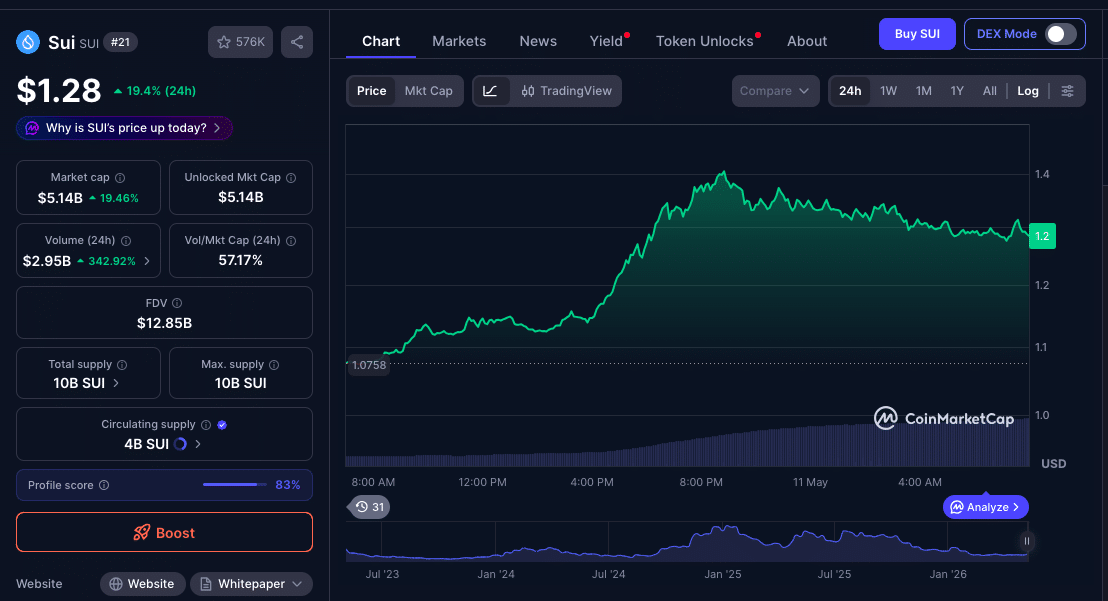
Sui’s token surged about 24% earlier today with increased trading volumes, stablecoin growth, and renewed enthusiasm over blockchain payment infrastructure. Meanwhile, Bitcoin is still bounded in a 80,500 – 82,000 range with traders focused on ETF flows and macro developments as well as the imminent US Senate markup session for the CLARITY Act.
Looking into the wider digital asset market, total crypto capitalization continued to sit around $2.7 trillion, while traders positioned for potential volatility later this week.
SUI Price Rally Accelerates on Ecosystem Growth
SUI dominated the crypto market when it rallied towards $1.40 level, surging by 24%, before retracing to $1.28 at press time, supported by over $2.6 billion in daily volume, as interest returned to high-throughput blockchain infrastructure projects.
Investor interest increased following several new ecosystem announcements tied to payments, tokenized assets, and stablecoin infrastructure during the recent Sui Live Miami event.
One of the biggest catalysts was the release of USDsui, a Stablecoin backed by US dollars through Bridge, Stripe’s payment company operating inside the Sui ecosystem. The stablecoin will be used in high-yield dollar accounts, cross-border payment services, and network-based tokenized real-world asset applications.
The developers also hinted at things like confidential transaction abilities and zero-fee payment functionality meant for AI-powered commerce and automated machine-to-machine transactions.
Those updates assisted in strengthening Sui as a utility blockchain.
Crypto market participants have also pointed out the network’s record of processing more than $1 trillion in stablecoin volume as evidence that capital is increasingly flowing toward blockchain infrastructure with real transaction demand behind it.
Bitcoin Consolidates as ETF Demand Supports Market
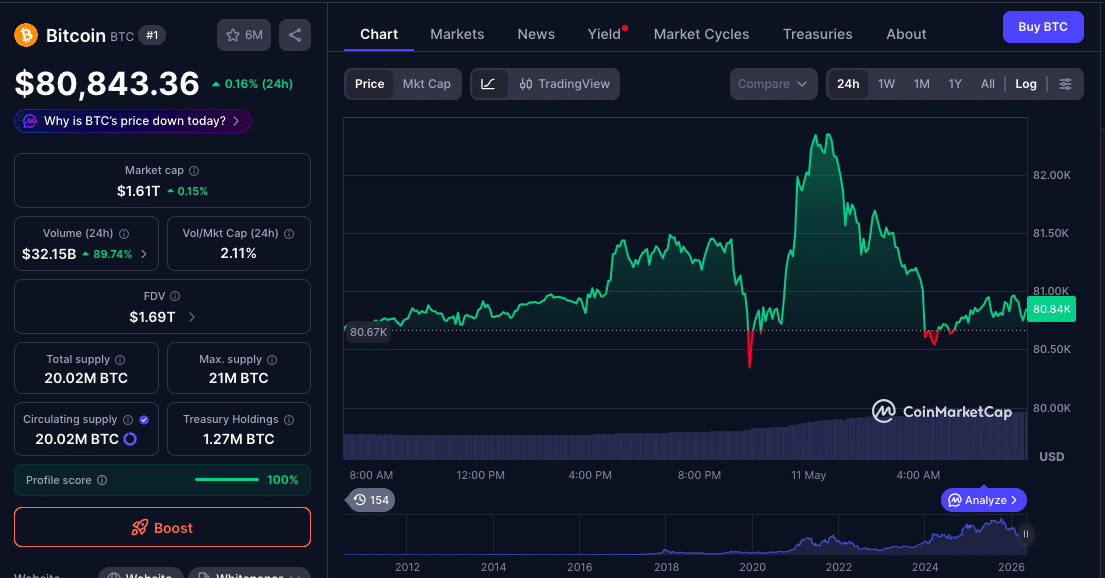
While altcoins captured attention, Bitcoin remained relatively stable near the $81,000 region
During most of the session, the asset traded range-bound with analysts keeping an eye on resistance near $82,500. A successful breakout above this level may open a higher price zone, while losing $80K support area could trigger short-term profit taking.
Demand for spot ETFs has kept on providing support to the market. Recent U.S. Bitcoin ETF data showed hundreds of millions of dollars in inflows during the first week of May; indicating continued institutional participation despite macro uncertainty.
Crypto market sentiment has also remained resilient despite stronger-than-expected U.S. economic data and geopolitical developments tied to the Middle East.
Options positioning is still overall bullish according to analysts; though traders are cautious about buying upside aggressively ahead of the regulatory events this week
Big Market Focus: House Vote on CLARITY Act
As the Senate Banking Committee finally set to have a long-anticipated markup session on the CLARITY Act on May 14, eyes are turning back toward Washington.
Known as the Digital Asset Market Clarity Act, the legislation is meant to simplify things in terms of creating regulatory boundaries between digital assets that should be regulated by the U.S. Securities and Exchange Commission (SEC) and those to be overseen by the Commodity Futures Trading Commission.
The bill would also deal with stablecoin oversight, market structure rules and restrictions associated with central bank digital currencies.
Recent negotiations surrounding stablecoin yield provisions had delayed progress; but lawmakers now appear closer to advancing the bill after a bipartisan compromise between senators on the Banking Committee.
If the legislation advances successfully; crypto firms such as Coinbase and Circle are expected to benefit from more certainty over their regulatory environment.
Crypto markets are treating the May 14 session as one of the most important U.S. crypto policy events of 2026 so far.
Institutional Capital Turns to Projects With Utility
Another noticeable trend across the crypto market has been the rotation away from speculative meme coin trading toward infrastructure-related projects.
Increased interest from institutions over the past several weeks has seen blockchain payment systems, tokenized real-world assets, AI-focused crypto platforms and stablecoin ecosystems take priority as topics of discussion.
With digital assets being progressively integrated into the traditional financial infrastructure, a number of firms are also looking into expanded crypto treasury strategies.
This transition might also be part of the reasons why infrastructure tokens, like SUI, have been able to outperform a large number of the rest of the market while BTC sat relatively range-bound.
Instead of a sweeping market euphoria, traders seem to be looking at projects with public adoption stats, payment integrations and narratives about their use over the long term.
Macro Developments Still Influence Sentiment
Outside the crypto markets, investors are also monitoring geopolitical developments following comments from Israeli Prime Minister Benjamin Netanyahu during a televised interview on CBS News’ 60 Minutes.
Netanyahu said that Israel plans to slowly cut down on its dependency on U.S. assistance for military support and also stated that Israeli-Iranian tensions remain unresolved.
Though indirect, geopolitical developments continue influencing risk sentiment through oil prices, Treasury yields and Federal Reserve expectations, all of which are becoming progressively more important to crypto flows in addition to ETF activity and institutional positioning.
Conclusion
The most recent market session reveals a crypto market driven more by infrastructure and regulatory developments than speculative excess.
The SUI price rally showed increasing interest from investors on blockchain ecosystems linked to payments; stablecoins, tokenization and AI-utilizing applications. Also, Bitcoin held around $81,000 but largely rangebound as ETF inflows kept the support behind price.
The upcoming May 14 CLARITY Act markup now stands as the next major catalyst for the sector.
However; traders remain cautious. The current recovery phase could still be interrupted by regulatory setbacks, macro volatility, or renewed selling pressure around Bitcoin resistance zones.
Glossary
Stablecoin: A cryptocurrency that is pegged to a stable asset like the U.S. dollar
ETF: Exchange-traded fund providing regulated access for investors to assets such as Bitcoin.
Tokenization: how traditional assets are represented on the blockchain networks.
Layer-1 Blockchain: A base blockchain network that processes and validates transactions independently.
Frequently Asked Questions About The Crypto Market
Why did SUI price surge nearly 24%?
After ecosystem updates connected with stablecoins; payment infrastructure, institutional staking and AI-based blockchain functionality sparked investor attention, SUI rallied.
What is the CLARITY Act?
The CLARITY Act is a draft law being considered by the United States; intended to provide clearer regulation of digital assets and stablecoins and crypto market structure.
Why is it important that Bitcoin holds above $81,000?
Sticking above $81,000 helps Bitcoin structure in the near term and maintains upside heading into key resistance levels.
What role are ETFs playing in the market?
Spot Bitcoin ETFs continue attracting institutional capital; helping absorb selling pressure and support Bitcoin prices during consolidation phases.