


This article was first published on Deythere.
- Banking Groups Resist as Yield Compromise Faces Criticism
- Lummis and Tillis Hold the Line as Bipartisan Coalition Stands Firm
- What the Stablecoin Yield Compromise Actually Does
- Markup Timeline, Political Risks, and Legislative Hurdles Ahead
- Conclusion
- Glossary
- Frequently Asked Questions About CLARITY Act Stablecoin Yield
- What is the stablecoin yield debate surrounding the CLARITY Act?
- Why are banks opposing the compromise?
- What does the compromise allow?
- When would the next procedural step for the bill happen?
- What is the probability that the bill passes in 2026?
- References
The fight over rules governing stablecoin yield under the CLARITY Act has reached a point where it is now playing out in public.
Tensions between lawmakers and the banking sector have escalated again just days ahead of an important Senate Banking Committee markup. The negotiation once held behind closed doors over stablecoin yield is now a full-fledged fight as the two sides dig in.
The dispute centers around a basic but high-stakes question: Should stablecoins be able to earn yield like bank deposits or should they be limited in order to not compete with existing lending systems?
Banking Groups Resist as Yield Compromise Faces Criticism
Five large Washington banking organizations: the American Bankers Association, Bank Policy Institute, Consumer Bankers Association, Financial Services Forum and Independent Community Bankers of America, issued a joint statement condemning the recent compromise.
They argue bluntly that the bill, even in its revised form, still does too little to ensure stablecoins do not function like bank deposits.
They argued that Senators Tillis and Alsobrooks are seeking to achieve the correct policy goal prohibiting the payment of yield and interest on stablecoins; however, the proposed language falls short of that goal… yield-earning stablecoins could reduce all consumer, small-business, and farm loans by one-fifth or more.”
This anxiety corresponds to a much bigger problem.
Deposits provide the resources for banks to lend. If users move money into stablecoins that give similar yields, the capacity of traditional lending could be reduced. That fear fueled months of lobbying that had previously blocked progress on the bill.
However; banking groups have continued to push for updating the language even more aggressively, effectively reopening negotiations that lawmakers believed were over.
Lummis and Tillis Hold the Line as Bipartisan Coalition Stands Firm
The lawmakers’ response was quicker.
Cynthia Lummis took to social media to publicly defend the bill; saying it was the product of months of negotiation:
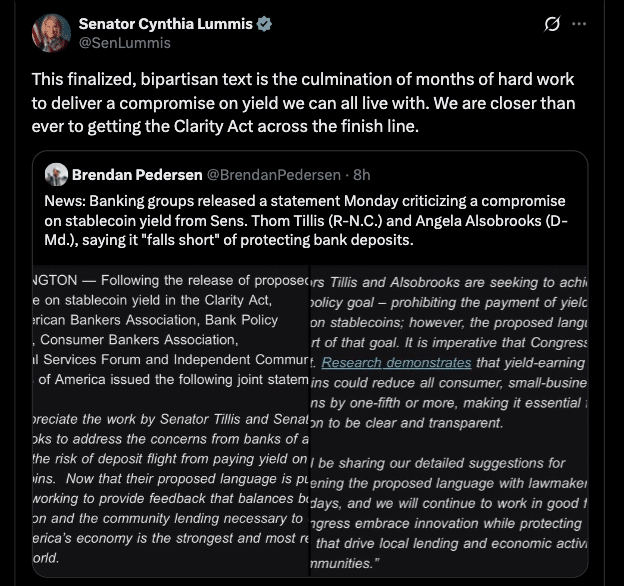
For Lummis, the legislation carries added weight. Having announced she will not seek reelection after 2025; the CLARITY Act is widely viewed as a defining piece of her policy legacy.
Thom Tillis who teamed with Angela Alsobrooks to craft the compromise; pushed back even more forcefully:
“We have worked on a bipartisan basis with all stakeholders to address the banking industry’s concerns about deposit flight.”
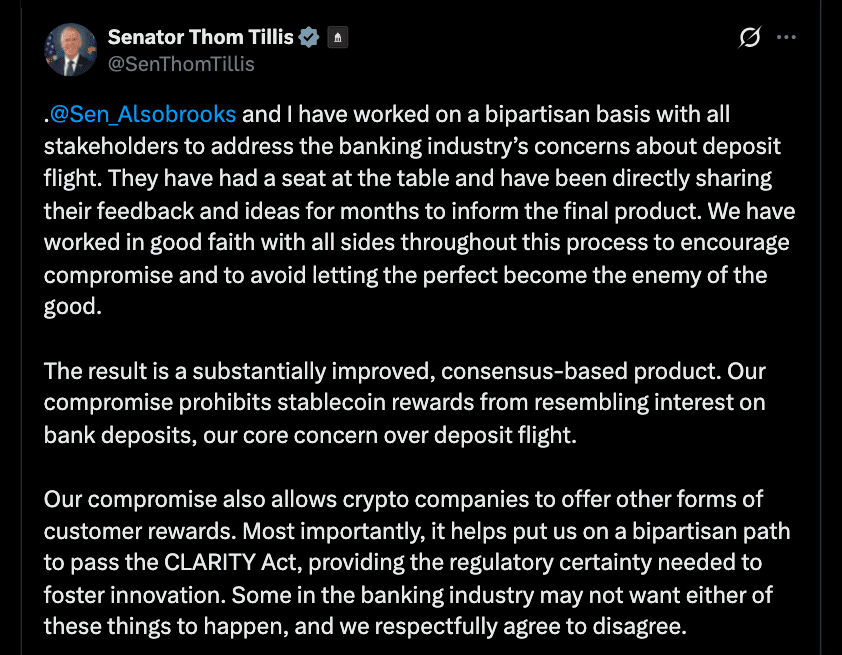
That unified defense at this point in the process means lawmakers are unwilling to reverse course on the compromise.
What the Stablecoin Yield Compromise Actually Does
The main issue of the CLARITY Act stablecoin yield debate lies in how the final language draws the line.
Under the Tillis-Alsobrooks framework: Crypto companies are banned from paying interest or yield that looks like bank deposit returns; It prohibits any reward “economically or functionally equivalent” to interest. However, activity-based rewards are still permitted, as long as they are linked to real platform or network usage.
Lawmakers are looking to ban passive income models where users accrue yield just by holding stablecoins, but want to keep incentives linked with genuine economic activity.
This compromise is what unlocked progress on the bill after months of gridlock. This is also why crypto firms responded favorably.
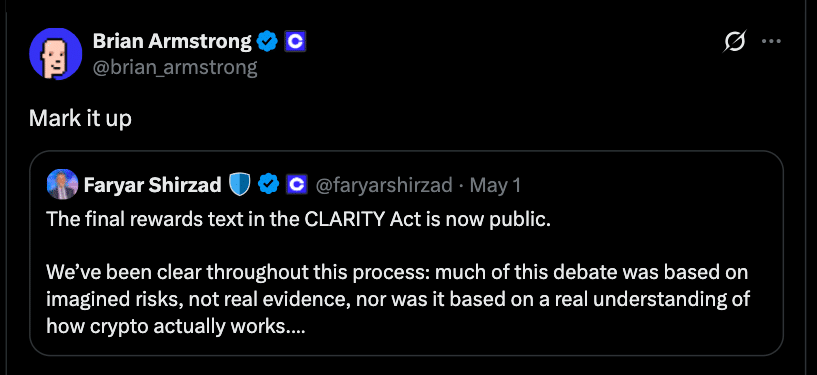
Almost immediately, Brian Armstrong replied with “Mark it up” meaning he supports the bill moving forward. The reason the dispute is back on the table is that banks still see this as a loophole rather than a solution.
Markup Timeline, Political Risks, and Legislative Hurdles Ahead
The Senate Banking Committee is targeting the week of May 11 for markup, through which the bill blueprint moves on to more serious consideration.
Meanwhile, Tim Scott, who chairs the committee, is working to secure enough Republican support. However, not all votes are locked in, with John Kennedy still withholding support.
In addition to committee approval, the bill needs to go through a few more steps and these include :
Senate Banking Committee markup; 60-vote Senate floor threshold; Reconciliation with the Senate Agriculture Committee version; Conformity to the House-passed bill of July 2025; Final presidential approval
Each stage introduces new risks.
Other points of contention are also arising. Other issues related to the DeFi liability provisions that have: Law enforcement issues over the previously discussed DeFi liability provisions are still to be worked out, while a safe-harbor for developers reviewed by Senate Judiciary Committee chair Chuck Grassley under U.S. criminal law continues.
Passage is far from assured, even with momentum.
Prediction markets now rate the chances of the bill passing into law by the end of 2026 as about 47%, a far cry from earlier this year. But analysts put the odds nearer to a coin flip.
Recent events provide a glimpse of why the expectations are mixed: The enthusiasm opened the door to higher crypto stocks and even drove Bitcoin close to $80K. While the deal removed a major obstacle for lawmakers, it did not eliminate political uncertainty. Analysts still see only around 40-50% odds of final passage
The next two weeks leading into the Memorial Day recess are now of high importance.
Conclusion
The fight over CLARITY Act stablecoin yield rules has moved beyond negotiation into open confrontation.
Banking groups are trying to find a last minute way to tighten restrictions, while lawmakers are suggesting the compromise is sealed. But that tension also points to a decades-old rift between traditional finance and the crypto industry, one this bill is trying to bridge..
Should the compromise survive, the CLARITY Act could move forward and reshape U.S. crypto regulation. If it fails, months of work could be undone.
Either way, the outcome will determine how stablecoins either compete with the banking system or coexist with them.
Glossary
CLARITY Act: a proposed U.S. law to regulate crypto market structure.
Stablecoin yield: earning a return on stablecoin holdings.
Markup: when a congressional committee considers and makes changes to a bill.
Deposit flight: the transfer of funds from banks to alternative assets.
DeFi: decentralized finance applications built on blockchain.
Frequently Asked Questions About CLARITY Act Stablecoin Yield
What is the stablecoin yield debate surrounding the CLARITY Act?
It revolves around the question of whether or not stablecoins should offer yield similar to bank deposits.
Why are banks opposing the compromise?
They worry that stablecoins will reduce deposits and undermine lending power.
What does the compromise allow?
It forbids passive yield while allowing rewards based on actual user behaviour.
When would the next procedural step for the bill happen?
A Senate Banking Committee markup is expected around May 11.
What is the probability that the bill passes in 2026?
Estimates currently range around 40-50%.