

Private stablecoin payments are quietly reshaping how large institutions view blockchain finance. What once felt too transparent for serious business use is now evolving into something more practical, controlled, and aligned with real-world financial needs.
- The Voice Behind the Shift Signals a Deeper Change
- Private Stablecoin Payments vs Public Transactions: A Clear Divide
- Privacy With Compliance at the Core
- Institutions Demand What Blockchain Lacked
- Market Momentum and Competitive Pressure Are Building
- Conclusion
- Glossary of Key Terms
- FAQs About Private Stablecoin Payments
According to the source, Polygon has launched private stablecoin payments through a new wallet feature. This system allows transactions to stay hidden from public view while still meeting compliance standards, a balance that could unlock wider institutional adoption.
The Voice Behind the Shift Signals a Deeper Change
The message from industry insiders is becoming clearer. Privacy is no longer optional for onchain finance.
As highlighted in a recent report, Polygon community lead Smokey noted, “For onchain payments to go mainstream, businesses need privacy. Not ‘hide from regulators’ privacy. Operational privacy.”
This statement reflects a growing understanding. Institutions are not looking to bypass rules. They want the same confidentiality they already have in traditional systems.
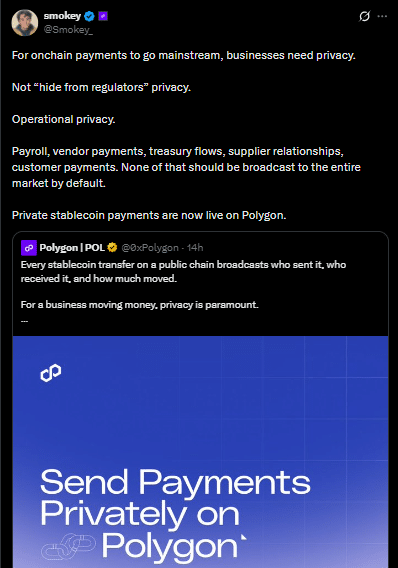
Private Stablecoin Payments vs Public Transactions: A Clear Divide
The difference between old and new systems becomes obvious when comparing how transactions work. In traditional blockchain payments, every detail is visible. Anyone can track who sent funds, who received them, and how much was transferred. This level of transparency works for public networks but creates risk for businesses.
Private stablecoin payments change that structure. Transactions pass through a shielded pool, which acts like a protective layer. It hides sensitive details while still confirming the transaction using zero-knowledge proofs.
In simple terms, the network proves a payment happened without exposing private data. This “before and after” shift makes private stablecoin payments far more suitable for institutional use.
Privacy With Compliance at the Core
Polygon makes a strong distinction between privacy and secrecy. The system ensures that private stablecoin payments remain compliant at every step.
As explained in a compliance analysis, “privacy means opacity to the market, not opacity to regulators.”
Each transaction goes through Know Your Transaction screening before execution. This ensures that funds meet regulatory standards.
At the same time, integration with Hinkal allows users to generate audit files. These files can be shared with tax authorities or regulators when required, giving institutions both control and accountability.
Institutions Demand What Blockchain Lacked
The push for private stablecoin payments is rooted in a long-standing gap between traditional finance and blockchain systems.
Polygon emphasized this clearly, stating in the same report, “Confidentiality has been the single biggest gap between onchain rails and what institutional finance actually needs to move serious stablecoin volume.”
It further noted that “banks, treasuries and payments teams already live with confidentiality on traditional rails. They won’t move operational flows onto a ledger that broadcasts every counterparty and every amount.”
This perspective adds weight to the argument. Without privacy, institutions simply cannot operate at scale on public blockchains.

Market Momentum and Competitive Pressure Are Building
The rise of private stablecoin payments comes at a time when privacy is already shaping the crypto narrative. In 2025, privacy-focused projects gained traction even during broader market weakness.
Polygon’s own ecosystem reflects this growth. Stablecoin market value on the network reached $3.6 billion, making it the eighth-largest stablecoin chain. This signals rising demand for practical use cases.
Meanwhile, competition is intensifying. Aptos introduced its confidential token model, while regulatory clarity from the GENIUS Act has encouraged institutional participation.
Even traditional finance is stepping in. Western Union launched its USDPT stablecoin on Solana, highlighting the growing convergence between legacy systems and blockchain innovation.
Conclusion
Private stablecoin payments are not a niche innovation anymore It is a partial alleviation of one of the biggest problems with blockchains. They combine privacy with compliance to provide the bridge between open networks and institutional requirements.
The move by Polygon signals more than a slight of hand. In my view, the future of the finance world on blockchain isn’t likely to be driven by radical transparency but rather controlled visibility. If that balance prevails, private stablecoin payments could function as a primary layer of global financial infrastructure.
Glossary of Key Terms
Private Stablecoin Payments: Transactions that hide sensitive details while remaining compliant with regulations.
Zero-Knowledge Proof: A method that confirms a transaction without revealing its data.
Shielded Pool: A system that conceals transaction details from public view.
KYT (Know Your Transaction): A compliance check before executing transactions.
Stablecoin: A cryptocurrency linked to a stable asset like the US dollar.
FAQs About Private Stablecoin Payments
What are private stablecoin payments?
They are transactions that protect user data while still following regulatory rules.
How do private transactions differ from public ones?
Public transactions reveal all details, while private ones hide sensitive data using secure verification.
Can regulators still track private payments?
Yes, audit files and compliance checks ensure regulators can review activity when needed.
Why is this important for institutions?
It allows businesses to operate securely without exposing financial data on public networks.