
Ripple’s dollar-backed stablecoin has entered a wider trading lane after a new OKX rollout opened access across more than 280 spot pairs, perpetual futures use cases, and selected margin collateral support.
The development gives Ripple RLUSD a stronger exchange footprint at a time when stablecoins are becoming one of crypto’s most practical products, not only for traders but also for institutions moving money between digital assets and fiat-linked liquidity. The key question now is simple: can broader exchange access help the token move from roughly $1.5 billion in circulating supply toward the $2 billion mark?
Ripple RLUSD Gains Exchange Depth Through OKX
The latest expansion gives Ripple RLUSD more than a listing. It gives the asset trading utility across a wider part of the exchange market, which matters because stablecoins grow when they are easy to use, easy to settle, and easy to move between trading strategies. The rollout allows eligible users to trade the token across 280+ spot pairs, use it with perpetual futures, and access it as institutional-grade margin collateral in selected markets.
That is a meaningful step because stablecoin adoption usually follows liquidity. Traders often choose the dollar token that fits the most pairs, the fastest movement, and the cleanest collateral use. In that sense, Ripple RLUSD is trying to enter a field long dominated by USDT and USDC, but with a sharper focus on regulated reserves and institutional payment rails.

Why the $2B Milestone Matters
A move toward $2 billion would not put Ripple RLUSD near the top of the stablecoin market yet, but it would show that Ripple’s stablecoin push is gaining real distribution. Ripple’s own transparency page showed total circulating RLUSD of about $1.489 billion as of April 23, 2026, with reserve funds of about $1.590 billion.
That reserve gap is important. In plain English, stablecoin users want to know that each token is backed by assets that can support redemption. Ripple states that the token is designed to maintain a $1 value, is issued on XRP Ledger and Ethereum, and is backed by segregated cash and cash equivalents with 1:1 redemption for US dollars, subject to availability by jurisdiction.
For traders, the $2 billion line would act like a confidence marker. It would suggest that exchange access, collateral use, and institutional demand are working together rather than sitting in separate corners.
Key Crypto Indicators to Watch
The first indicator is circulating supply, if Ripple RLUSD supply rises steadily after the OKX expansion, it would show that traders and institutions are actually minting or holding more of the token, not just reacting to a headline.
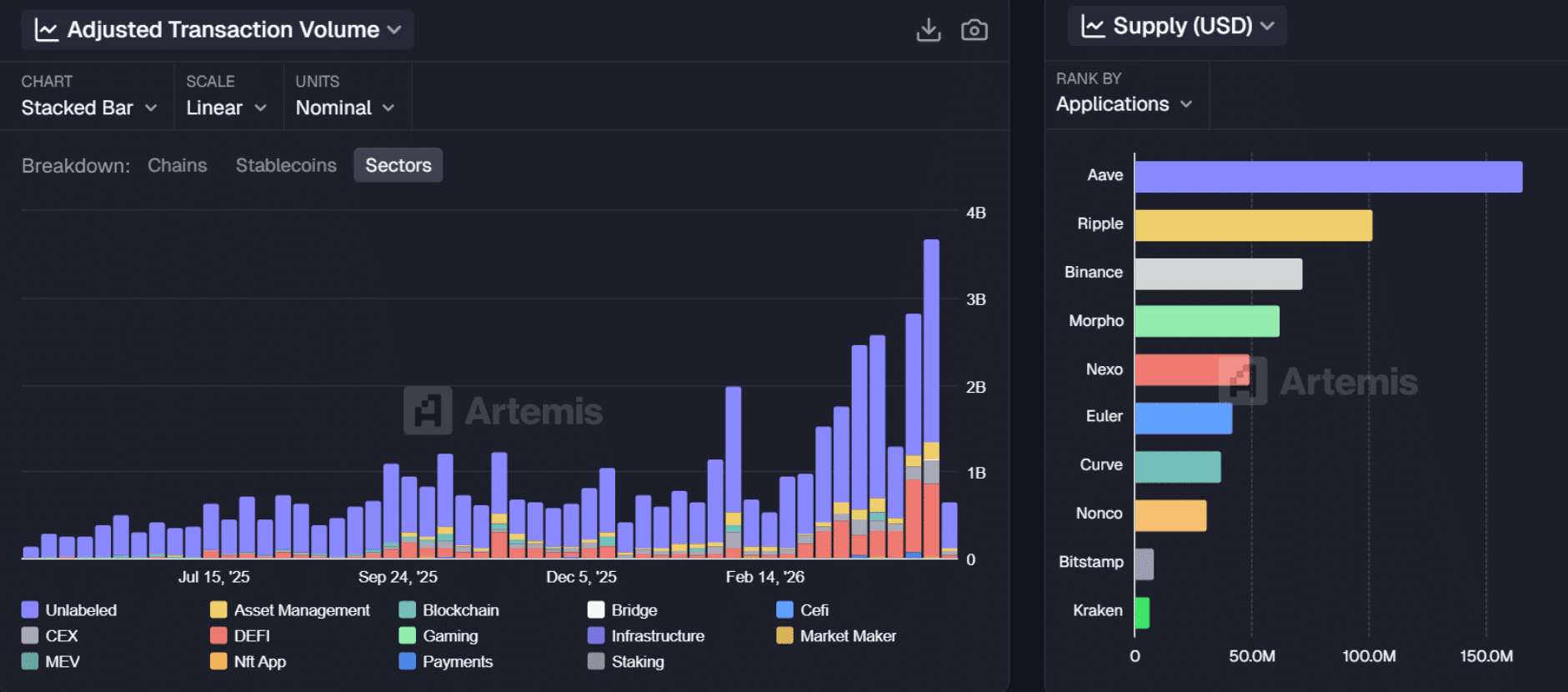
The second indicator is liquidity depth, a stablecoin can be listed across many pairs, but what matters is whether order books become deep enough for large trades without wide slippage. Thin liquidity makes an asset look available, but not always useful.
The third indicator is chain distribution, Ripple RLUSD is issued on XRP Ledger and Ethereum, and that split matters because Ethereum brings DeFi reach while XRP Ledger can support faster payment-focused settlement. If more supply shifts toward XRP Ledger, it may strengthen the token’s connection to Ripple’s broader payments infrastructure.
The fourth indicator is collateral demand, margin collateral use is a quiet but powerful adoption signal because institutions usually care about risk controls, settlement efficiency, and redemption trust before they use a stablecoin inside leveraged markets.
The fifth indicator is reserve transparency as Ripple says it provides monthly reserve reports by an independent third-party accounting firm to validate circulating supply and backing assets. In a market still shaped by past stablecoin failures, that kind of reporting is not decoration; it is table stakes.
Institutional Use Could Shape the Next Phase
Ripple has spent years positioning itself around payments, liquidity, and enterprise-grade crypto infrastructure. Ripple RLUSD fits that direction because it gives the company a dollar-linked asset that can sit inside trading, settlement, and cross-border payment flows.
This is where the OKX rollout becomes more than a market access update. If institutions use the token as collateral and traders use it across hundreds of pairs, the stablecoin may gain daily utility. That is often what separates a temporary listing effect from a durable adoption curve.
Still, competition will be tough. USDT and USDC already benefit from huge network effects, and most traders do not switch stablecoins unless there is a clear reason. Ripple RLUSD will need more than trust; it will need repeated use across exchanges, payment partners, and on-chain markets.
Conclusion
The OKX expansion gives Ripple RLUSD a stronger shot at reaching the $2 billion supply level, but the milestone is not automatic. The next phase depends on whether liquidity deepens, collateral use grows, and circulating supply continues to rise beyond the early listing effect. For now, the signal is positive: Ripple’s stablecoin has moved from a new entrant to a serious product trying to win space in one of crypto’s most competitive markets.
Frequently Asked Questions
What is Ripple RLUSD?
Ripple RLUSD is a US dollar-backed stablecoin designed to maintain a 1:1 value with the dollar and support trading, settlement, and payment use cases.
Why is OKX support important?
OKX support matters because it gives the token access to 280+ spot pairs, selected futures use, and margin collateral functions, which can improve liquidity and market utility.
Can it reach $2 billion in supply?
It can, but only if demand keeps growing after the rollout. Supply, liquidity depth, reserve trust, and institutional use will decide whether the target becomes realistic.
Glossary of Key Terms
Stablecoin: A crypto asset designed to track the value of another asset, usually the US dollar.
Circulating supply: The number of tokens currently issued and available in the market.
Margin collateral: Assets used to support leveraged trading positions.
Liquidity: The ease with which an asset can be bought or sold without sharply moving its price.
Sources