


This article was first published on Deythere.
- Bitcoin Correlation Exposes Fragile Fee Structures
- Reflexive Fee Sectors: Where Revenue Expands And Collapses Fast
- DePIN and Stablecoins Offer a Different Fee Model
- DEXs and Derivatives Sit in the Middle, Volatility Helps, But Risk Remains
- Valuation Risk: Why Fee Compression Could Trigger Market Repricing
- Conclusion
- Glossary
- Frequently Asked Questions About Crypto Fees
In the first half of 2025, a total of $9.7 billion in on-chain crypto fees were paid by users, an increase of 41% year-over-year and the second-highest level ever recorded according to research published by 1kx.
That growth has changed the way that investors analyze crypto protocols. Fees have moved from the sixth measurement to direct revenue impacting valuations, decks and institutional narratives.
Going forward, 1kx estimates crypto fees to exceed $32 billion in 2026 as application-layer activity across DeFi, wallets and new verticals continues to grow.
However, this expansion also comes with an important caveat; most of that growth has happened during a strong bull market, where firmer prices have supported activity generally. The important question is not how much those crypto fees can go up in a bull market; it is their behavior when conditions reverse.
Bitcoin Correlation Exposes Fragile Fee Structures
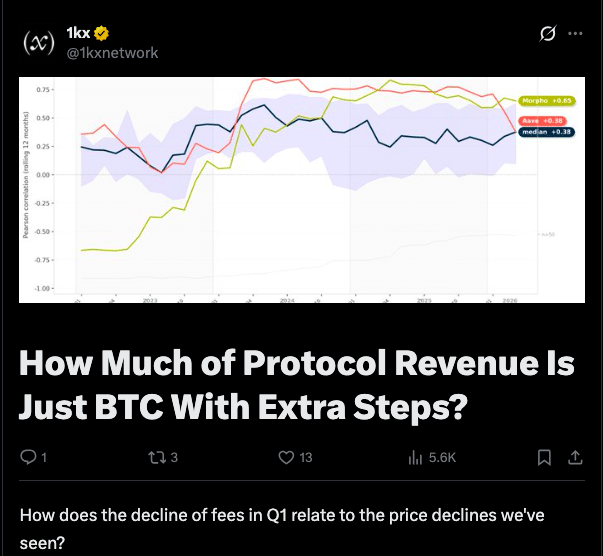
According to the 1kx analysis, nearly every major Bitcoin fee category is positively correlated with BTC price; thus, as BTC rises higher in value, fee generation tends to rise too. At first glance, it feels like evolution. In reality, it brings up dependency issues.
The report pulls out an important fact that a correlation of 0.6 is only part of the story but it is the behavior of fees in down cycles that counts.
Some sectors could drop at 0.8x of Bitcoin, while others may shed at 1.5x the rate, creating downside leverage risk.
This introduces the concept of downside beta, where fee revenue doesn’t just follow Bitcoin but can also overreact to it.
As the report notes, a protocol can look like a stable business in a bull market, yet behave like a leveraged bet on Bitcoin when macro conditions deteriorate.
Reflexive Fee Sectors: Where Revenue Expands And Collapses Fast
1kx specifically refers to the most exposed segments as “reflexive fee clusters.”
They encompass liquid staking, restaking, vault strategies, launchpads and automation-driven protocols. Their crypto fee structure is directly tied to market volume, leverage and investor sentiment.
These sectors do well when prices go up. Rates rise, capital comes in and activity picks up. However, this very dynamic gets reversed during periods of decline.
For example, liquid staking and restaking rely heavily on borrowed capital and risk appetite. In a tighter market, yields shrink and so does participation.
Vault curators face similar issues. During bullish momentum, assets under management will grow, however price during sell-offs can evaporate rapidly due to outsized outflows.
Launchpads are even more sensitive. Their crypto fee generation depends mostly on the market. New token launches speed up in strong markets. Activity can dry up almost instantaneously when confidence vanquishes.
The same pattern is followed by automation and DeFAI protocols. Their revenue is directly reliant on transaction volume and strategy deployment, both moving in the opposite direction when traders pull back.
Neither of these sectors generate fees independently, they are outputs of speculative activity, which itself is a function of price direction).
DePIN and Stablecoins Offer a Different Fee Model
Not all the crypto fee sectors act in the same way. 1kx also showcases Decentralized Physical Infrastructure Networks (DePIN) as the least-correlated category of assets with Bitcoin fees, meaning their fees are least tied with BTC price.
DePIN protocols earn their revenue not through trading or yield, but from providing real-world services. They compute, storage, bandwidth and infrastructure usage.
Demand for these services comes from operational needs rather than speculation. Although token prices continue to influence incentives, they now have no direct effect on fee levels.
Consequently, DePIN is estimated to earn over $450m in 2026 alone with sustained triple-digit growth.
The same can be said about stablecoin issuers and RWA protocols. Unlike others, they are not purely reliant on trading volume as their revenue is generated through issuance, reserves and asset management.
They have correlation with Bitcoin at about 0.2, which is much lower than the majority of DeFi sectors.
It does not make them immune to declines, but it gives them a stronger structural case for maintaining revenue during market stress.
DEXs and Derivatives Sit in the Middle, Volatility Helps, But Risk Remains
A gap exists between these two ends. Decentralized exchanges, lending platforms and derivatives protocols are moderately correlated to Bitcoin with DEXs around 0.33 and lending around 0.3 against BTC; while derivatives correlate very differently
These sectors benefit from volatility. Even in falling markets, trading activity can remain high, supporting fee generation. But this advantage is not stable.
Fee compression, liquidations and position unwinds during stress events can destabilize the revenue streams. The outcome is a more complicated crypto fee schedule where fees may initially hold but as conditions worsen, they trend lower.
Consequently, this renders their revenues less predictable than what simple correlation metrics imply.
Valuation Risk: Why Fee Compression Could Trigger Market Repricing
The truth is that crypto fees extend beyond just revenue; they have a direct impact on valuations.
1kx data shows that price-to-fee (P/F) ratios across crypto sectors vary, with some blockchains trading at thousands of times their annualized fees, while DeFi protocols sit closer to traditional financial multiples.
Valuations could adjust quickly if fee growth slows or declines. In DeFi & finance, reduced revenues can get priced before the rest of the trend sets in i.e. changes in fees often lead price movements. This becomes even more pronounced in the case of a Bitcoin drawdown.
Fee compression may occur first in high correlation sectors and then multiple contraction. Investors who have valued these protocols as stable businesses will now likely need to regard them as cyclical, beta-sensitive assets.
Conclusion
Crypto fees are growing fast, and they suggest an industry moving toward sustainable revenue.
However, the basis of that growth is still deeply anchored to Bitcoin and greater market movements.
As long as macro conditions remain supportive, fears of inflation subdued, oil stable, and risk perceptions healing, the expansion in fees could extend, thus supporting the ongoing narrative. Reversing conditions changes the situation very fast.
A Bitcoin drawdown would not just affect prices. It would expose which fee models are truly resilient and which are simply riding market momentum.
Glossary
On-chain fees: payments made on a blockchain for the use of its resources or services
Downside beta: How an asset/revenue stream behaves in a downturn (especially if it makes things worse)
DePIN: Blockchain networks with real-world infrastructure services
P/F Ratio: price-to-fee ratio for valuing crypto protocols
AUM : Assets under management in investment or DeFi platforms
Frequently Asked Questions About Crypto Fees
What are crypto fees?
Crypto fees are the costs that users pay in order to use a blockchain network such as transaction fees, trading fees and protocol fees.
What brought about the $9.7B in crypto fees?
The surge was driven by an increase in DeFi growth, trading activity, and usage of applications seen during a bullish market.
How are crypto fees connected with Bitcoin?
The prices for most of the categories also go up and down in sync with Bitcoin price, which opens a margin between earnings and losses due to increased or reduced market activity.
Which sectors have the most stable fees?
DePIN, stablecoins, and RWA protocols show lower correlation with Bitcoin and more stable revenue structures.
How do fees behave during a market downturn?
Sectors with greater correlation may see fees fall more quickly than the price of Bitcoin itself, revealing fragile models of revenue.
References