

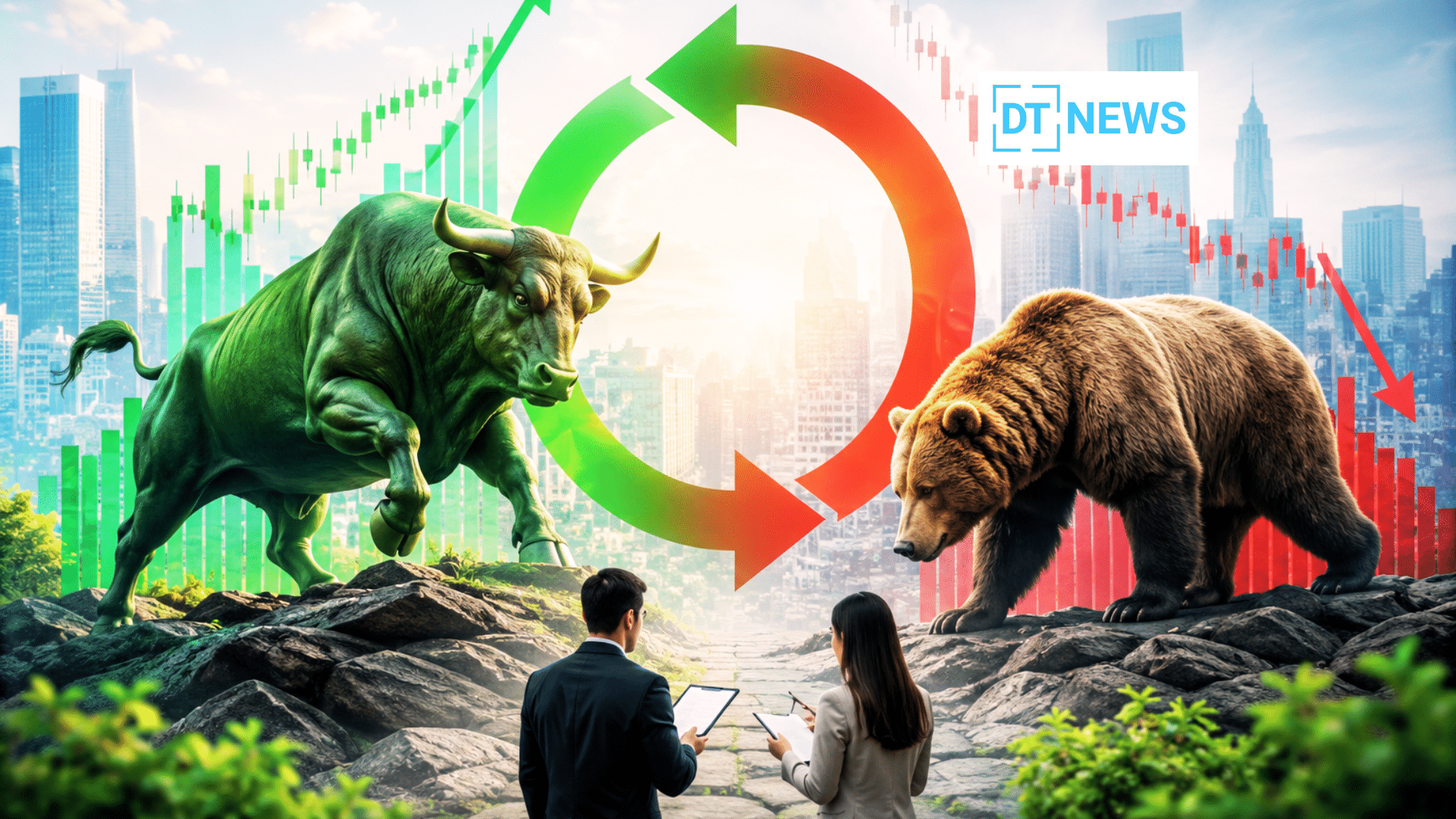

Bull market vs bear market is a foundational framework used to understand how financial markets transition between phases of expansion and decline. Bull market vs bear market reflects changes in price direction, investor sentiment, liquidity conditions, and capital flow across assets such as equities and Bitcoin.
- Bull market vs bear market: What do these market phases represent?
- What are the key characteristics of each market phase?
- How do market drivers influence bull and bear cycles?
- How do investors approach different market conditions?
- What indicators help identify market direction?
- How does Bitcoin behave across market cycles?
- Conclusion
- Glossary
- Frequently Asked Questions About Bull Market vs Bear Market
These cycles are shaped by macroeconomic forces, regulatory developments, technological progress, and investor psychology. For market participants, understanding bull market vs bear market is essential for interpreting risk, managing exposure, and making informed decisions during volatile conditions.
Bull market vs bear market: What do these market phases represent?
Bull market vs bear market refers to two opposing phases of market behavior driven by sustained price movement and shifting sentiment. A bull market represents a prolonged period of rising prices supported by optimism and strong demand.
A bear market represents a prolonged period of falling prices driven by fear and reduced participation. In bull market vs bear market cycles, direction determines behavior. Rising phases attract liquidity, encourage new participation, and strengthen confidence.

Declining phases reduce risk appetite, slow activity, and increase caution. These patterns are visible across traditional financial markets and digital assets like Bitcoin, where sentiment shifts often occur rapidly due to higher volatility.
What are the key characteristics of each market phase?
Bull market vs bear market conditions can be identified through distinct and recurring characteristics that reflect investor behavior and market structure. A bull market is typically marked by rising asset prices, strong investor confidence, high trading volumes, increasing liquidity, positive media coverage, widespread optimism, and fear of missing out that draws in new participants.
These elements tend to reinforce each other and sustain upward momentum. A bear market, on the other hand, is characterized by declining asset prices, weakening confidence, lower trading activity after volatility spikes, reduced liquidity, negative media sentiment, panic-driven selling, and a rise in failed or struggling projects within risk assets.
These conditions often reinforce downside pressure and extend the period of contraction. In bull market vs bear market environments, these characteristics rarely appear in isolation. Instead, they interact and amplify the dominant trend of the cycle.
How do market drivers influence bull and bear cycles?
Bull market vs bear market phases are strongly shaped by underlying macroeconomic and structural drivers that influence liquidity and investor behavior. Interest rates and inflation are key factors. Lower interest rates generally increase liquidity and encourage risk taking, which supports bullish conditions.
Higher rates reduce borrowing capacity and tighten financial conditions, often contributing to bearish pressure. Regulatory developments also play a significant role, particularly in cryptocurrency markets where policy clarity or restrictions can quickly shift sentiment.
Institutional adoption is another important driver, as increasing participation from large investors tends to strengthen upward cycles, while reduced institutional exposure can accelerate downturns. Technological advancements also influence long term cycles.
Improvements such as blockchain scalability upgrades, Lightning Network development, and Layer 2 solutions enhance utility and can support sustained demand in digital assets. In bull vs bear market analysis, these drivers help explain why cycles expand during periods of liquidity and confidence, and contract when financial conditions tighten.
How do investors approach different market conditions?
Bull market vs bear market requires different behavioral and strategic approaches depending on the phase of the cycle. In bull markets, investors often participate in upward momentum while gradually securing profits to protect gains.
Exposure is usually managed carefully to avoid overextension during late stage euphoria, where emotional buying can increase risk. Portfolio diversification also becomes important to reduce concentration risk while capturing growth.
In bear markets, attention usually moves toward keeping capital safe and thinking beyond short-term price drops. Investors tend to scale down risk, hold back from panic selling, and add positions bit by bit instead of going all in at once through dollar cost averaging.
This approach is based on the idea that declining markets frequently reflect temporary pessimism rather than permanent value loss, although careful evaluation of fundamentals remains essential. Across bull market vs bear market cycles, disciplined execution and emotional control often matter more than precise market timing.
What indicators help identify market direction?
Bull market vs bear market conditions are usually identified through a combination of technical, macro, and sentiment signals rather than one fixed indicator. On the technical side, analysts watch price trends, moving averages, and momentum to see whether the market is consistently moving up or slipping into a downtrend.
Macro indicators include inflation trends, interest rate movements, employment data, and liquidity conditions, all of which influence capital availability and investor behavior. Sentiment indicators usually focus on how the market feels rather than what the charts show.
Media coverage, investor confidence, and overall participation in trading activity often shift noticeably when markets reach emotional extremes, either excessive optimism in strong rallies or deep pessimism during sharp declines. In bull vs bear market analysis, separating these indicators into categories improves clarity and helps reduce misinterpretation when signals conflict.
How does Bitcoin behave across market cycles?
Bull market vs bear market dynamics are clearly visible in Bitcoin’s historical performance, which is shaped by both structural supply factors and external economic conditions. One major driver is the halving cycle, where Bitcoin’s supply issuance is reduced approximately every four years.

This structural event has historically aligned with periods of increased upward momentum. Institutional adoption is another key factor as growing participation from large investors can strengthen demand during expansion phases.
Upgrades like the Lightning Network and other improvements to the Bitcoin network tend to make it more practical to use and gradually strengthen its long term value case. But when regulations change or the broader economy turns uncertain markets often react fast and that can deepen or speed up sell offs as investors move away from risk.
Bitcoin’s price behavior shows that bull market vs bear market conditions in digital assets are shaped by a mix of how new supply enters the system how demand rises or falls over time and how global economic conditions shift investor appetite for risk.
Conclusion
Bull market vs bear market continues to serve as an essential framework for understanding financial markets and shaping investment decisions across different economic conditions. During expansion phases bull market vs bear market awareness helps investors balance participation in growth with disciplined profit management and risk control.
During contraction phases, it supports structured accumulation strategies, capital preservation and long term positioning through approaches such as dollar cost averaging. Bull vs bear market ultimately shows that financial markets move in repeating cycles driven by liquidity, psychology, and macroeconomic forces. Investors who understand these phases and adjust their strategies accordingly are better positioned to navigate uncertainty and build sustainable long term outcomes.
Glossary
Bull market : Rising prices with strong investor confidence and optimism.
Bear market : Falling prices driven by fear, uncertainty, and weak demand.
Market cycle : Repeating rise and fall pattern in financial markets.
HODL : Holding assets long-term despite market ups and downs.
DCA : Investing fixed amounts regularly to reduce volatility risk.
Frequently Asked Questions About Bull Market vs Bear Market
Why do bull and bear markets happen?
They happen because of changes in economy, news, investor mood, and market conditions.
How long do market cycles usually last?
Market cycles usually last for months or years depending on economic conditions.
How do investors behave in a bull market?
Investors buy more in a bull market as they expect prices to keep rising.
How do investors behave in a bear market?
Investors often sell or wait in a bear market because they expect prices to fall.
What factors influence bull and bear markets?
Interest rates, inflation, liquidity, regulations, and investor behavior influence market cycles.