
This article was first published on Deythere.
- New Token Plan Brings Order but Leaves Holders with a Decision
- WLFI Damage Control Narrative Meets Loss of Trust
- Governance Structure Still Overshadows the Fix
- Market Reaction Hinges on Execution, Not Messaging
- Conclusion
- Glossary
- Frequently Asked Questions About WLFI Governance Proposal Plan
- What is the WLFI governance proposal plan?
- Why are some holders concerned?
- What does the plan change?
- Does the proposed plan address the governance problems?
- What will it take for the plan to succeed?
- References
Following weeks of public scrutiny and market pressure, there is certainly a lot of interest surrounding the latest WLFI governance proposal plan as World Liberty Financial works to reignite investor confidence.
The project, which has gotten attention because of its ties to Donald Trump, is now facing a credibility test after several events including fights over governance and concerns about lending and investor protests which shook confidence in the structure.
But as recent reporting reveals, the team has quickly mobilized to deliver an updated token framework intended to bring order back. However, the urgency behind the proposal has also influenced how it is being interpreted.
Instead of a long-planned upgrade, the move is widely seen as a response to building pressure, especially following high-profile criticism from Justin Sun and growing criticism of WLFI’s internal controls and lending practices.
New Token Plan Brings Order but Leaves Holders with a Decision
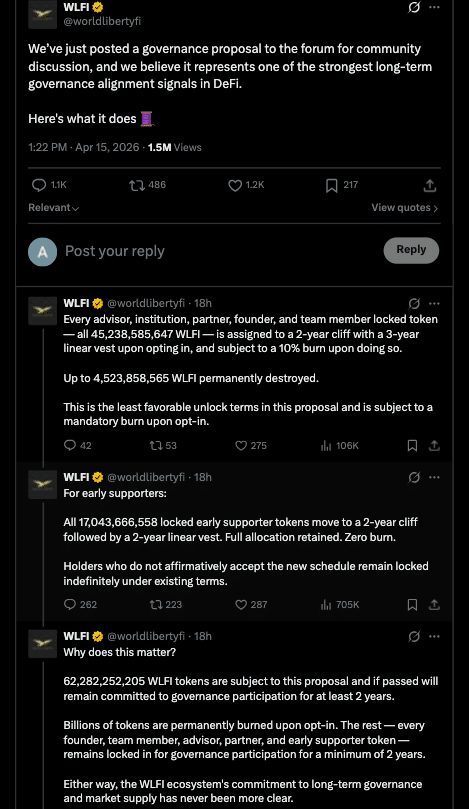
The main focus of the seeming WLFI governance proposal plan is the restructuring of 62.28 billion locked tokens, aimed at restoring clarity to what had become an increasingly unclear system.
The proposal offers a more rigid vesting structure:
Early supporters would see 17.04 billion tokens moved into a two-year cliff followed by a two-year linear release, while insiders including founders and partners would face an even longer timeline, with 45.24 billion tokens subject to a two-year cliff and three-year vesting schedule.
Up to 4.52 billion WLFI will also be burnt (another 10%) as a display of accountability in relation to insider-linked tokens.
The structure appears disciplined on the surface. It delays supply pressure, synchronizes insider incentives with long-term performance and provides a clearer guide to token circulation.
But the most important feature is not vesting really, it’s the opt-in mechanism.
The holders would be required to actively accept the new terms. Those who do get a defined schedule for unlocking. Those who don’t are subject to their previous terms, which could, according to recent reporting, translate into limited access to their tokens for long periods of time, possibly permanently.
This somehow creates a split system, where clarity is conditional, not universal.
WLFI Damage Control Narrative Meets Loss of Trust
The WLFI governance proposal plan appears to be clearly designed as a sign of reform. The longer insider lockups and token burn imply that the team is prepared to take some of the cost for restoring credibility.
However, the larger context makes it more difficult to take the proposal for what it seems. Confidence amongst investors had already been shaken by previous events, including arguments about constraints on wallets and governance choices.
Reports described how certain accounts of investors including those associated with Justin Sun had been restricted within the system, and questions remain around just how much say or control over user assets did the protocol in fact have.
Reports also cited increasing investor frustration over what they characterized as centralized control and limited transparency, especially surrounding decision-making and access to the token.
This context gives a different spin to how the new proposal is viewed. Instead of being seen strictly as a structural upgrade, it is being read as just an effort to contain fallout.
Governance Structure Still Overshadows the Fix
While the WLFI governance proposal plan clarifies token mechanics, it does little to change the internal governance framework.
One of the biggest questions is around concentration of influence. WLFI also announced a “Super Node” tier which required large token commitments, for increased access and governance weight.
It enforces a hierarchy around policymaking power, separating large and small capital holders, begging the question of whether holders with smaller stakes can enter decision-making roles at all.
Things get more complicated by the project’s involvement in leveraged lending structures. According to on-chain data, WLFI has collateralized tens of millions in stablecoin loans with its own tokens, a configuration that analysts say risks external participants being exposed to losses should market conditions sour.
These combined forces reveal that the power distribution is still unchanged even while the token unlock situation is being resolved.

Market Reaction Hinges on Execution, Not Messaging
The success of the WLFI governance proposal plan will depend far more on how it is implemented than on its design.
A few critical tests now define the next phase for the project:
First, the proposed token burn needs to be done transparently on-chain. In the absence of verifiable proof, the move is at risk of being viewed as symbolic rather than substantive.
Second, the extent of participation will show whether holders have faith in the new framework. A low opt-in rate would show continued skepticism and leave a large portion of tokens in limbo.
Third, the project needs to spell out how wallet restrictions, governance decisions and administrative controls actually work.
Without this transparency, there will be uncertainty despite the vesting improvements, meaning nothing really changes.
Finally, accountability around past decision making, in particular those that are the result of lending structures and risk exposure, will be an important part of rebuilding trust.
Conclusion
The WLFI governance proposal plan does succeed in one respect and that is the introduction of a clearer path for token unlocks, reducing near-term uncertainty regarding supply.
But beyond that, its impact is limited. The proposal doesn’t really alter the way power is distributed or decisions made or how much control a protocol retains over user assets. It is, instead, a heavy-handed reaction to an ecosystem that was already under stress.
In that respect, experts say it operates more like a pressure valve, not really a reset because governance proposals alone will not determine the next phase.
Glossary
Cliff Vesting: A previous where a number of tokens are locked up until release starts
Linear Vesting: Slow distribution of tokens throughout the vesting period.
Token Burn: Restructuring of tokens by burning them.
Governance: How decisions are made for a blockchain protocol.
Collateralized Lending: Borrowing using assets as security.
Frequently Asked Questions About WLFI Governance Proposal Plan
What is the WLFI governance proposal plan?
A new token unlock proposal for ecosystem stabilization that enables vesting schedules and token burns
Why are some holders concerned?
Because participation is voluntary, and those who decline the new terms could be locked out forever.
What does the plan change?
Prolonged vesting, tighter insider lockups, and a possible 10% token burn.
Does the proposed plan address the governance problems?
No, it optimizes token structure but does nothing to address wider governance issues.
What will it take for the plan to succeed?
Execution, transparency and whether investors will trust the system again.