

Stablecoin regulation is rapidly turning into one of the biggest financial battles in Washington as banks, crypto firms, and lawmakers struggle over the future of digital dollars. What once looked like a narrow policy disagreement has now evolved into a larger debate about banking control, consumer rewards, and the role of crypto in the American financial system.
- White House Says Banks Ignored Earlier Stablecoin Regulation Talks
- The CLARITY Act’s “Loophole” Dispute Sits at the Center of the Fight
- White House and Galaxy Research Challenge Banking Industry Claims
- Political Tensions Rise Ahead of Senate Markup
- Conclusion
- Glossary of Key Terms
- FAQs About Stablecoin Regulation
According to the source, a senior White House official accused major banking trade leaders of refusing to attend earlier meetings focused on resolving disputes around stablecoin rewards and yield. The controversy erupted just days before the Senate Banking Committee prepares to review the CLARITY Act, a major proposal aimed at building a broader framework for digital asset markets.
White House Says Banks Ignored Earlier Stablecoin Regulation Talks
Patrick Witt, executive director of the White House Presidential Advisory Committee on Digital Assets, claimed American Bankers Association President Rob Nichols and other banking executives rejected invitations to February meetings focused on stablecoin rewards. Witt later criticized those leaders publicly on X, arguing banks had an earlier opportunity to settle concerns before reopening the fight ahead of the Senate vote.
The comments pulled the White House deeper into the stablecoin regulation debate. Instead of appearing as a late technical concern, the banking industry’s objections now look like part of a wider campaign to slow crypto competition before the CLARITY Act advances further.
The CLARITY Act seeks to establish rules for digital asset markets, but stablecoin rewards have become the bill’s most controversial issue. Banks fear crypto firms could use reward systems to compete directly with traditional savings accounts and attract deposits away from lenders.

The CLARITY Act’s “Loophole” Dispute Sits at the Center of the Fight
The American Bankers Association argues the current CLARITY Act language leaves room for crypto platforms to bypass restrictions. Even if stablecoin issuers cannot offer direct yield, affiliated exchanges, brokers, or apps could still provide rebates, rewards, or incentives that function like interest payments.
Banks warn that stablecoin regulation allowing these structures could weaken traditional lending models. Since banks depend heavily on customer deposits to fund mortgages, business loans, and consumer credit, even moderate deposit migration could raise funding costs and pressure net interest margins.
The latest Senate compromise attempts to separate passive yield from activity-based rewards. Lawmakers hope that distinction can stop stablecoins from becoming full substitutes for interest-bearing bank accounts while still allowing platforms to reward users for payments and ecosystem participation.
Crypto firms, however, argue consumers deserve access to returns generated from stablecoin reserves, which are usually backed by cash and short-term Treasury bills.
White House and Galaxy Research Challenge Banking Industry Claims
The White House Council of Economic Advisers pushed back against banking concerns in a recent economic analysis. The report estimated that banning stablecoin yield would increase bank lending by only about $2.1 billion, equal to roughly 0.02% of total US lending.
Officials argued that stablecoin reserves would continue circulating throughout financial markets through Treasury bills, banks, and liquid assets rather than disappearing from the economy entirely.
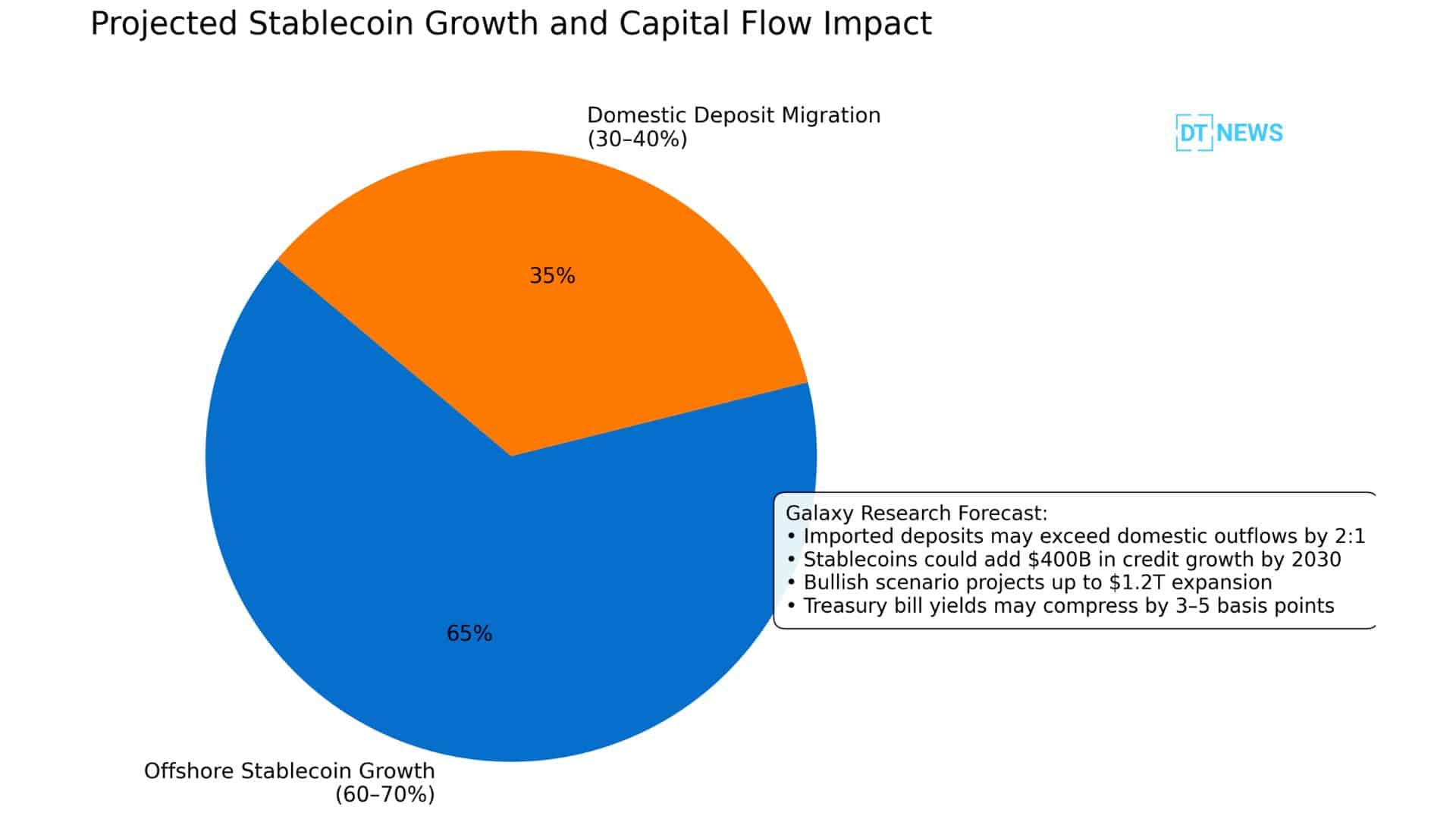
Meanwhile, a separate report from Galaxy Research suggested banks may be overstating the long-term risks. Galaxy projected that 60% to 70% of future stablecoin growth could come from offshore users seeking easier access to dollar-denominated assets.
That forecast changes the entire economic narrative. Instead of simply draining domestic deposits, stablecoins could pull foreign capital into US financial infrastructure. Galaxy estimated imported deposits from overseas demand could exceed domestic deposit migration by roughly 2:1.
The firm also projected that each newly issued stablecoin dollar could generate nearly 32 cents in net US credit expansion. Under its base forecast, stablecoins could contribute around $400 billion in additional credit growth by 2030. In stronger adoption scenarios, that figure could climb to nearly $1.2 trillion.
Galaxy further estimated that growing demand for stablecoin reserves could compress Treasury bill yields by 3 to 5 basis points, potentially lowering federal borrowing costs over time.
Political Tensions Rise Ahead of Senate Markup
The stablecoin regulation dispute has now become deeply political. Coinbase-backed Stand With Crypto accused banks of protecting profits while trying to weaken stablecoin rewards before the Senate markup of the CLARITY Act.
Senator Bernie Moreno intensified the conflict by accusing major banks of preserving monopolistic control over financial services. Moreno linked the debate to alleged debanking practices during the Biden era and referenced “Operation Choke Point 2.0,” a phrase commonly used by crypto advocates who believe regulators pressured banks to distance themselves from digital asset businesses.
At the same time, some Democrats continue pushing for stronger anti-money-laundering rules, ethics safeguards, and consumer protections within the CLARITY Act framework.
Conclusion
The battle over stablecoin regulation has become much larger than a disagreement about crypto rewards. It now reflects a broader struggle over who controls digital finance, how consumers access financial returns, and whether traditional banks can maintain dominance in an increasingly tokenized economy.
If the CLARITY Act advances with its current compromise intact, stablecoins could accelerate global demand for dollar-backed digital assets and reshape payment systems worldwide. However, if lawmakers tighten restrictions under banking pressure, crypto firms may face new barriers just as international appetite for digital dollars continues growing.
Glossary of Key Terms
Stablecoin Regulation: Rules governing stablecoins, reserves, and digital payment systems.
CLARITY Act: Proposed US legislation focused on crypto market structure and oversight.
Stablecoin Yield: Rewards or returns offered to users holding stablecoins.
Net Interest Margin: The difference between what banks earn from loans and pay on deposits.
Operation Choke Point 2.0: Phrase used by crypto advocates alleging regulatory pressure against crypto-linked banking activity.
FAQs About Stablecoin Regulation
What is stablecoin regulation?
Stablecoin regulation refers to laws controlling stablecoin reserves, payments, and consumer protections.
Why are banks concerned about stablecoins?
Banks fear stablecoins could pull deposits away from traditional savings accounts and increase funding costs.
What does the CLARITY Act aim to do?
The CLARITY Act seeks to establish a broader regulatory framework for digital assets in the United States.
What did Galaxy Research predict about stablecoins?
Galaxy projected stablecoins could drive hundreds of billions in future credit expansion while increasing global demand for US dollars.