

Morgan Stanley has moved closer to expanding its presence in the digital asset investment market after updating filings for its proposed Ethereum and Solana exchange-traded funds. The move reflects the growing competition among financial institutions seeking to offer regulated crypto investment products in the United States.
- Morgan Stanley ETF filings reveal a new fee strategy
- What do the proposed Ethereum and Solana ETFs include?
- How will staking rewards work for the new funds?
- Why are lower fees becoming important in crypto ETFs?
- What details were revealed about Ethereum staking capacity?
- What does Morgan Stanley’s move mean for the crypto ETF market?
- Conclusion
- Glossary
- Frequently Asked Questions About Morgan Stanley Ether and Solana ETFs
- What did Morgan Stanley file with the SEC?
- Who will provide staking services for the ETFs?
- What fee will the new ETFs charge?
- What are the proposed ETF ticker symbols?
- Will the ETFs offer staking rewards?
- Sources
The amended filings provide fresh details about the planned funds, including their structure, staking arrangements and expected trading names. The company has also outlined a competitive pricing approach, with the proposed fee details appearing in the updated registration documents.
The company’s revised Form S-1 filings show that both proposed ETFs would carry a 0.14% annual sponsor fee. The pricing would place the products below several existing market offerings and highlights the firm’s effort to compete in an increasingly crowded crypto ETF sector. The updates come as investors and industry participants continue watching the development of spot crypto ETFs and the regulatory process surrounding new product launches.
Morgan Stanley ETF filings reveal a new fee strategy
The latest amendments submitted for Morgan Stanley’s Ethereum and Solana ETFs show that both funds are expected to charge a 0.14% annual sponsor fee based on each fund’s net asset value. The proposed fee would undercut current competing products. The lowest-fee spot Ethereum ETF currently available in the U.S. is the Grayscale Ethereum Staking Mini ETF at 0.15%, while Franklin Templeton’s Solana ETF carries a 0.19% fee.

The pricing reflects a competitive approach as the company makes a late entry into the spot crypto ETF market. The sector is currently dominated by issuers such as BlackRock and Fidelity and lower fees have become a key tactic for attracting investor attention. The U.S. Securities and Exchange Commission received another update from Morgan Stanley as the firm revised its ETF filings for the second time since submitting the initial applications.
What do the proposed Ethereum and Solana ETFs include?
The Ethereum ETF filing lists the proposed fund name as the Morgan Stanley Ethereum Trust, with MSSE as its planned trading ticker once approval is granted. The proposed Solana ETF appears in the filing as the Morgan Stanley Solana Trust, with MSOL mentioned as the ticker symbol for the fund. If regulators approve the funds, they would become the 11th spot Ether ETF and the seventh spot Solana ETF to launch in the United States.
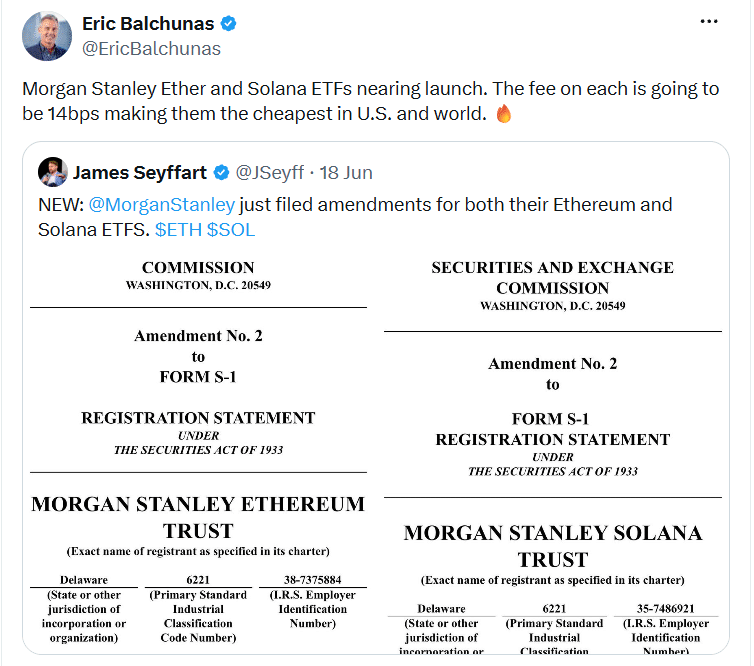
Eric Balchunas reacted to the updated filings by pointing out the 0.14% fee, saying the proposed ETFs would be “the cheapest in the U.S. and world.” The analyst’s comments came after the new details were disclosed. However, the funds are not yet approved, and their launch will depend on the SEC’s decision.
How will staking rewards work for the new funds?
The amended filings provide details about how staking services would operate for both ETFs. Figment, Galaxy Blockchain Infrastructure and Coinbase Canada are listed as staking service providers for the proposed products. Each ETF would apply a 5% fee on staking rewards generated through the service arrangements. The remaining 95% of staking rewards would remain within the trusts.
The filings state that Morgan Stanley would not receive staking rewards beyond the management fee. The structure separates the sponsor’s compensation from the rewards generated through blockchain participation. For the Ethereum ETF, custodians would place ETH into Ethereum staking smart contracts, while staking providers would operate validators for the trust.
The filing also noted that staked Ether could face slashing penalties if validators fail to meet network requirements. The Solana ETF would follow a similar staking structure. Service providers could operate delegated validators for staked SOL while custodians would not control the private keys connected to staked tokens.
Why are lower fees becoming important in crypto ETFs?
Low fees have become a major competitive factor as asset managers attempt to attract investors in the expanding spot crypto ETF market. The company previously used a similar pricing approach for its Bitcoin ETF, which launched in April with a 0.14% fee. That rate was below Grayscale’s 0.15% fee on its mini Bitcoin ETF.
The Bitcoin product recorded $30.6 million in first-day inflows after launch. Since then, total inflows have reached $331 million, exceeding ETFs from Invesco, Franklin Templeton and CoinShares that launched in January 2024. The latest Ethereum and Solana ETF filings continue this pricing strategy as Morgan Stanley attempts to compete with established players.
The move could increase fee competition among ETF issuers as firms look for ways to attract assets in a crowded market. However, fees are only one factor investors consider. Fund structure, liquidity, distribution networks and institutional confidence also influence decisions when choosing investment products.
What details were revealed about Ethereum staking capacity?
The Ethereum filing included additional information about the network’s staking conditions. The document stated that approximately 3.64 million ETH was waiting for validator activation as of May 18, 2026. The filing explained that Ethereum allows about 56 validators per epoch, which equals roughly 57,600 ETH per day.
Based on these figures the estimated waiting period before queued ETH could begin earning staking rewards is around 63 days. These details provide investors with more information about how staking operations could affect potential rewards if the ETF receives regulatory approval. The filings detail the funds’ custody setup, validator services and how staking rewards would be handled.
What does Morgan Stanley’s move mean for the crypto ETF market?
Morgan Stanley is advancing its plans for Ethereum and Solana ETFs as competition among financial institutions in the digital asset sector continues to grow. The proposed 0.14% fee places the planned funds below current market offerings, while the staking structure provides additional details about how investors could participate in blockchain rewards.

The company’s approach follows its Bitcoin ETF launch and signals a broader effort to build a presence across multiple crypto asset categories. The market will continue to monitor the SEC’s review process, as approval decisions will determine whether the proposed ETFs move from registration filings to active trading products.
Conclusion
Morgan Stanley is positioning its proposed Ethereum and Solana ETFs around competitive fees and detailed staking arrangements as it seeks a larger role in the crypto investment market. The updated filings provide greater clarity on fund operations including staking providers, reward distribution and expected trading tickers.
While the products remain subject to regulatory approval the developments show how competition among ETF providers is shaping the next stage of digital asset investment products. The updates reflect how financial firms are expanding their approach toward crypto-based investment products.
Glossary
Ether ETF- Fund that gives investors exposure to Ether.
Solana ETF- Fund that gives investors exposure to Solana.
Spot ETF- ETF backed by actual crypto holdings.
Staking- Earning rewards by helping secure a blockchain.
MSSE- Ticker for Morgan Stanley’s proposed Ether ETF.
Frequently Asked Questions About Morgan Stanley Ether and Solana ETFs
What did Morgan Stanley file with the SEC?
Morgan Stanley updated its filings for proposed Ether and Solana ETFs.
Who will provide staking services for the ETFs?
Figment, Galaxy Blockchain Infrastructure and Coinbase Canada will provide staking services.
What fee will the new ETFs charge?
The proposed ETFs will charge a 0.14% annual fee.
What are the proposed ETF ticker symbols?
The Ether ETF would trade as MSSE and the Solana ETF as MSOL.
Will the ETFs offer staking rewards?
Yes both ETFs are designed to include staking rewards.