



Coinbase Gemini lawsuit has taken center stage after New York authorities initiated legal action against two major crypto platforms over their prediction market offerings. The case was filed in April 2026 by the New York Attorney General’s office and challenges how event-based trading products are classified under state law.
- What does the Coinbase Gemini lawsuit say about the alleged violations?
- How did the Coinbase Gemini lawsuit begin in New York?
- Why is the Coinbase Gemini lawsuit focused on licensing rules?
- What financial penalties are involved in the Coinbase Gemini lawsuit?
- How are Coinbase and Gemini responding to the lawsuit?
- What is the broader regulatory conflict behind the lawsuit?
- Conclusion
- Glossary
- Frequently Asked Questions About Coinbase Gemini Lawsuit
It focuses on whether these platforms operated within gambling regulations or outside licensed financial oversight. The dispute has quickly become a key reference point in the broader regulatory debate surrounding prediction markets in the United States.
What does the Coinbase Gemini lawsuit say about the alleged violations?
The Coinbase Gemini lawsuit claims both firms ran unlicensed prediction market operations that functioned as gambling under New York law. The New York Attorney General Letitia James said Coinbase Financial Markets and Gemini Titan allowed users to place bets on outcomes linked to sports and elections.

These event contracts also extended to other public outcomes such as award-related results, where users traded based on predictions rather than ownership of financial assets. The state argues that these products fall under gambling rules because outcomes depend on chance and external events. The platforms allegedly did not obtain approval from the New York State Gaming Commission.
How did the Coinbase Gemini lawsuit begin in New York?
The Coinbase Gemini lawsuit originated after an investigation by the Office of the Attorney General into prediction market activity available to New York residents. The inquiry found that users aged 18 to 20 could access these platforms, even though New York law sets 21 as the minimum age for mobile sports betting. Regulators viewed this as a direct compliance gap.
Attorney General Letitia James stated, “Gambling by another name is still gambling, and it is not exempt from regulation under our state laws and Constitution.” She also said the goal is to stop unlicensed operations and enforce state gaming rules.
Why is the Coinbase Gemini lawsuit focused on licensing rules?
The Coinbase Gemini lawsuit places strong emphasis on licensing because the state argues both firms bypassed standard gambling regulations. New York officials said licensed gambling operators contribute taxes that support public education, youth sports programs, and addiction treatment services.
By not obtaining licenses, Coinbase and Gemini allegedly avoided these obligations. The platforms are also accused of exposing younger users to gambling-like financial risk. Regulatory filings referenced research suggesting early exposure to gambling can increase financial stress and mental health challenges.
What financial penalties are involved in the Coinbase Gemini lawsuit?
The Coinbase Gemini lawsuit includes significant financial claims that raise the stakes for both companies. New York is seeking at least $2.2 billion from Coinbase and $1.2 billion from Gemini. These amounts include alleged illegal profits tied to prediction market activity.
The state is also requesting restitution for users and penalties equal to three times the profits earned. The financial scope reflects how rapidly prediction markets have expanded across the crypto sector.
How are Coinbase and Gemini responding to the lawsuit?
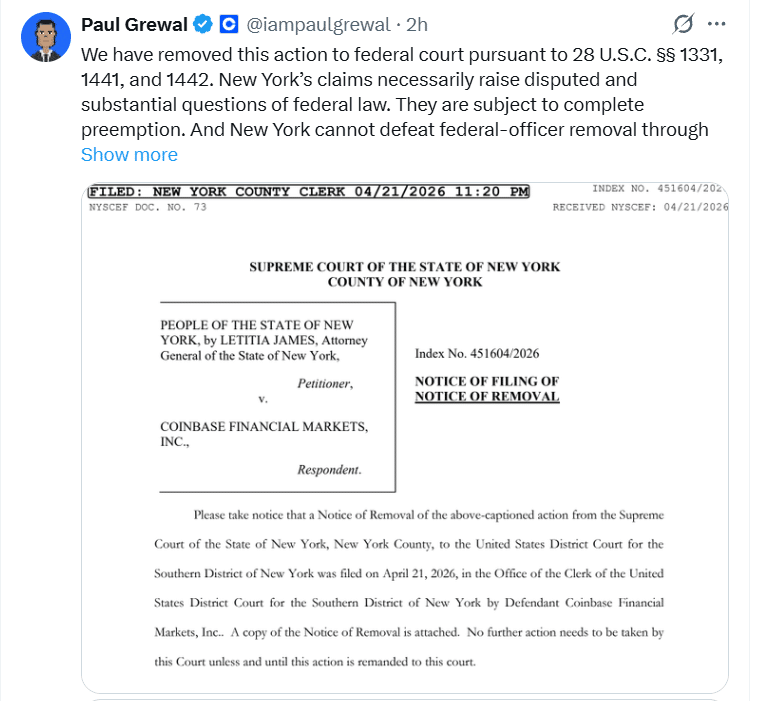
The Coinbase Gemini lawsuit has been strongly challenged by Coinbase, which disputes New York’s jurisdiction. Coinbase Chief Legal Officer Paul Grewal said the company removed the case to federal court on April 21, 2026. In a post on X, he stated that the matter belongs under federal law, citing federal-question jurisdiction and federal-officer removal provisions.
Grewal also said the claims are preempted by federal authority and that state regulators cannot override it through what he described as “artful pleading.” Coinbase has maintained that prediction markets fall under Commodity Futures Trading Commission oversight. Gemini Titan, launched under the Gemini ecosystem led by Tyler and Cameron Winklevoss, has not issued a detailed public response in earlier reports.
What is the broader regulatory conflict behind the lawsuit?
The Coinbase Gemini lawsuit reflects an ongoing clash between state gambling enforcement and federal market regulation. Coinbase entered prediction markets through its integration with Kalshi, which expanded event contracts in the United States. Gemini Titan also operates in the same emerging segment of event-based trading products.

The Commodity Futures Trading Commission has asserted oversight authority over prediction markets, while several states argue gambling laws still apply locally. Federal court activity in recent years has already shaped parts of this debate, including rulings involving Kalshi and state regulators.
Conclusion
The Coinbase Gemini lawsuit marks a significant test case for how prediction markets will be regulated in the United States. The outcome may determine whether these platforms are treated as financial instruments under federal oversight or as gambling products under state law. It also signals continued scrutiny of crypto-linked event trading even as the industry expands.
Coinbase Gemini lawsuit developments will likely influence how platforms structure compliance, access rules, and product design going forward. The case now stands at the intersection of crypto innovation and regulatory authority, where legal boundaries remain actively contested.
Glossary
Coinbase Gemini Lawsuit: New York case over crypto prediction markets
Prediction Markets: Trading on future event outcomes
Unlicensed Gambling: Betting without legal approval
Event-Based Contracts: Trades tied to real-world events
Letitia James: NY AG leading the case
Frequently Asked Questions About Coinbase Gemini Lawsuit
Why did New York sue Coinbase and Gemini?
New York sued them because it says they ran illegal prediction markets without proper licenses.
What did the companies do wrong?
The state says the companies allowed betting on events without following gambling laws.
How much money is involved in the case?
New York is asking for billions of dollars in fines and penalties from both companies.
Did Gemini respond to the lawsuit?
Gemini has not given a detailed public response in earlier reports.
Why is this case important?
This case is important because it could decide how prediction markets are regulated in the US.