

This article was first published on Deythere.
- Bitcoin Rejection at $79k Defines Current Range
- Oil Rally and Hormuz Standoff Drive Risk-Off Sentiment
- Analysts Split: Spot Demand vs Short Squeeze Dynamics
- Institutional Accumulation Continues Despite Volatility
- Fed Decision and Big Tech Earnings Set the Next Move
- Conclusion
- Glossary
- Frequently Asked Questions About Bitcoin Price Today
- Why did Bitcoin price today drop below $77,000?
- How does oil affect Bitcoin?
- What does $79,000 mean?
- Are institutions still buying Bitcoin?
- What Can Drive Bitcoin Above $80,000
- References
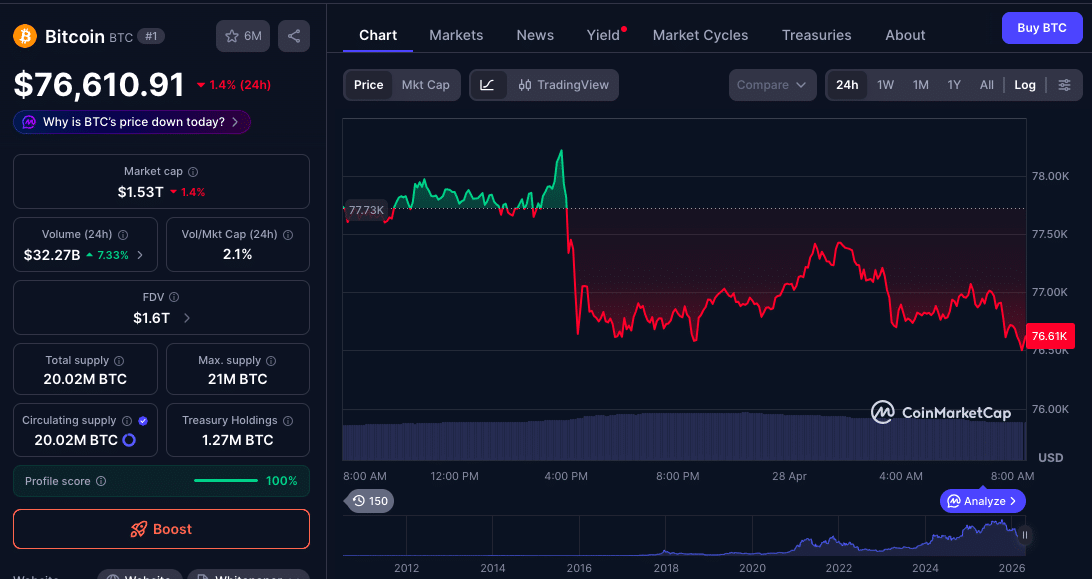
Bitcoin price today hit $76,610 in a 1.4% drop over 24hrs as it failed again to break above the key resistance zone of $79k. Bitcoin rose to $79,399 on Monday in a failed bid to breach the key psychological level, the third rejection in eight sessions.
The decline extended across the entire market. Ether’s price fell 3.7% to $2,290; XRP down 3.2% to $1.39; Solana fell 3.9% to $84.10; BNB fell 1.8% to $625. Almost all of the top 10 cryptocurrencies closed in the red during the same time period, with only Tron and Dogecoin managing to avoid losses.
Macro pressure intensified at the same time. Brent crude oil rose above $109 per barrel; stretching a seven day rally and reached a three week-high as tensions surrounding the Strait of Hormuz dragged on.
Bitcoin Rejection at $79k Defines Current Range
The failed rejection at $79,000 seals the Bitcoin price today more than any short-term volatility.
Bitcoin has been rejected at this level three times in eight sessions becoming the clear ceiling of the current range.
The climb to $79,399 on Monday and the quick rejection confirmed that sellers are stronger in that zone.
Markets read failed breakouts as a sign that either demand is weak, or market players are keeping their hands in their pockets until stronger catalysts arrive.
The outcome is a tightening structure. Bitcoin is now trading between a defined level of resistance close to $79,000 and rising support under the psychological price of $77,000. Without a decisive breakout, the range risks becoming entrenched rather than transitional.
Oil Rally and Hormuz Standoff Drive Risk-Off Sentiment
Macro conditions are directly hitting the Bitcoin price today, especially through energy markets.
Oil prices have gone higher as geopolitical tensions escalate. Brent crude ran up over 1% to surpass $109 a barrel and extend its gains to seven days in a row.
The rally is tied to the war unfolding between Iran and the US, Iran and the United States, with the Strait of Hormuz; a route that carries about 20% of global oil supply, remaining heavily disrupted.
Negotiations for a deal have hit a rock. Iran’s offer to end the closure of the strait fell short, and US officials have been unable to relax their terms for a deal.
This is important for crypto as increasing oil prices feed into inflation expectations. More inflation means lower probabilities of an immediate monetary easing and tighter financial conditions, both of which have a tendency to weigh on risk assets such as Bitcoin.
This relationship was apparent through all of April. Bitcoin dipped to below $70,000 when oil shot up sharply earlier this month. It broke toward $78,000, when tensions softened for a while and oil retreated.
Now, the return back above $109 is seen as a new macro headwind.
Analysts Split: Spot Demand vs Short Squeeze Dynamics
Opinions regarding the recent movement of Bitcoin price today are split.
One view, represented by Mike Novogratz, points to renewed demand. He argues that US retail investors are returning, and when combined with institutional flows and limited supply, the setup supports further upside.
To some degree, this is supported by leveraging on-chain data. Over the past two weeks, Whale wallets have stacked up with more than 40K BTC as sentiment flipped from fear to FOMO.
On the other hand, an analyst Ki Young Ju believes that the move up to $79,000 was mostly caused by a derivatives-led short squeeze rather than new strong spot buying.
Funding data backs this understanding. Funding rates on perpetual futures remain negative at approximately -0.13% up to seven days according to Coinglass, indicating that short traders continue paying longs to hold their positions. That structure often comes before both squeezes and an unwinding of that move.
These two perspectives are not mutually exclusive. Spot demand may be back, as short covering speeds movement higher. The main test will be whether new buying supports the next failure at $79,000 or if short squeeze momentum exhausts.

Institutional Accumulation Continues Despite Volatility
While short-term price action remains uncertain, institutional activity continues to build beneath the surface of the Bitcoin price today. Bloomberg reported that Strategy purchased $3.9 billion in Bitcoin in April, its largest monthly buy in a year.
Additionally, Metaplanet announced a bond offering of $50 million to fund more Bitcoin purchases. The company has been regularly using yen-denominated debt to grow its Bitcoin treasury, making it one of the largest non U.S. corporate holders.
These changes show a disconnect between short-term spikes and accumulation periods. Despite price struggling beneath resistance, corporate demand continues to build.
Fed Decision and Big Tech Earnings Set the Next Move
The next major catalysts for Bitcoin price today are macro-driven and imminent.
In the meantime, the Fed is expected to announce its policy decision on Wednesday. Markets are pricing in higher odds of rate cut after the US justice department ended its probe into Fed Chair Jerome Powell.
Also, earnings from major technology companies including Alphabet, Microsoft, Amazon, Meta, and Apple, are due across Wednesday and Thursday. Those companies combined account for about a quarter of the overall market capitalisation of the S&P 500.
These events could determine whether Bitcoin breaks out or remains capped. Any dovish developments regarding Fed or a strong earnings season can push Bitcoin above $80,000 firmly. In the absence of these catalysts, however, the constant lack of upside momentum in the region above $79,000 will likely create a lasting range top.
Conclusion
Bitcoin price today is being affected by a combination of technical resistance, macro pressure, and conflicting market signals.
Repeated rejection at $79,000 has created a solid ceiling, while rising oil prices and geopolitical tension are sustaining risk-off conditions. Institutional accumulation combined with waning sentiment indicates that demand beneath the surface has yet to go away.
The next move depends on catalysts already in motion. Federal Reserve policy and major tech earnings will determine whether Bitcoin breaks through resistance or remains trapped within its current range.
Glossary
Resistance Level: Price level where selling pressure prevents further upward movement.
Funding Rate: The fee that is exchanged between long and short traders in perpetual futures everywhere.
Short Squeeze: Sudden price increase caused by forced buying from short sellers.
Risk-Off Environment: A market condition in which investors flee riskier assets for safety.
Whale: Person or institution who holds an unusually large amount of cryptocurrency that could move the markets.
Frequently Asked Questions About Bitcoin Price Today
Why did Bitcoin price today drop below $77,000?
Bitcoin fell due to resistance at $79,000, higher oil prices and more widespread macro uncertainty.
How does oil affect Bitcoin?
Rising oil prices boost inflation expectations, thus delaying rate cuts and pressuring risk assets.
What does $79,000 mean?
It has acted as resistance three times in eight sessions, setting the current trading range.
Are institutions still buying Bitcoin?
Yes. Firms such as Strategy and Metaplanet are still amassing larger amounts in spite of the ups and downs.
What Can Drive Bitcoin Above $80,000
A dovish Federal Reserve decision or strong tech earnings could act as catalysts