

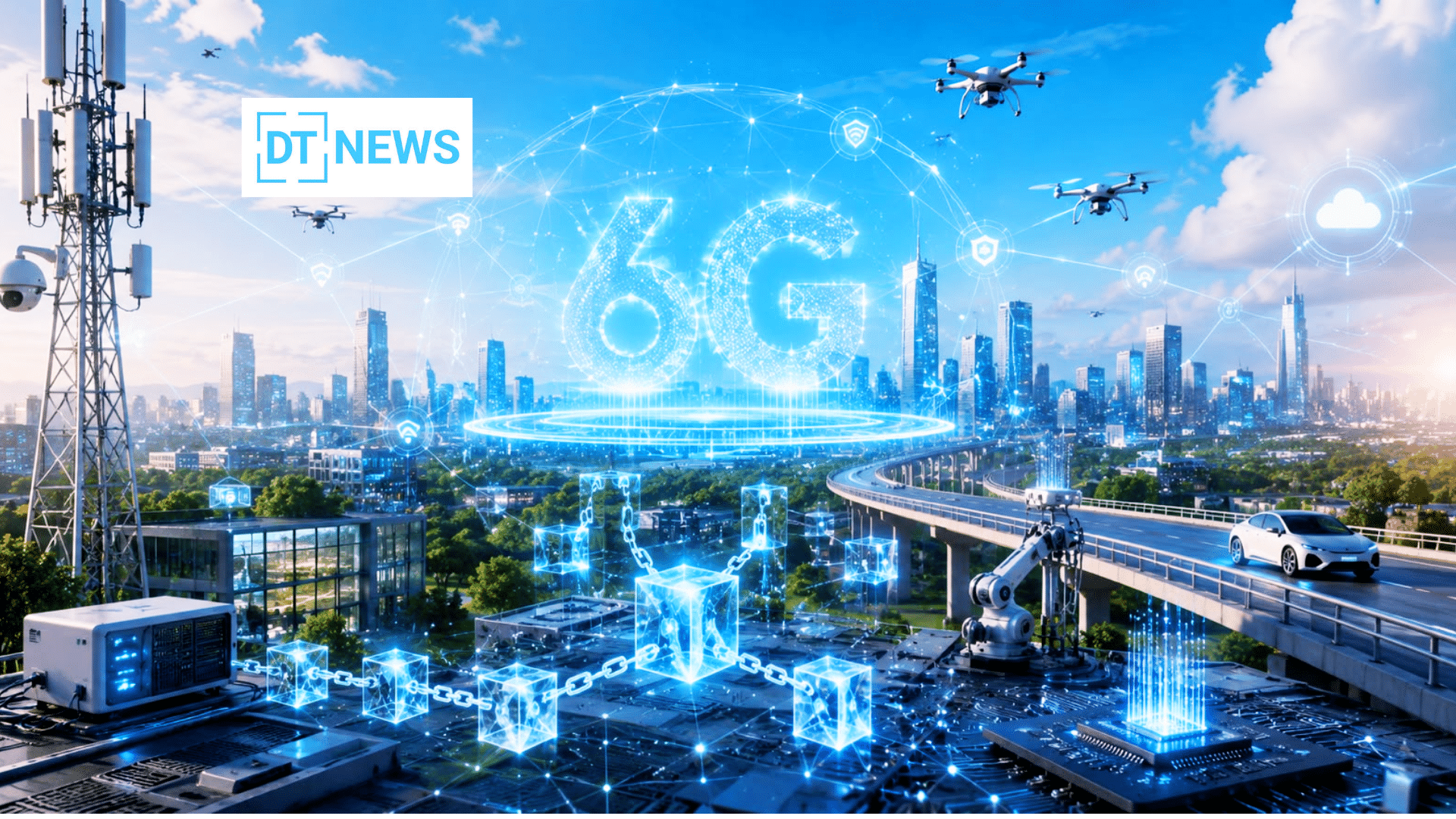


Blockchain in 6G networks is emerging as an active research area as experts explore how decentralized technologies could strengthen security, trust, and resource management in future wireless systems. Although commercial 6G deployment has not started in 2026, ongoing studies are examining how decentralized architectures can improve privacy, transparency, and collaboration across increasingly connected digital environments.
- What does blockchain in 6G networks mean for future connectivity?
- Why are blockchain and edge computing being developed together?
- Which applications are researchers focusing on?
- How do AI, federated learning, and IoT strengthen this approach?
- What are the advantages and current limitations?
- What are the advantages and current limitations?
- What does current research reveal about future deployment?
- Conclusion
- Glossary
- Frequently Asked Questions About Blockchain in 6G Networks
Researchers are also evaluating the role of blockchain edge computing alongside artificial intelligence (AI) and federated learning to support intelligent resource management without relying entirely on centralized cloud infrastructure. Together, these complementary technologies are being studied for their potential to improve trust management, secure coordination, and efficient resource allocation across billions of connected devices, digital twins, autonomous systems, and massive Internet of Things (IoT) deployments.
What does blockchain in 6G networks mean for future connectivity?
Blockchain in 6G networks serves as a decentralized trust layer rather than a technology that carries wireless signals. It records verified transactions across multiple systems using cryptographic techniques that help preserve data integrity and make unauthorized modifications easier to detect.

Researchers are studying its role in decentralized identity management, secure authentication, trusted data sharing, resource allocation, and automated network management. Blockchain creates verifiable records that can reduce reliance on centralized trust models while supporting resilience in distributed environments.
When combined with edge computing, blockchain-based systems can support trusted coordination while edge infrastructure processes data closer to where it is generated. In this context blockchain edge computing combines decentralized trust with local data processing to reduce latency, lower bandwidth usage, and improve responsiveness for applications that require real-time decision-making.
Why are blockchain and edge computing being developed together?
Researchers believe blockchain and edge computing address different but complementary challenges within future wireless systems. Edge computing improves response times by processing information near users, while blockchain establishes trust among distributed participants.
This combination allows blockchain-enabled edge computing architectures to support secure device authentication, decentralized access control, trusted data sharing, automated resource allocation, transparent service management, and privacy-preserving collaboration. Researchers consider blockchain edge computing an important research direction because it enables trusted coordination while edge infrastructure delivers low-latency processing.
As future communication networks expand to include autonomous vehicles, drones, industrial sensors, healthcare systems, and smart city infrastructure, blockchain in 6G networks is being investigated as a potential technology for improving trust and coordination in future distributed systems.
Which applications are researchers focusing on?
Several use cases highlight the potential of blockchain in 6G networks across future digital ecosystems. Secure device authentication remains a major priority because billions of IoT devices are expected to operate within future networks. Blockchain-enabled decentralized identity frameworks could help devices authenticate one another without relying entirely on centralized authentication servers, reducing risks linked to identity theft, spoofing, and unauthorized access.
Researchers are also examining blockchain edge computing for resource management. Blockchain-based frameworks can maintain verifiable records, while smart contracts may automate parts of service agreements and resource allocation. Computing power, storage, and network bandwidth distributed across multiple providers could therefore be managed more efficiently through trusted coordination.
Data integrity is another important application. Blockchain creates tamper-evident records that help verify whether stored information has been modified after being recorded. Researchers note that while blockchain protects stored records, it cannot verify whether the original information produced by sensors was accurate. Network slicing is also receiving attention.
Blockchain in 6G networks may improve the management of virtual networks by automating access control, validating service agreements, recording transactions, and coordinating resources across multiple operators. Secure data sharing is another area under investigation. Researchers believe blockchain edge computing could improve transparency, accountability and controlled information exchange between healthcare providers, industrial facilities, financial institutions, government agencies, and other organizations.
How do AI, federated learning, and IoT strengthen this approach?
Artificial intelligence is expected to become deeply integrated into future 6G infrastructure. Researchers are increasingly exploring federated learning, which allows AI models to train locally on edge devices rather than transferring sensitive information to centralized cloud servers.
Blockchain combined with edge computing can help verify participating devices, maintain audit trails for model updates, manage incentives, and coordinate trust among participants in federated learning systems. Within this research area, blockchain edge computing supports trusted collaboration while reducing the need to transfer confidential raw data between participants.
The growing Internet of Things also supports the case for blockchain in 6G networks. Connected devices across healthcare, manufacturing, agriculture, transportation, and smart cities require reliable trust mechanisms. Blockchain can authenticate connected devices, record activity, protect sensor information, support secure firmware updates, detect unauthorized modifications and improve traceability across distributed environments.
What are the advantages and current limitations?
Researchers identify several potential advantages of blockchain edge computing within future communication systems. Blockchain-based architectures may improve security processes by strengthening authentication, auditability, and data integrity mechanisms. Decentralized architectures can also improve resilience by reducing reliance on centralized authorities. Smart contracts may support automated service provisioning, payments, and resource allocation, while distributed ledgers improve transparency and simplify auditing.
Despite these benefits, several technical challenges remain under investigation. Scalability is an ongoing concern because future 6G networks may process extremely large transaction volumes. Some blockchain consensus mechanisms introduce additional latency that may not suit applications requiring near real-time communication.
Researchers are also examining energy consumption, expanding storage requirements, and interoperability between blockchain platforms, telecommunications standards, cloud providers, and edge infrastructure. Many studies suggest lightweight permissioned or consortium blockchain models may be more suitable for telecommunications than traditional public blockchain networks.
Researchers are also exploring post-quantum cryptography (PQC) integration for future blockchain-enabled 6G systems. As quantum computing advances, cryptographic methods used in current networks may require upgrades to protect long-term data security. PQC approaches are being studied as a way to strengthen future communication infrastructure against emerging quantum-related threats.
Another challenge is balancing blockchain verification overhead with the ultra-low latency requirements expected in 6G applications. Researchers continue investigating approaches that maintain trusted verification while minimizing performance trade-offs for latency-sensitive services.
What are the advantages and current limitations?
Researchers identify several potential advantages of blockchain edge computing within future communication systems. Blockchain-based architectures may improve security processes by strengthening authentication, auditability, and data integrity mechanisms. Decentralized architectures can also improve resilience by reducing reliance on centralized authorities. Smart contracts may support automated service provisioning, payments, and resource allocation while distributed ledgers improve transparency and simplify auditing.
Despite these benefits, several technical challenges remain under investigation. Scalability is an ongoing concern because future 6G networks may process extremely large transaction volumes. Some blockchain consensus mechanisms introduce additional latency that may not suit applications requiring near real-time communication.
Researchers are also examining energy consumption, expanding storage requirements, and interoperability between blockchain platforms, telecommunications standards, cloud providers, and edge infrastructure. Many studies suggest lightweight permissioned or consortium blockchain models may be more suitable for telecommunications than traditional public blockchain networks.
Researchers are also exploring post-quantum cryptography (PQC) integration for future blockchain-enabled 6G systems. As quantum computing advances, cryptographic methods used in current networks may require upgrades to protect long-term data security. PQC approaches are being studied as a way to strengthen future communication infrastructure against emerging quantum-related threats.
Another challenge is balancing blockchain verification overhead with the ultra-low latency requirements expected in 6G applications. Researchers continue investigating approaches that maintain trusted verification while minimizing performance trade-offs for latency-sensitive services.
What does current research reveal about future deployment?
Current studies increasingly evaluate blockchain alongside complementary technologies instead of treating it as a standalone solution. Researchers are investigating blockchain-secured federated learning, decentralized edge intelligence, trusted vehicular communication, privacy-preserving artificial intelligence, unmanned aerial vehicle (UAV) networks, semantic communications, and secure resource orchestration.

The focus is also on developing blockchain frameworks that reduce computational overhead while maintaining security and meeting the demanding performance requirements expected in future 6G environments. Researchers are also developing blockchain frameworks that reduce computational overhead while maintaining security and supporting the demanding performance expected from future wireless systems.
Most studies conclude that blockchain in 6G networks delivers stronger results when combined with artificial intelligence, edge computing, federated learning, advanced encryption, zero-trust security models, and intelligent network management. Ongoing research also continues to examine how blockchain edge computing can evolve alongside these complementary technologies.
Conclusion
Blockchain in 6G networks continues to attract research attention as experts explore decentralized architectures capable of supporting future wireless communication. Current findings suggest blockchain could strengthen secure authentication, transparent resource management, trusted data sharing and automated service execution while working alongside complementary technologies rather than replacing existing communication systems.
Researchers also view blockchain edge computing as an important area of study because it combines trusted coordination with low-latency processing across distributed environments. Although commercial 6G deployment remains under development and several technical challenges still need to be addressed, ongoing research indicates blockchain could potentially contribute to more secure, scalable and privacy-aware communication infrastructure in the years ahead.
Glossary
Blockchain in 6G networks: Next-generation wireless connectivity.
Blockchain Edge Computing: Trusted edge processing with blockchain security.
Network Slicing: Multiple virtual networks on one infrastructure.
Post-Quantum Cryptography (PQC): Security against future quantum attacks.
Smart Contracts: Automated digital agreements.
Frequently Asked Questions About Blockchain in 6G Networks
How does blockchain help 6G networks?
Blockchain helps 6G networks by securing identities, managing resources, and enabling trusted data sharing.
Why combine blockchain with edge computing?
Blockchain adds trust, while edge computing reduces delays and improves network performance.
How does blockchain support IoT in 6G?
Blockchain helps IoT devices with secure identification, data protection, and activity tracking.
What are the challenges of blockchain in 6G?
Key challenges include scalability, latency, energy use, and integration complexity.
Will blockchain replace 6G networks?
No, blockchain will work as a security layer alongside 6G technologies.