



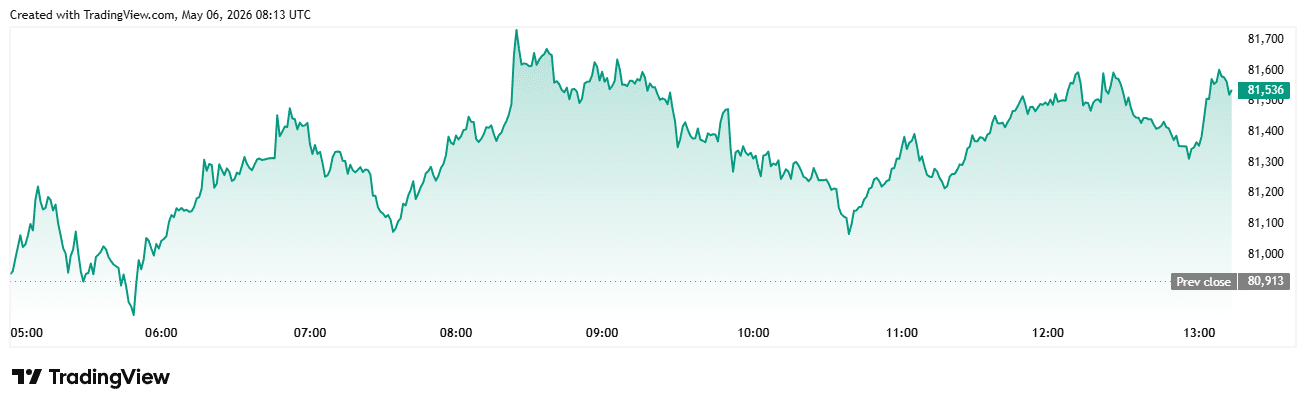
Bitcoin price prediction trends are entering a new phase after Bitcoin climbed above $80,000 while traditional markets struggled under pressure from oil shocks, rising Treasury yields, and geopolitical uncertainty. The unusual divergence has triggered fresh debate across financial markets about whether Bitcoin is truly decoupling from stocks or reacting to several macro forces at once.
According to the source, the latest BTC rally unfolded during one of the most complex macro backdrops seen this year. Oil prices surged after renewed tensions surrounding the Strait of Hormuz, Treasury yields moved higher, the U.S. dollar strengthened, and equities weakened. Yet Bitcoin held near $81,000 instead of falling alongside stocks.
The contrast was striking. On May 4, the S&P 500 slipped 0.4%, the Dow Jones dropped 1.1%, and the Nasdaq fell 0.2%, while Brent crude surged 5.8% to $114.44 per barrel. Under normal conditions, those signals would pressure crypto markets. Instead, the ongoing BTC rally forced analysts to reconsider Bitcoin’s evolving role in global finance.
A Two-Clock Market Is Reshaping Bitcoin Price Prediction
The latest Bitcoin price prediction narrative centers around what analysts describe as a “two-clock market.” During Asian trading hours, AI-linked chip stocks and regional technology equities fueled risk appetite. Bitcoin moved higher alongside that momentum, helping launch the latest BTC rally before U.S. markets even opened.
Later, macro pressures took control. Rising oil prices, stronger Treasury yields, and dollar strength pulled U.S. equities lower as investors reacted to inflation risks tied to the Middle East conflict.
That sequence matters because Bitcoin did not react to one market driver alone. Instead, the latest Bitcoin price prediction outlook now reflects two overlapping impulses. One came from AI-driven optimism and technology risk appetite. The other emerged from geopolitical stress and bond-market repricing.
The next morning added another layer to the story. Oil prices eased slightly while U.S. futures turned positive, yet Bitcoin softened instead of extending gains. That reversal weakened the argument that Bitcoin had fully transformed into a safe-haven asset.
Instead, markets appeared to signal that Bitcoin may follow different lead indicators depending on the trading session.
Bond Markets, ETF Flows, and Oil Are Fueling the BTC Rally
The original report repeatedly linked the BTC rally to bond-market stress and liquidity conditions. Rising Treasury yields increase borrowing costs and tighten financial conditions across global markets, which usually hurts speculative assets.
However, Bitcoin remained firm even as the dollar strengthened and yields climbed. Analysts increasingly believe Bitcoin is being pulled into “bond-market math,” where inflation expectations, energy shocks, and Federal Reserve policy now influence crypto alongside traditional assets.
At the same time, ETF demand continues shaping the latest Bitcoin price prediction outlook. Spot Bitcoin ETFs have connected BTC to mainstream brokerage accounts, institutional portfolios, and public-market exposure. That overlap means Bitcoin can move alongside AI equities when investors rotate capital into high-growth sectors.
The relationship has become more layered than before. Retail brokerage demand, ETF wrappers, and portfolio allocation strategies are now linking Bitcoin to the same screens driving technology stocks.
Updated data showed Bitcoin trading above $81,300 with a market capitalization near $1.63 trillion. Meanwhile, the broader crypto market remained above $2.6 trillion.
Bitcoin Price Prediction Hinges on Four Critical Signals
Several macro signals could now decide the next stage of the Bitcoin price prediction cycle. If oil prices remain elevated, inflation fears may continue pressuring liquidity markets. Bitcoin would then need to hold above $80,000 despite stronger Treasury yields and a firmer dollar.
According to the World Bank, energy prices could rise 24% in 2026 if Middle East disruptions worsen. The institution also projected Brent crude could trade between $95 and $115 under severe supply stress.
If tensions around the Strait of Hormuz ease, oil pressure may cool and risk appetite could strengthen again. That scenario would likely support the ongoing BTC rally alongside technology equities.
AI stocks also remain important. If chipmakers continue leading global risk markets, Bitcoin may trade increasingly like a brokerage-account technology asset rather than a pure inflation hedge.
Meanwhile, weakening ETF flows or derivatives activity could expose the BTC rally as temporary positioning rather than durable demand.

Conclusion
The latest Bitcoin price prediction debate is no longer about whether Bitcoin simply rises or falls with stocks. The market is undergoing what analysts now describe as a real macro regime test.
Bitcoin’s identity is evolving into something more complex than a traditional risk asset or digital safe haven. In one session, BTC can behave like a technology trade driven by AI optimism. In another, it can react like a fast-moving hedge against geopolitical stress and monetary uncertainty.
That incomplete stock correlation may become the defining feature of Bitcoin’s next cycle. As oil prices, ETF demand, Treasury yields, AI equities, and global tensions compete to shape market behavior, the ongoing BTC rally may reveal whether Bitcoin has truly entered a hybrid macro role within modern finance.
Glossary of Key Terms
Treasury Yields: Returns earned from U.S. government bonds that influence borrowing costs and liquidity.
Bitcoin ETF: A regulated fund that gives investors Bitcoin exposure through stock exchanges.
Strait of Hormuz: A major global oil shipping route connecting Middle Eastern energy exports to world markets.
Liquidity Conditions: The ease with which money flows across financial systems and investment markets.
Macro Regime Shift: A long-term change in how financial markets behave and react to economic forces.
FAQs About Bitcoin Price Prediction
Why did Bitcoin rise while stocks fell?
Bitcoin benefited from AI-driven momentum, ETF demand, and changing macro sentiment despite weakness in equities.
What is the “two-clock” Bitcoin theory?
It suggests Bitcoin reacts differently during Asian and U.S. trading sessions based on changing market drivers.
Why do oil prices matter for Bitcoin?
Rising oil prices increase inflation fears, which affect Treasury yields, liquidity conditions, and crypto sentiment.
Can the BTC rally continue above $80,000?
Future price action depends on ETF flows, oil prices, Treasury yields, and broader market confidence.