

Vitalik Buterin believes the future of decentralized decision-making may require serious reconsideration. The Ethereum co-founder recently warned that enthusiasm around DAOs, blockchain voting, and digital democracy appears to be fading as global politics grows increasingly unstable. His remarks have triggered renewed debate about how crypto governance should evolve in an era marked by uncertainty and political tension.
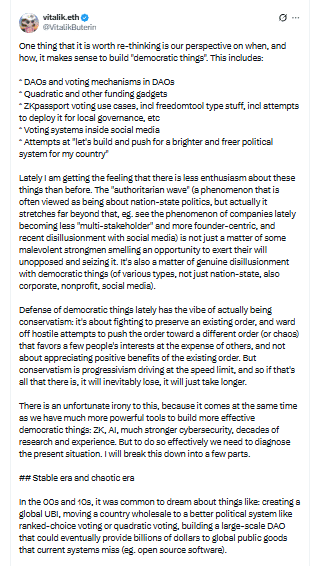
According to the source, Vitalik Buterin shared these concerns in a detailed discussion posted on X. He argued that a growing “authoritarian wave” and widespread frustration with democratic institutions are reshaping public attitudes toward participation and power. In this environment, many tools that once symbolized innovation in crypto governance may need to be redesigned.
Democratic Experiments Are Losing Momentum
Decentralized networks once fueled strong hopes for digital democracy, an idea widely explored by Vitalik Buterin through early blockchain governance experiments. Systems such as DAO voting, quadratic funding, and blockchain identity tools were designed to strengthen crypto governance and enable transparent community decision-making.
Some proposals introduced ZKpassport identity verification, allowing secure voting while protecting user privacy. Others tested governance models inside social media platforms, aiming to help online communities make collective decisions rather than rely solely on centralized moderators.
Another vision involved DAOs funding global public goods like open-source software and climate initiatives. However, Buterin now notes that enthusiasm around these experiments appears to be fading. In a public comment, he explained that the current “authoritarian wave” reflects not only power struggles but also growing frustration with democratic systems themselves.
Vitalik Buterin Says Crypto Governance Must Adapt to a Chaotic Era
Vitalik Buterin believes the global political climate has shifted dramatically. He described the 2000s and 2010s as relatively stable decades when ambitious governance reforms seemed achievable.
During that time, ideas such as universal basic income experiments or large DAOs funding public goods appeared realistic. Today, the 2020s feel more chaotic due to geopolitical conflicts, economic uncertainty, and rapid technological change.
Real-world politics offers clear examples. Vitalik Buterin pointed to the long-running difficulty of ending gerrymandering in the United States. Even widely supported reforms often stall because political power structures resist change.
He also noted a broader governance shift inside companies. Many organizations are moving away from multi-stakeholder governance toward founder-centric control. This trend reflects declining confidence in complex democratic systems.

Consensus Tools and Technology Could Reshape Crypto Governance
Instead of rigid voting systems, Vitalik Buterin believes the future of crypto governance should focus on tools that help communities discover shared priorities. Platforms like Pol.is already show how large groups can identify common ground through structured discussions, while anonymous voting systems allow participants to express honest opinions without pressure.
Another approach involves assurance-style voting, where supporters pledge backing privately and commitments appear only after a proposal reaches a certain threshold. This model helps communities coordinate collective action without strategic voting.
Buterin described such systems as “sanctuary tools for collective voice,” capable of revealing public opinion even during political tensions, such as conflicts involving Iran where government priorities may differ from citizens’ views. He also highlighted a striking irony.
Trust in democratic institutions may be falling, yet technologies that could improve governance continue to advance. Innovations in zero-knowledge cryptography, artificial intelligence, cybersecurity, and governance research could strengthen crypto governance, while AI agents may eventually represent users’ preferences in complex decision processes.
Conclusion
The warning from Vitalik Buterin arrives at a pivotal moment for decentralized technology. Trust in traditional institutions appears to be fading, while frustration with centralized power continues to grow. This tension creates both risk and opportunity for crypto governance.
Buterin argues that governance systems must evolve with real-world complexity rather than depend on ideal theories. Pluralistic models that encourage diverse viewpoints can help prevent power from concentrating in a single group. At the same time, he stresses a simple democratic principle: everyone should retain some voice in decisions, even when expertise matters.
If blockchain communities absorb these lessons, crypto governance may still mature into a resilient system for collective decision-making in an increasingly unpredictable world.
Glossary of Key Terms
DAO (Decentralized Autonomous Organization): A blockchain-based organization governed by community voting rather than centralized leadership.
Crypto Governance: The system through which blockchain communities decide upgrades, funding distribution, and network policies.
Quadratic Funding: A funding model that prioritizes community participation rather than large financial contributions.
Zero-Knowledge Cryptography: A privacy technology that verifies information without revealing sensitive data.
Pluralistic Governance: A governance structure that encourages diverse viewpoints and prevents power concentration.
FAQs About Vitalik Buterin
Why did Vitalik Buterin warn about an authoritarian wave?
He believes public frustration with democratic systems is increasing, which could affect governance models in both politics and blockchain communities.
What challenges does crypto governance face today?
Low voter participation, declining enthusiasm for DAO governance, and global political instability create challenges for decentralized decision-making.
What are assurance-style voting systems?
They are governance models where participants commit support privately until a proposal reaches a required backing threshold.
Can artificial intelligence participate in governance?
AI agents could analyze user preferences and represent individuals in governance decisions, improving participation.