

Treasury GENIUS Act rule is part of a joint proposal by the US Treasury’s Financial Crimes Enforcement Network and Office of Foreign Assets Control aimed at targeting illicit finance risks in payment stablecoins. The proposed rule, issued under the GENIUS Act signed in July 2025, sets out compliance obligations for stablecoin issuers.
- How does the Treasury GENIUS Act rule define its enforcement framework?
- What compliance functions must issuers implement?
- Why is illicit finance the central focus of the proposal?
- What are the potential benefits and industry concerns?
- What does the proposal say about insurance and rollout?
- How does this fit within the broader legislative landscape?
- Conclusion
- Glossary
- Frequently Asked Questions About US Treasury GENIUS Act Rule
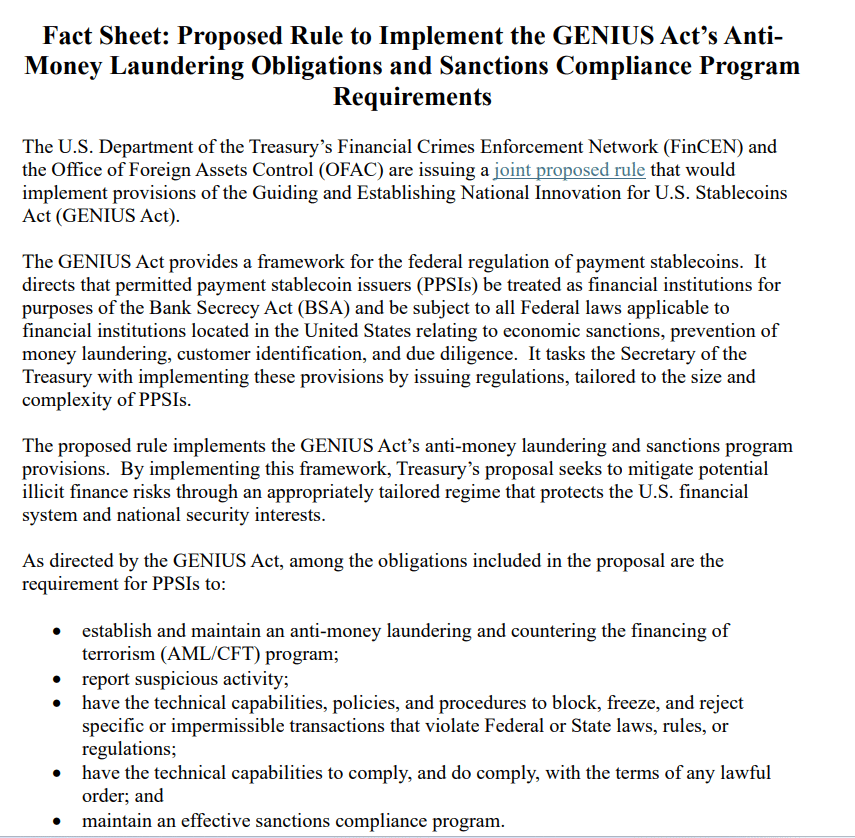
It would require issuers to adopt anti-money laundering, sanctions, and transaction-control measures. The framework brings payment stablecoin issuers under Bank Secrecy Act obligations as part of its implementation.
How does the Treasury GENIUS Act rule define its enforcement framework?
The Treasury GENIUS Act rule is centered on illicit finance enforcement and applies to payment stablecoin issuers operating in the United States. Under the proposal, issuers would be treated as financial institutions for the purposes of the Bank Secrecy Act.

As a joint proposed rule from FinCEN and OFAC, it requires issuers to establish and maintain anti-money laundering and counter-terrorism financing programs. They must also implement sanctions compliance systems and report suspicious activity. These requirements place issuers within existing federal compliance structures tied to financial monitoring and enforcement.
What compliance functions must issuers implement?
The Treasury GENIUS Act rule requires issuers to have the ability to block, freeze, and reject certain transactions. These functions apply where transactions violate federal or state laws or sanctions requirements.
Issuers must also maintain the technical capabilities and procedures to comply with lawful orders. This includes systems that can identify and act on restricted or impermissible activity. The proposal makes these transaction-control functions a core operational requirement.
Why is illicit finance the central focus of the proposal?
The Treasury GENIUS Act rule targets risks related to money laundering and sanctions evasion within the stablecoin sector. By applying Bank Secrecy Act obligations, regulators are extending established financial safeguards to payment stablecoin issuers.
At the same time, these requirements introduce compliance responsibilities such as monitoring systems and reporting obligations. This may improve oversight while also increasing compliance costs and operational pressure for issuers.
What are the potential benefits and industry concerns?
The Treasury GENIUS Act rule sets defined compliance expectations around AML and sanctions controls for stablecoin issuers. This could support more consistent oversight of stablecoin activity. However, issuers may face higher compliance costs and increased operational complexity. The requirement to block, freeze, and reject transactions may also introduce friction in processing and user experience.
Snir Levi, CEO of Nominis, said, “Bringing stablecoin issuers into full BSA/OFAC compliance effectively turns them into bank-like gatekeepers.” He added that it could lead to “significantly more wallet freezes, transaction blocking and asset seizures at scale,” offered as an industry view.
What does the proposal say about insurance and rollout?
The Treasury GENIUS Act rule follows the implementation timeline of the GENIUS Act signed in July 2025. The law is set to take effect 18 months after signing or 120 days after final regulations are issued.
In a related proposal, the Federal Deposit Insurance Corporation stated that stablecoin holders would not be insured. However, reserve deposits held by issuers would be protected. This distinction clarifies how protections apply within the proposed framework.
How does this fit within the broader legislative landscape?
The Treasury GENIUS Act rule is moving forward as broader crypto legislation remains pending. The CLARITY Act, which aims to establish a wider digital asset market framework, has not progressed in the Senate Banking Committee.

While stablecoin implementation under the GENIUS Act continues through regulatory proposals, broader market structure legislation remains under discussion. No timeline has been set for further progress on the CLARITY Act.
Conclusion
Treasury GENIUS Act rule is centered on enforcement and compliance, with a focus on illicit finance risks in the stablecoin sector. The proposal would bring issuers under Bank Secrecy Act obligations and require transaction-control capabilities such as blocking, freezing, and rejecting certain transfers.
It outlines compliance requirements alongside operational considerations for issuers. Final requirements will be set through rulemaking. As implementation progresses the framework is expected to shape how stablecoin issuers operate under US regulatory oversight.
Glossary
Anti-Money Laundering : Rules to prevent money laundering
CFT: Measures to block terrorist financing
OFAC: US agency enforcing sanctions
FinCEN: US agency tracking financial crimes
BSA: Law requiring banks to report suspicious transactions
Reserve Deposits: Funds held by issuers to back the value of stablecoins.
Frequently Asked Questions About US Treasury GENIUS Act Rule
What is the Treasury GENIUS Act rule?
a US Treasury proposal that sets anti-money laundering and sanctions rules for stablecoins.
What agencies are involved in this rule?
The rule is proposed by FinCEN and OFAC under the US Treasury.
What must stablecoin issuers do under the rule?
Issuers must have AML and CFT programs, sanctions compliance systems, and the ability to block or freeze certain transactions.
How does the rule affect transaction control?
Issuers must be able to block, freeze, or reject transactions that violate laws or sanctions.
When will the Treasury GENIUS Act rule take effect?
It will take effect 18 months after the law was signed or 120 days after final regulations are issued.