

Bitcoin vs gold ownership is entering a new stage in the United States as more individual investors start choosing digital assets. Data shared on 7 March by Bitcoin Teddy showed that more than 50 million Americans currently hold Bitcoin, while about 37 million people in the country own gold. This gap in ownership suggests that investor preferences are slowly changing as confidence in the market begins to improve again.
- What does Bitcoin vs gold ownership reveal about investor behavior?
- Why are American buyers returning to Bitcoin?
- Why is $63,700 considered a critical level for BTC?
- What role does market sentiment play in the current cycle?
- Will inflows decide Bitcoin’s next move?
- Conclusion
- Glossary
- Frequently Asked Questions About Bitcoin vs Gold Ownership
These numbers do not mean that Bitcoin has become more valuable than gold in terms of total wealth held. Gold still holds a much larger share of value in the United States because it has been trusted for generations as a traditional store of wealth. Even so, the ownership figures suggest that many investors are now willing to consider Bitcoin as an additional reserve asset alongside long-established options such as gold.
Market behavior also shows that buying interest is returning, even though caution has not completely faded. Bitcoin has mostly been moving sideways in recent sessions. Buyers often step in when the price dips, while traders remain careful because volatility can still appear quickly. The growing discussion around Bitcoin vs gold ownership reflects how digital assets are slowly becoming a more common part of mainstream investment portfolios.
What does Bitcoin vs gold ownership reveal about investor behavior?
The Bitcoin vs gold ownership numbers suggest a clear change in how people in the United States are approaching alternative investments. Data shared by Bitcoin Teddy on 7 March showed that more than 50 million Americans hold Bitcoin, while about 37 million people in the country own gold.

For decades, gold has been viewed as a reliable store of wealth due to its long history and global acceptance. The fact that Bitcoin now has more individual holders in the United States signals a generational and technological change in investment preferences. However, the comparison must be viewed carefully.
Ownership numbers reflect participation, not market value. Gold’s total holdings in the U.S. remain far larger because the metal has accumulated wealth over centuries. Even so, the growing Bitcoin vs gold ownership gap suggests retail investors increasingly see Bitcoin as a long-term asset rather than just a speculative trade.
Why are American buyers returning to Bitcoin?
Market activity is showing signs that interest from U.S. investors is picking up again. Data from CryptoQuant indicated that the Coinbase Premium has widened once more. This indicator measures the price gap between Bitcoin on Coinbase and prices on other global exchanges. When the premium increases, it usually means buyers in the United States are paying slightly more to acquire Bitcoin on the platform.
Many analysts interpret this signal as real spot buying rather than short-term trading activity. The trend suggests that American investors are once again accumulating Bitcoin. In the past, strong participation from U.S. buyers has often pushed the market to react quickly.
However, analysts also warn that higher demand does not automatically remove risks from the market. Prices can still face pressure if broader conditions change. The Bitcoin vs gold ownership discussion may be gaining attention, but stable price performance will remain important to maintain long-term investor confidence.
Why is $63,700 considered a critical level for BTC?
Market analysts are paying close attention to an important support level that could influence Bitcoin’s short-term direction. Alphractal analyst Joao Wedson said Bitcoin needs to stay above $63,700 to prevent another possible decline in the market. Bitcoin is currently trading at $67,829.63, up 0.94% over the past 24 hours, keeping the price above the level analysts are watching.
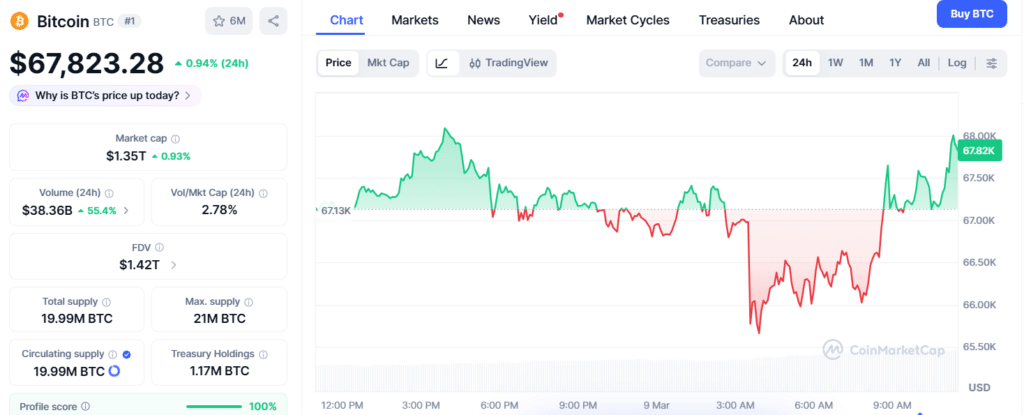
If the price falls below $63,700, the next areas of risk are seen near $57,000, $52,400, and $48,700. Wedson also explained that these levels are not fixed and can change as blockchain data updates over time. Current market conditions show a fragile balance between buying demand and investor caution. When prices drop, buyers often step in and create renewed interest.
At the same time, price recoveries tend to trigger quick reactions from traders watching the market closely. This push and pull between demand and uncertainty continues to influence the wider Bitcoin vs gold ownership conversation, as investors monitor whether Bitcoin can maintain its momentum in the market.
What role does market sentiment play in the current cycle?
Bitcoin’s recent price action does not resemble a dormant market cycle. Instead, it reflects a period where confidence is gradually returning but uncertainty remains. Sideways trading has dominated the market as participants weigh new demand against broader macro concerns. Each dip attracts buyers who appear ready to accumulate, while others remain hesitant due to volatility risks.
The dynamic creates a standoff between optimism and caution. In this environment, even small shifts in demand can lead to sharp reactions in price. The expanding Bitcoin vs gold ownership trend reflects that tension. Participation is rising, but the market still requires strong inflows to sustain upward momentum.
Will inflows decide Bitcoin’s next move?
The trading week starting on 9 March may play an important role in shaping Bitcoin’s short-term direction. If trading starts with solid inflows and positive market sentiment, analysts believe Bitcoin could hold on to its current strength. Continued buying interest from U.S. investors may also support the growing Bitcoin vs gold ownership trend.

On the other hand if capital flows weaken and outflows increase, the market could face fresh pressure. In that situation, the support levels highlighted by analysts may come into focus again. The next few trading sessions will likely show whether the present demand is strong enough to support a steady recovery.
Conclusion
Bitcoin vs gold ownership now reflects a significant transformation in U.S. investment behavior. More than 50 million Americans reportedly hold Bitcoin. Surpassing the roughly 37 million who own gold. The milestone highlights how digital assets are becoming a mainstream component of personal portfolios.
Yet the comparison remains nuanced, as gold continues to dominate in overall value held by investors. At the same time strong U.S. demand signals renewed confidence in Bitcoin even as the market trades cautiously. Whether that momentum continues may depend heavily on Bitcoin’s ability to hold above $63,700 and attract sustained inflows in the coming days.
Glossary
Coinbase Premium: When U.S. buyers pay slightly more for Bitcoin on Coinbase.
Store of Value: An asset used to keep wealth safe over time.
Sideways Trading: When a price moves in a small range without a clear direction.
Support Level: A price where buying interest may slow or stop a decline.
Bitcoin vs Gold Ownership: A comparison of how many people own Bitcoin versus Gold.
Frequently Asked Questions About Bitcoin vs Gold Ownership
How many Americans own Bitcoin and gold?
More than 50 million Americans own Bitcoin. While about 37 million Americans own Gold as an investment.
Does Bitcoin have more total value than gold?
No Gold still has much more total value as people have invested in it for many centuries.
Why is $63,700 an important level for Bitcoin?
Analysts say Bitcoin needs to stay above $63,700 to avoid possible price drop.
What could happen if Bitcoin falls below $63,700?
If Bitcoin drops below this level the next risk levels could appear near $57,000, $52,400, and $48,700.
What does Bitcoin vs gold ownership trend show?
The trend shows that digital assets like Bitcoin are becoming more popular among investors.