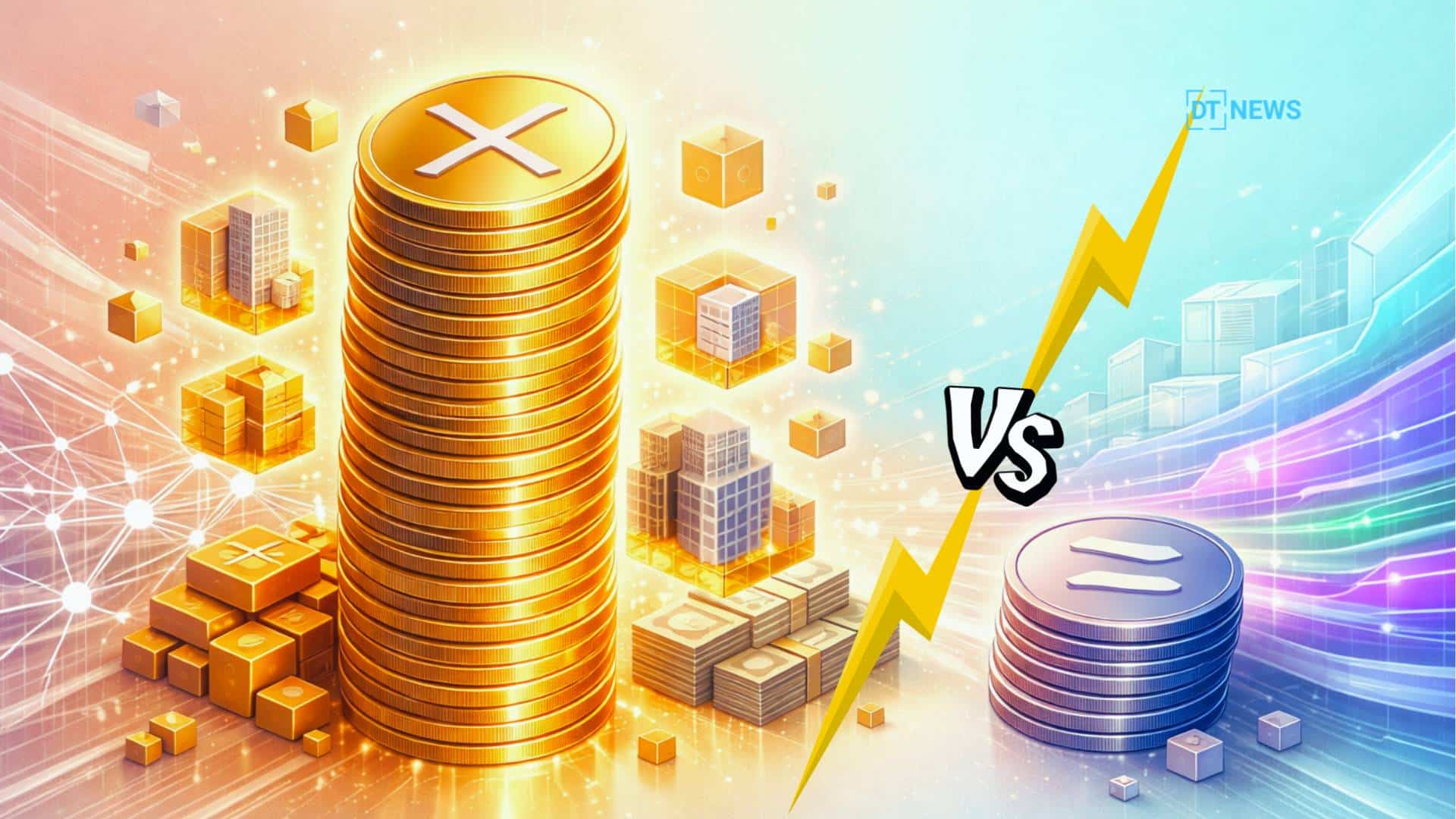

XRPL vs Solana RWA tokenization has entered a new phase as the XRP Ledger (XRPL) moves ahead of Solana in total on-chain real-world asset value, excluding stablecoins. The XRP Ledger now supports roughly $1.756 billion in tokenized assets, compared with Solana’s $1.682 billion.
Although the difference between the two networks is relatively small, the change is still notable. It points to a shift toward high-value, institution-focused tokenization rather than activity driven by widespread retail participation.
How Has XRPL vs Solana RWA Tokenization Evolved?
The XRP Ledger’s recent expansion is mainly driven by represented assets, which have reached about $1.45 billion after rising 276.75% in the past 30 days. During the same timeframe, Solana’s distributed assets grew by 43.34%, while Ethereum and Polygon recorded increases of 16.58% and 22.48%, respectively. These numbers do not suggest that XRPL is the most active platform for tokenization. Instead, they show that it currently leads in terms of asset value held on-chain, not transaction activity.

Represented assets are logged on the blockchain but remain largely under the control of issuers, limiting open transfers. This setup allows institutions to handle large-value assets securely without relying on a wide retail holder base. Such a structure reflects a wider trend in real-world asset markets, where the ability to store significant value under clear rules is being favored, even if on-chain movement remains relatively low.
Why Are Institutions Favoring XRPL?
XRPL’s infrastructure is built with a strong focus on control and regulatory alignment. Tools such as PermissionedDomains enable access to be limited through verified credentials, while PermissionedDEX supports trading environments open only to approved participants. XRPL has also enabled MPTokensV1, a token standard designed to address common issuance and lifecycle management requirements.
This setup allows issuers to apply familiar market rules directly on-chain, helping regulated firms operate without reshaping their existing processes. Recent activity reflects this direction. Aviva Investors has teamed up with Ripple to bring traditional fund structures onto XRPL, and a $280 million diamond tokenization initiative in the UAE has used Ripple-backed custody technology. Market observers highlight that XRPL is designed to handle large-value asset issuance with governance and compliance embedded at the protocol level.
How Does XRPL Compare With Solana in Metrics?
The XRPL vs Solana RWA tokenization contrast becomes clear when looking at participation and activity levels. XRPL currently shows just 22 holders and a 30-day transfer volume of about $10.11 million, reflecting a decline of 91% and indicating that value is held in a small number of controlled positions. Solana presents a very different picture, with more than 285,000 holders, roughly $1.64 billion in distributed assets, and a 30-day transfer volume of $2.18 billion, up 36.92%.
This gap follows a familiar institutional approach. Asset managers often begin by using a blockchain as a secure ledger for tracking and managing assets under tight rules. Wider distribution and secondary trading usually come later, once compliance frameworks and operational processes are tested. At present, XRPL is focused on building value through controlled structures, while Solana continues to drive activity through broad participation and liquidity.
What Could Happen Next in XRPL RWA Tokenization?
In the base case, XRPL continues to bring on a limited number of large represented issuances, allowing it to stay competitive in value-based rankings within the broader XRPL vs Solana RWA tokenization landscape, even if it does not become a major focus in crypto-native trading activity. The upside scenario for XRPL vs Solana RWA Tokenization depends on permissioned trading and lending features moving into active use, which would let institutions use tokenized assets as collateral.
That shift could lead to higher transfer volumes and broader on-chain participation, potentially strengthening XRPL’s position in XRPL vs Solana RWA tokenization. The downside is that if these assets remain mostly locked within controlled structures and transaction activity stays muted, the recent growth may be viewed as strength on paper rather than evidence of a fully active market.
Conclusion
The XRPL vs Solana RWA tokenization shift points to an important change in how blockchain networks are being used. XRPL’s structured and control-focused design is attracting institutions that value secure, high-value asset issuance. At the same time Solana remains strong in areas such as broad participation and liquidity.
Together these trends show that the market is currently favoring tokenization models that can hold large amounts of value under clear rules. As XRPL continues to build out permissioned trading and asset management features, it may shape how real-world assets are handled on-chain, while Solana keeps its role as a platform for open and active market activity.
Glossary
Represented Assets: Blockchain-recorded assets mainly controlled by the issuer.
On-Chain Assets: Assets issued and maintained directly on a blockchain.
PermissionedDEX: An exchange open only to verified participants.
PermissionedDomains: XRPL tool that limits access to approved users.
MPTokensV1: XRPL standard for compliant token creation and management.
Frequently Asked Questions About XRPL vs Solana RWA Tokenization
How much real-world asset value does XRPL hold?
XRPL holds about $1.756 billion in real-world assets on-chain, excluding stablecoins.
Why did XRPL vs Solana RWA tokenization shift in XRPL’s favor?
XRPL overtook Solana as its represented assets grew by about 276% in 30 days.
Why are institutions choosing XRPL?
Institutions prefer XRPL as it offers built-in compliance tools and controlled access features.
How many RWA holders does Solana have?
Solana has more than 285,000 real-world asset holders.
What could happen next in XRPL RWA tokenization?
XRPL could grow further if institutions expand trading and use tokenized assets as collateral.