
This article was first published on Deythere.
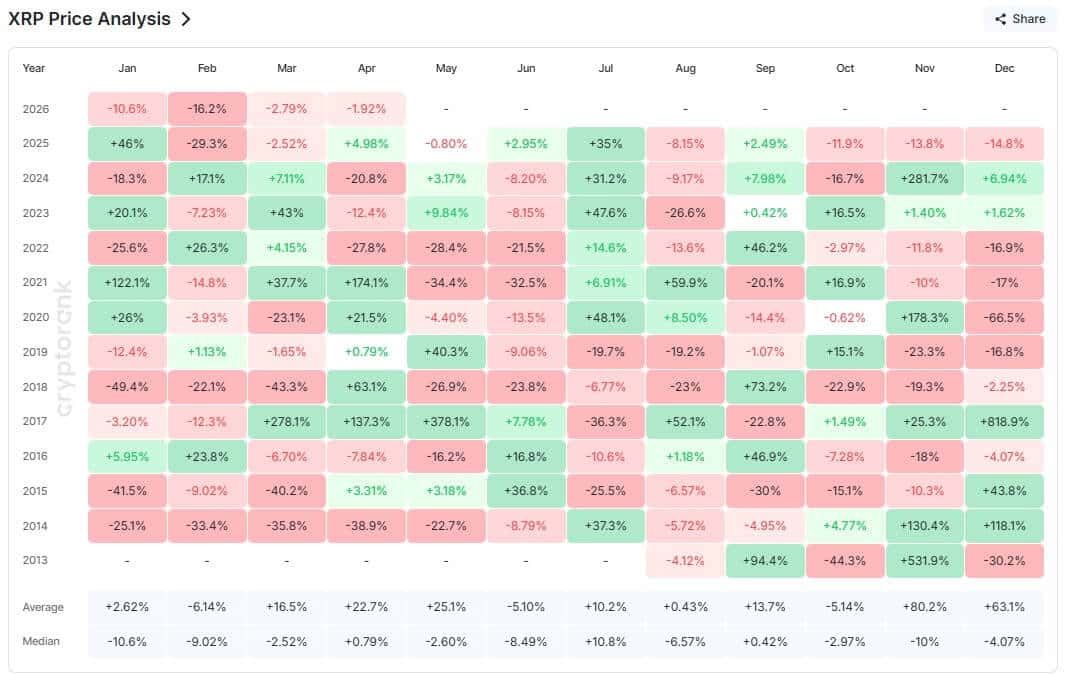
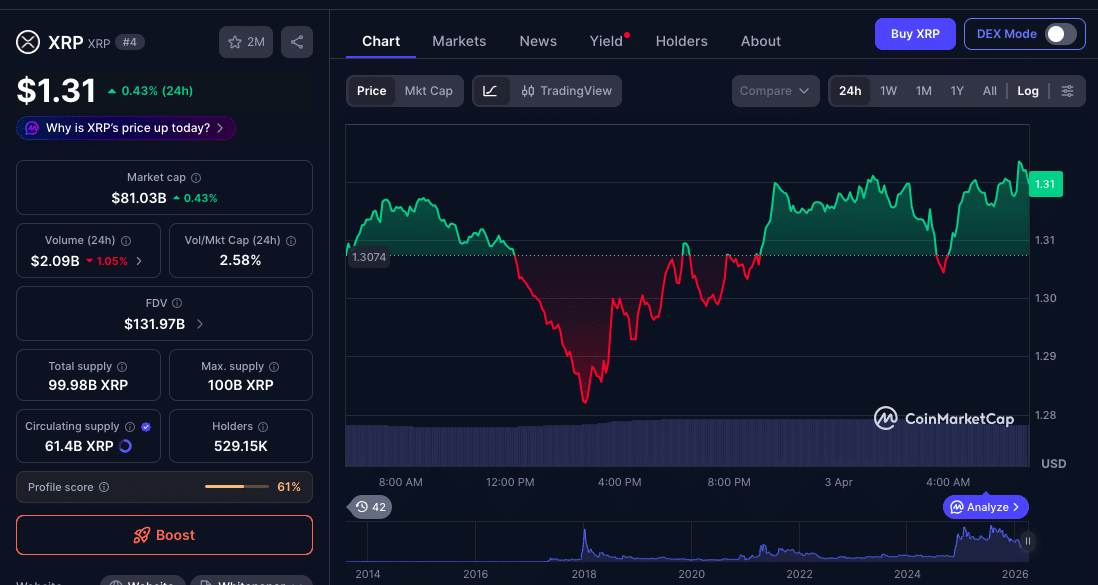
The present XRP price outlook is dented by a continuous slide that has now extended over six months of losses; the longest losing streak since 2014. XRP has sunken more than 55% since October 2025, with the token last quoted at roughly $1.31 at press time.
Data shows the fall-off has averaged around 10% a month, an extended depreciation in value but still not as drastic as the 27% average monthly drop over the course of a seven-month downturn that lasted from December 2013 to June 2014.
This shortfall has played out amid a wider risk-off dynamic across digital assets. Bitcoin’s fall from over $126,000 to about $66,000 has pulled down sentiment across the market and lessened trader appetite.
Price Recovery Impeded by Lack of Liquidity and General Market Fragility
Based on reports; XRP has lost 28.58% year-to-date in 2026, with its first quarter recording a loss of 27.1%; the worst Q1 for XRP since 2018. The asset’s market cap has also suffered a hit, as it has lost almost $29 billion during this time.
XRP price outlook is not just weak because of sentiment but also due to market structure that has deteriorated. According to CryptoQuant data, XRP’s 30-day liquidity index on Binance has declined to around 0.062, which is one of the lowest readings seen in times past.
The 30-day turnover index is still around $4.46 billion, indicating less participation with thinner trading action. These conditions mean that order books are growing shallower, meaning the market is more susceptible to sharp price swings when large trades do hit.
Lower liquidity also means that buying pressure is not as effective against sustaining an upward move, which is part of the explanation of why XRP price outlook has continued to struggle even when Ripple is enjoying positive development.
Ripple Integrates XRP Within $13 Trillion Corporate Treasury Infrastructure
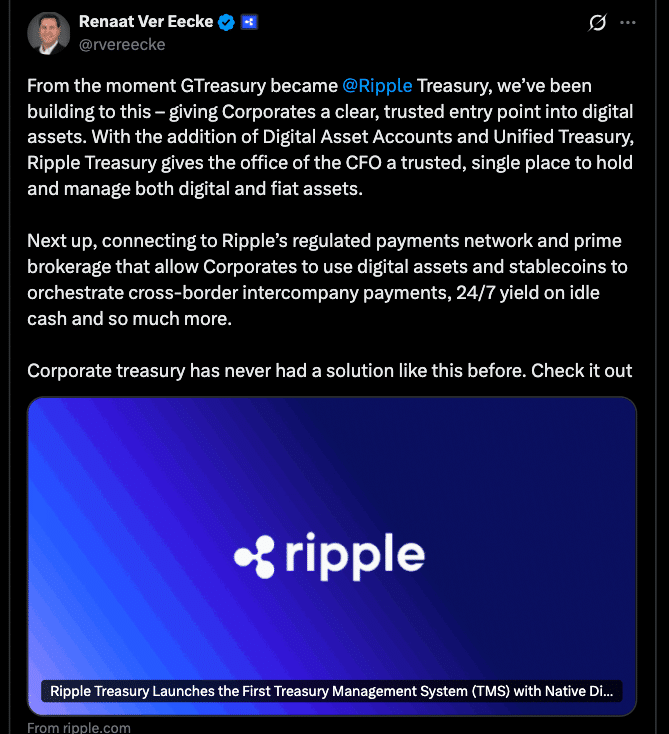
Although price is still crude, Ripple is making strides to expand the role of XRP within institutional finance. On April 1; the company announced the launch of Digital Asset Accounts and Unified Treasury in GTreasury, an enterprise treasury management platform that handled $13 trillion in payments volume over the last twelve month period .
This solution enables corporate finance professionals the ability to hold, view and manage XRP, RLUSD and other digital assets native to its platform, as well as fiat positions in one intuitive interface. Positions are shown with real-time fiat valuations and transactions get logged automatically with native token amounts and their respective fiat equivalence along with the market price at that point of execution.
Ripple also confirmed that balances are tracked to 15 decimal places; improving alignment between internal accounting and on-chain data, .
The platform gives the office of the CFO “a trusted, single place to hold and manage both digital and fiat assets,” said Renaat Ver Eecke, senior vice president at Ripple Treasury, encouraging their effort to embed digital assets directly into financial flows.
Ripple’s survey in 2026 of over 1,000 global finance leaders found that 72% believe their organizations need a digital asset solution to remain competitive at all, with many still lacking practical tools to integrate.
U.S. and International Expansion in Trading and Payments
Ripple expansion goes beyond treasury systems The company is also strengthening its institutional trading with Ripple Prime, which has expanded its HyperliquidX integration to support HIP-3 assets among others.
This allows institutional customers access to on-chain perpetual contracts pegging traditional assets like gold, silver and oil under a single umbrella that does not interact directly with Web3 wallets or fragmented collateral systems.
Hyperliquid now stands as the largest decentralized perpetuals platform, with over $5 billion in open interest and over $200 billion in monthly trading volume. Volume on HIP-3 daily is above $2 billion with open interest at $2 billion, but only seven of the top 30 markets by volume offered on the platform are crypto pairs.
Ripple has also continued to build out its payments strategy with partnerships like the one with Convera, which has a presence in around 200 countries and supports more than 140 currencies. This model is like a “stablecoin sandwich,” where both ends of the transaction are fiat, while stablecoins comprise the transfer layer.
Last year alone, stablecoins accounted for $33 trillion in volume processed globally, a 72% increase; though less has been tied to real-world payment functions so far.
Ripple is also collaborating with regulators and institutions like the participation in the Monetary Authority of Singapore’s BLOOM initiative, to test programmable cross-border trade settlement using XRPL and RLUSD.
XRPL is being adapted for the institutional use through permissioned domains and a permissioned decentralized exchange built to meet compliance standards.
Conclusion
The current XRP price outlook shows a clear difference in infrastructure growth and pricing. XRP remains in its deepest drop in over a decade, caused by low liquidity and deteriorating participation levels as well as continuous selling pressure.
However, Ripple is building a full institutional stack across treasury management, trading infrastructure and global payments at breakneck speed.
That disconnect is the basis of the market’s hesitation between Ripple’s progress and XRP price outlook and direct utility. Even as the company has embedded XRP into corporate finance systems and opened up institutional access, those gains haven’t led to visible spot demand so far.
Thus, investors are treating Ripple’s expansion more as a long-term and not an immediate catalyst.
Glossary
Liquidity Asset: A token for moving value across systems
Treasury Management System: Software used by companies to manage cash and financial assets.
Turnover Index: Measures trading activity for a given time period.
Institutional Adoption: Adoption of assets by large financial institutions
Stablecoin: A crypto asset linked to the value of fiat currency
Frequently Asked Questions About XRP Price Outlook.
How come XRP keeps crashing when Ripple news is positive?
Because XRP itself is not directly correlated with Ripple’s revenue or its own valuation.
What’s the current state of XRP’s downturn?
It is in the longest losing streak in more than 12 years.
So what’s Ripple doing differently now?
XRP is being integrated into corporate treasury and institutional finance systems.
Will this help XRP price outlook?
Potentially, yes, but only if adoption creates real demand.
What is the biggest issue XRP is currently facing?
Poor liquidity and absence of spot demand for XRP