

This article was first published on Deythere.
- XRP and Solana ETFs Inflows Break the Trend
- Bitcoin and Ethereum ETF Outflows Persist
- Drivers Behind the Divergence
- What This Means for Institutional Asset Allocation
- Conclusion
- Glossary
- Frequently Asked Questions About XRP and Solana ETFs Inflows
- Why are investors pouring capital into XRP and Solana ETFs?
- Is this an indication of weakness on the part of Bitcoin and Ethereum in general?
- Are these inflows large compared to BTC and ETH ETF flows?
- Is it retail or institutional behavior?
- References
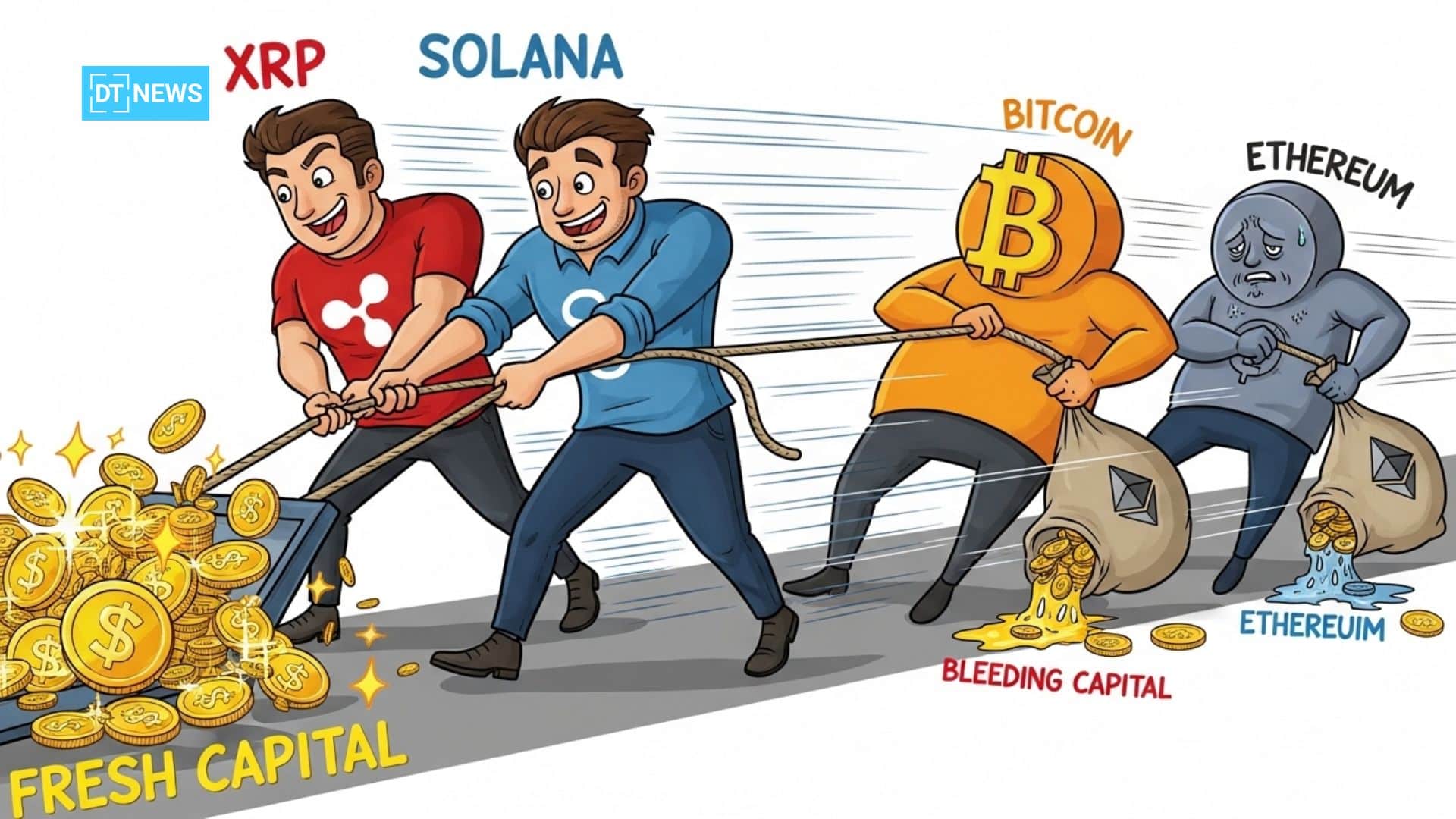
The markets have seen a noticeable contrast in the patterns of capital flowing into exchange-traded funds (ETFs). Crypto funds linked to Bitcoin (BTC) and Ethereum (ETH) still suffered net flows, while XRP and Solana ETFs actually experienced fresh inflows.
Market-tracking firms have picked up on this, to mean a possible re-evaluationis taking place within digital assets.
XRP and Solana ETFs Inflows Break the Trend
Data on spot ETF flow have revealed that Bitcoin ETFs, which usually attract the biggest portion of institutional money, have seen net outflows in recent weeks; and combined withdrawals have reached into the hundreds of millions. The report showed that Bitcoin ETFs experienced $689.22 million in net outflows over the week, while XRP and Solana ETFs saw minimal inflows.
XRP led this spot ETF inflows, with this asset posting net inflows of roughly around $39.04 million, followed by Solana with $2.94 million, in strong contrast to BTC and ETH fund losses.
Analysts cite that this might mean investors spreading their exposure through the emerging crypto ETF space, potentially looking for assets with more clarity on regulations or those which offer a unique network utility.
Bitcoin and Ethereum ETF Outflows Persist
Meanwhile, Bitcoin and Ethereum ETF products continue to bleed assets at volume. Previous ETF data revealed that Bitcoin and Ethereum products saw a combined outflow of almost $782 million over the past week, with BlackRock’s iShares Bitcoin Trust (IBIT) contributing to huge withdrawals among BTC ETPs.
Drivers Behind the Divergence
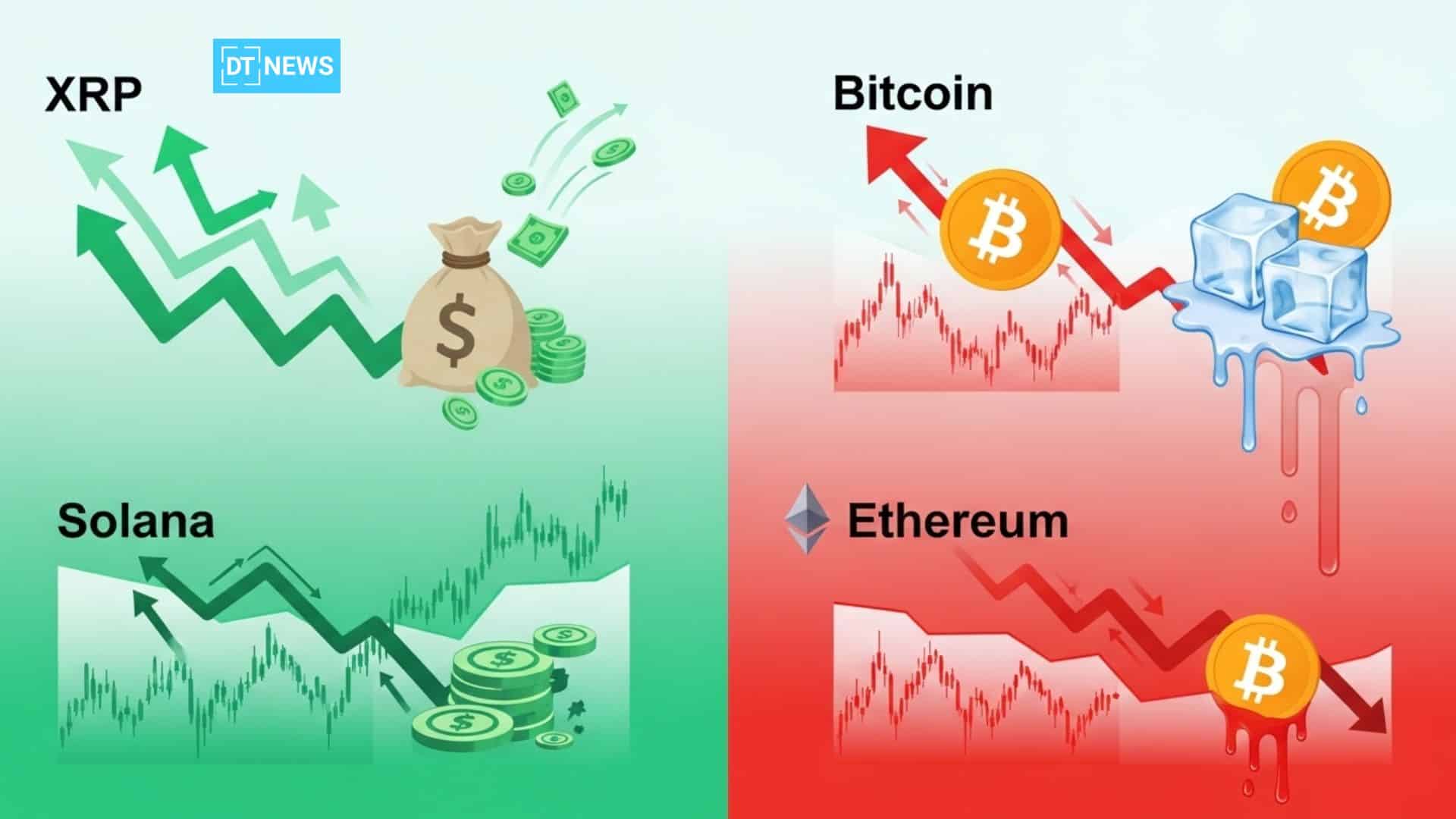
Multiple reasons explain why XRP and Solana ETFs have attracted new capital as Bitcoin and Ethereum ETFs bled out.
With XRP, there has been steady regulatory clarity after Ripple’s long fight with the U.S. Securities and Exchange Commission which ended up dissolving a huge uncertainty for XRP-based investment products and raising their appeal on institutional buyers.
The Clarity Act, which seeks to establish how crypto assets are overseen in the U.S., is pinpointed by market commentators as one catalyst behind renewed demand for XRP ETFs.
Solana ETFs which listed later and saw over $1 billion in assets amassed have also been buoyed by the network’s throughput and growing decentralized finance as well as NFT ecosystems. As of Jan. 2026 data, Solana ETF assets exceeded $1.1 billion, and those funds displayed rare resilience with net outflows on just a few days.
On the other hand, Bitcoin’s overall sensitivity and market conditions have led to outflows from BTC ETF products.
What This Means for Institutional Asset Allocation
The increasing relevance of XRP and Solana ETF inflows suggests that institutions are willing to have a broader exposure in the crypto market. For the first months of 2026, capital entering XRP and Solana ETFs suggested that investors were not retreating from crypto entirely, but were reallocating to segments they believe offered differentiated value propositions.
According to data from tracking platforms, XRP ETFs have seen a combined total of over $1 billion inflows since their market launch, constituting what some analysts are calling a record streak of positive flows unachieved by Bitcoin or Ethereum in the same period.
Conclusion
XRP and Solana ETFs have been recipients of constant new capital even as Bitcoin and Ethereum ETF products saw net outflows, pointing to a divergence in investor preferences in line with changing market dynamics.
Although BTC and ETH lead in aggregate market capitalization and long-term institutional interest, the divergence in ETF flows speaks of how diversified strategies and regulatory clarity can change capital allocation.
The performance of industry stocks can also provide clues about how the entire market informs its risk-return calculations.
Glossary
Altcoin ETF inflows: Net capital flowing into exchange-traded funds that track altcoins, or cryptocurrencies like XRP and Solana.
Spot ETF: A fund that has direct exposure to the underlying asset, providing investors with a pure spot market price without using derivatives.
Net outflows: When more capital leaves a fund than enters within a certain time frame.
Regulatory viewpoint: The explicit legal/regulatory consideration of certain assets in a way that might boost investor confidence and the allocation of capital.
Rotation: The movement of capital by major investors between different asset classes or products.
Frequently Asked Questions About XRP and Solana ETFs Inflows
Why are investors pouring capital into XRP and Solana ETFs?
Both XRP and Solana ETFs are enticing to investors looking for diversified exposure in the crypto market as XRP obtained regulatory clarity from Ripple’s legal development and as Solana has continued to grow their ecosystem.
Is this an indication of weakness on the part of Bitcoin and Ethereum in general?
Not really; BTC and ETH continue to lead the market, though outflows from their ETF products speak of a selective reshuffling not a whole exit from crypto.
Are these inflows large compared to BTC and ETH ETF flows?
In absolute terms, inflows into XRP and Solana ETFs are still below those of Bitcoin and Ethereum ETFs, though their upward trajectory stands out compared with recent outflows from the bigger funds.
Is it retail or institutional behavior?
ETF movement generally shows institutional and professional investors behavior than it does retail, simply because of the type and size.